” I agreed to it when my husband, Jason, first suggested it. Back then, it sounded reasonable—she lived twenty minutes away, we both worked full time, and if something happened while we were out of town, someone needed access. It felt like a practical decision, not the opening move in a territorial war.
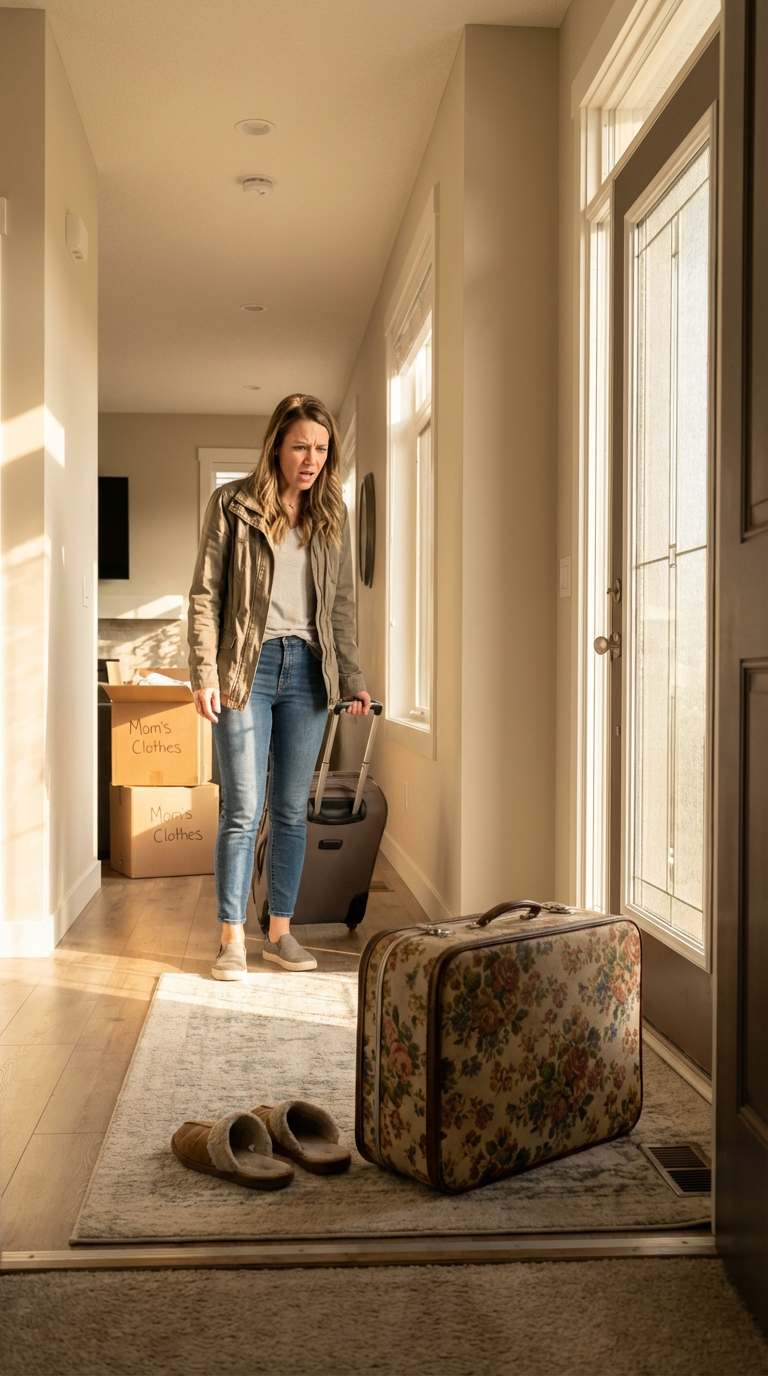
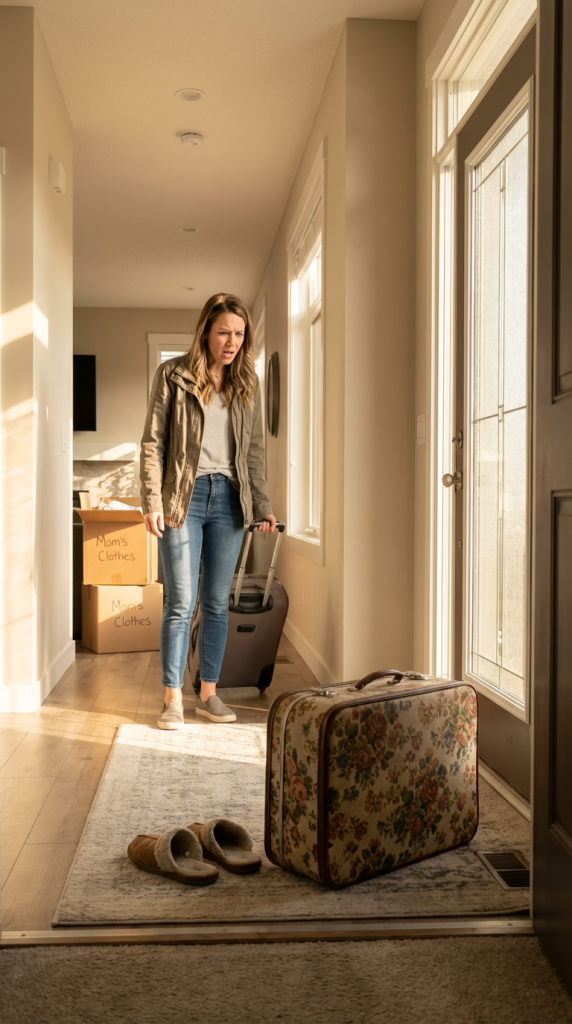
I realized how wrong I was the day I came home from a four-day work trip and found my mother-in-law’s slippers lined neatly beside my front door.
They were the same pale pink terry-cloth slippers she wore every morning at her own house. Only now, they were in mine.
Coming Home to a New Tenant
I dragged my suitcase up the porch steps, already exhausted. My boss had squeezed three presentations and a client dinner into 72 hours. All I wanted was a shower, takeout, and Netflix in my own bed. Jason was supposed to pick me up from the airport, but he’d texted that morning: “Emergency at work, Mom will grab you.”
Except she hadn’t. I’d taken an Uber home alone.
When I pushed the front door open, something felt off. The air smelled like her—lavender dryer sheets and that strong floral perfume she bathed in. The TV was on in the living room, low volume, droning daytime talk show voices. A half-empty mug sat on the coffee table. The throw blanket I always used was folded precisely in a way I never folded it.
“Hello?” I called.
“In here!” came her voice—from my kitchen.
I walked in and stopped short. My mother-in-law, Linda, stood at my stove, stirring a pot of soup like she lived there. Our fridge was open, her reading glasses perched on her nose as she scanned the shelves. She was wearing pajamas. Not day clothes. Pajamas. In my kitchen. At 3 PM.
“What are you doing here?” I asked, trying to keep my voice neutral.
She turned, smiling like I was the one who’d popped in unannounced. “You’re back! How was your trip?”
I glanced around. My brain started inventorying: two extra grocery bags on the counter with brands I never bought, a stack of her mail on the table, and the clincher—a suitcase near the hallway, hers, half-unpacked, with her clothes hanging over the back of a chair.
“Mom,” I said slowly, “why is your suitcase here?”
Her smile tightened just a fraction. “Oh, that. I’ll explain when Jason gets home. Sit, sit. You must be tired.”
My stomach dropped. “Explain what?”
She turned back to the stove. “I moved in. It just makes sense, dear.”
The “It Just Makes Sense” Speech
There are moments when your life splits into “before” and “after.” Before: mildly overbearing mother-in-law who made passive-aggressive comments about my cooking, our decor, and how “career women always look so tired.” After: uninvited roommate.
“Moved in?” I repeated.
“Well, yes.” She said it like we’d already discussed it and I’d agreed. “The stairs at my house are getting too hard on my knees, and Jason said you two were worried about me being alone. So we thought this would be best.”
“Jason said… what?” The words felt like sand in my mouth.
She turned off the burner and faced me fully. “He was going to talk to you. I told him not to stress you while you were traveling. You work so hard. But the house has the extra bedroom, and I can help with cooking, cleaning, maybe future babies…” She smiled knowingly. “It’s the logical thing.”
Logical. For whom?
“Where is Jason?” I asked, my voice deceptively calm.
“He went to help the movers with the heavier furniture,” she said. “We only brought what we needed. I’m not trying to be a burden. Just some essentials.”
Movers. Furniture. Essentials.
I walked down the hall in a daze toward the guest room. The door was open. Inside, our neutral, rarely used guest space had transformed into Linda’s bedroom. Her dresser against the wall. Her framed photos on the nightstand. Her floral comforter on the bed. My spare towels replaced with her embroidered ones.
My heartbeat pounded in my ears.
The Husband’s Explanation
Jason came home an hour later, sweat-stained and oblivious, carrying a box labeled “Books – Mom.”
He froze when he saw my face. “Hey. You’re home.”
“We’re going to talk,” I said. “Now.”
He set the box down. “Can we do this after dinner? Mom made—”
“No.”
We went to our bedroom and shut the door. Linda, hovering near the hallway, looked offended but stayed out. For now.
“You knew she was moving in?” I asked.
He rubbed the back of his neck. “Look, it’s not like that.”
“It’s exactly like that. Her stuff is in the guest room. She told me you agreed. There were movers.”
“She’s getting older,” he said. “The stairs at her place are dangerous. You know she fell last winter. Her doctor said living alone isn’t ideal.”
“So you volunteered our house without talking to me?” I said. “Our marriage. Our space.”
His jaw tightened. “She’s my mother. I have to take care of her.”
“I’m not asking you not to,” I said. “But taking care of her doesn’t automatically mean bringing her into our home full-time. We could have budgeted for assisted living, in-home care, moving her to a condo. We could have talked about options. You didn’t even give me that.”
He sighed. “I knew you’d say no. You’ve never really liked her.”
I laughed once, humorless. “So instead of having an adult conversation, you went behind my back and let her move in while I was out of town.”
“She had to move quickly,” he said. “Her landlord is raising rent. She can’t afford it. What was I supposed to do? Let my mother become homeless?”
“Don’t you dare,” I snapped. “This isn’t about homelessness and you know it. This is about you deciding that you and your mother outrank me in my own home.”
He said nothing.
That silence was my answer.
The First Night
I didn’t sleep. Linda’s presence filled every space. Her television murmured through the wall late into the night. Her cough echoed down the hallway. The smell of her lavender lotion seeped under the door.
At 6 AM, I woke to the sound of cabinets opening and closing. I walked into the kitchen to find Linda reorganizing my pantry.
“You don’t mind, do you?” she asked, already moving spice jars. “This will make more sense. I’ve always done it this way.”
“Actually, I do mind,” I said. “Please put everything back.”
She paused, jar in hand. “I’m just trying to help.”
“I didn’t ask for help,” I said. “And I certainly didn’t ask you to move in.”
She set the jar down with exaggerated care. “You young people are so sensitive. Jason and I agreed this was best. You’ll see.”
There it was again: Jason and I. I was the outsider in my own marriage.
The Slow Invasion
Over the next two weeks, Linda spread through the house like ivy through cracks.
- She replaced my living room throw pillows with ones she’d “brought from home” because mine “had no color.”
- She started cooking dinner every night without asking, then criticized me when I tried to cook. “You work too much to be in the kitchen. Let me handle this.”
- She began doing our laundry—and “accidentally” shrank my favorite sweaters while Jason’s clothes were folded perfectly on his side of the closet.
- She rearranged my home office while I was at work, moving my desk to “better light” and “hiding the clutter” (my project piles) in boxes I couldn’t immediately find.
- She answered the door for my friends, greeting them with, “Oh, you must be one of her people,” like I was a guest in her space.
The worst part? Jason defended her every time.
“She’s just trying to contribute,” he’d say. “She feels useless if she’s not helping.”
“She’s undermining me,” I’d reply. “In every room.”
He’d roll his eyes. “You always think the worst of her.”
The Breaking Point
The breaking point came on a Saturday morning.
I woke up early, craving a quiet coffee on the couch with my book. Linda had taken to waking up before us and “getting a head start on the day,” but on weekends she usually slept in. I tiptoed into the kitchen, savoring the silence.
As I poured my coffee, I heard her voice—low, sharp—from the living room.
“You know, Jason, you don’t have to put up with this forever.”
I froze, mug halfway to my lips.
“She’s your wife,” she continued. “But the way she talks to you? The way she disrespects your family? It’s not right.”
My heart hammered. I edged closer, staying out of sight.
Jason sighed. “Mom, please don’t start.”
“I’m just saying,” she said. “Marriage is hard enough without a woman who doesn’t appreciate what she has. You give her this beautiful home, security, and she complains because your poor mother needs a roof over her head?”
My hands shook. I stepped into the doorway.
“Funny,” I said, “I don’t remember this being solely Jason’s home.”
Linda jumped. Jason’s head snapped toward me.
“How long have you been there?” Linda asked, face flushing.
“Long enough,” I said. “Long enough to know exactly how you talk about me when you think I’m not listening.”
Jason stood. “We were just—”
“You were just letting your mother suggest that our marriage is negotiable,” I said. “In my living room.”
Linda crossed her arms. “If you were kinder, I wouldn’t have anything to say.”
“Kinder?” I repeated. “I came home to find you’d moved in without asking. I’ve watched you systematically erase my choices in my own house. You gossip about me to my husband, imply he’d be better off without me, and somehow I’m the unkind one?”
She sniffed. “You’re overreacting.”
And that was it. The match on the gasoline.
The Decision
I didn’t yell. Something inside me went very calm, very still.
“Jason,” I said, eyes on my husband. “You have twenty-four hours to choose: your mother lives here, or I do. Not both.”
His mouth fell open. “You can’t be serious.”
“I’m completely serious,” I said. “This is my boundary. I will not live like this. If she lives here, I don’t.”
Linda gasped. “You’re making him choose between us? How manipulative.”
I turned to her. “You already did that when you moved in without asking and started treating my marriage like a competition.”
Jason ran a hand through his hair. “Can everyone just calm down?”
“No,” I said. “Calm is what got us here. Me being calm, accommodating, trying to keep peace while my life got rearranged around me.”
I set my coffee down. “You don’t have to answer now. But tomorrow at this time, I’m packing a bag if she’s still here.”
Then I went to our bedroom, closed the door, and started making a list: lawyer, separate bank account, temporary place to stay.
The Choice
The next 24 hours were the longest of my life. Linda alternated between crying loudly in the living room and slamming cabinets passive-aggressively. Jason shuttled between us, trying to broker peace.
“Maybe we can all just sit down and talk,” he kept saying.
“We’re beyond ‘talk,’” I replied. “We’re at ‘decide.’”
He slept on the couch that night.
The next afternoon, I emerged from the bedroom with my suitcase half-packed. Linda sat at the dining table, arms crossed, triumphant.
“She’s bluffing,” she said to Jason.
I looked at him. “Well?”
He stared at the table. “This is my mom’s only place to go.”
I nodded slowly. “Okay.”
Linda smirked. “See? He knows his responsibilities.”
I walked back to the bedroom, zipped my suitcase, and carried it to the front door. My hands shook, but my back stayed straight.
“Where are you even going?” Jason demanded, following me.
“To a friend’s,” I said. “Then to a lawyer.”
“Over this?” he exclaimed. “You’re tearing our marriage apart over this?”
“I’m not the one who drove a wedge into our marriage,” I said. “You did that when you let someone else move into it without my consent. And you’re doing it again right now by choosing her comfort over our partnership.”
He flinched.
I opened the door, took a breath of cold air, and stepped outside.
Changing the Locks
Two days later, I returned—with a locksmith.
I’d stayed with Jenna, cried in her spare room, eaten ice cream straight from the tub, and talked to a lawyer who confirmed something important: the house was in both our names. Legally, I had as much right to be there as Jason did.
I texted him: “Coming by at 2 to pick up some things. Please have your mom out of the house.”
He didn’t respond.
At 2, I arrived with the locksmith. Linda’s car was in the driveway. Of course it was.
She opened the door before I could knock. “You’re not welcome here,” she said.
“Legally, I am,” I replied. “Please step aside.”
She tried to block me. The locksmith cleared his throat awkwardly behind me.
“If you don’t move,” I said quietly, “I’ll call the police and let them explain co-ownership to you.”
Jason appeared behind her, looking exhausted. “Just let her in, Mom.”
She huffed but moved.
I walked straight to the kitchen and handed the locksmith the back door key. “Change all the exterior locks,” I said. “Now.”
Jason stared. “What are you doing?”
“Setting a boundary you clearly couldn’t,” I said. “New locks. You and I will each get a key. Your mother will not.”
“You can’t do that,” Linda snapped. “I live here.”
“No,” I said, turning to her, voice steady. “You don’t. You were never invited to live here. You moved yourself in. That ends today.”
Jason looked between us, panicked. “Where is she supposed to go?”
“Her house,” I said. “The one she still has, because I called her landlord this morning. Funny thing—her lease isn’t up for three months, and he never issued a rent increase notice.”
Linda’s mouth fell open. “You had no right—”
“I had every right to confirm whether this ‘emergency move’ you guilted my husband into was even real,” I said. “It wasn’t.”
Jason turned to her slowly. “You said you couldn’t afford to stay.”
She spluttered. “Well, I—The neighborhood is changing. It’s not safe. I thought—”
“You thought you’d get a bigger, nicer place for free,” I said. “At my expense.”
The locksmith finished the first lock with a click that sounded like closure.
The Aftermath
Linda left that day, furious, after Jason helped her pack her things back into her car. She called me every name she could think of on her way out, accusing me of “stealing her son,” “abandoning family,” and “being a cold, ungrateful woman.”
I didn’t respond. I stood in the doorway, arms crossed, watching her go.
Jason stayed.
We started marriage counseling a month later. The therapist didn’t pick sides, but she did ask hard questions:
- “Why did you feel comfortable making a major life decision without your wife’s input?”
- “What message did that send about whose needs matter most in this marriage?”
- “How do you define ‘family,’ and where does your partnership with your wife fit into that compared to your relationship with your mother?”
Jason squirmed. He’d been raised to believe a “good son” always took care of his mother first. The therapist gently pointed out that he was no longer just a son—he was a husband. And those roles sometimes conflict.
“Being a good husband sometimes means setting boundaries with your mother,” she said. “If you can’t, your wife will never feel secure.”
It took months, but Jason slowly started to understand. He went low-contact with Linda for a while. She responded with guilt-trip texts, angry voicemails, and relatives calling to say I’d “stolen their boy.” He told them all the same thing: “This is between my wife and me.”
Where We Are Now
It’s been a year since I changed the locks.
Linda no longer has a key. She visits occasionally—with advance notice, for a few hours at a time. Jason meets her for lunch in neutral places. She’s still salty. Still makes comments. But she no longer has physical access to our home without our consent.
Our marriage? Stronger than before. The crisis forced us to define what partnership actually means:
- Major decisions are joint decisions.
- No one, not even parents, moves in without both of us agreeing.
- Our home is our safe space. Visitors are guests, not silent co-owners.
Do I regret how firm I was? No. If anything, I wish I’d set boundaries earlier.
Changing the locks wasn’t just about keeping Linda out. It was about reclaiming my life, my marriage, my home. It was a literal and symbolic act: this house is ours, not hers.
If Jason hadn’t eventually stood with me, I would have left. It’s that simple. Choosing a partner who chooses you—even when it’s hard, even when it disappoints their family—is non-negotiable.
My mother-in-law moved into our house without asking. I changed the locks.
And that’s the day our marriage finally became ours.