My name is Olivia, I’m 31 years old, and two weeks ago I did something I never thought I was capable of. I deleted my fiancé’s nearly completed novel—three years of work, 90,000 words—after discovering that the manipulative, cruel villain was based entirely on me. He says I destroyed his dream. I say he destroyed us first, one page at a time.
I met Ryan four years ago at a literary festival where I was working as an event coordinator. He was charismatic, passionate about writing, and had just quit his corporate job to pursue his dream of becoming a published author. I was immediately drawn to his creativity and ambition. He talked about stories the way other people talk about falling in love—with wonder, obsession, and complete dedication.
We started dating, and those first months were magical. Ryan would read me passages from his work-in-progress, ask for my thoughts on character development, and thank me profusely for supporting his dream. I loved being his muse, his first reader, his biggest cheerleader. He’d stay up until 3 AM writing, and I’d bring him coffee and encouragement.
Six months into our relationship, Ryan started a new novel. He was secretive about it in a way he hadn’t been with previous projects, saying he wanted to get further along before sharing it. I understood—creative work is vulnerable, and writers need space. I gave him that space, even as the secrecy stretched from weeks to months.
We moved in together after a year. Ryan converted our second bedroom into a writing office and spent hours in there every day. I worked full-time as an event manager while he wrote, and I covered most of our expenses since his freelance income was minimal. I didn’t mind—I believed in his talent and wanted to support his dream. He promised that once he got published, everything would balance out.
He proposed after two years together, and I said yes without hesitation. We planned a small wedding for the following year. Everything seemed perfect, except for one growing tension: Ryan’s novel had taken over his entire life.
He became obsessed with this book in an unhealthy way. He stopped socializing, rarely left his office, and grew irritable when interrupted. Our conversations became one-sided—I’d share things about my day, and he’d zone out or redirect everything back to his novel. The creative partnership we’d once shared had turned into me supporting from the sidelines while he disappeared into his fictional world.
I tried to be patient. I knew creative work required sacrifice. But I was starting to feel like I was engaged to a ghost who occasionally emerged from his office to eat the meals I’d prepared and complain about plot problems.
About eight months ago, things shifted. Ryan started watching me differently—studying me in a way that made me uncomfortable. He’d take notes during our arguments. He’d ask me weirdly specific questions about my thoughts and motivations, then scribble in his ever-present notebook. When I asked what he was writing, he’d smile mysteriously and say, “Just capturing inspiration.”
I told myself it was normal. Writers observe people. They draw from life. I was probably being paranoid.
Then came the comments from his writing group.
Ryan met with a small critique group every other week—four other aspiring novelists who workshopped each other’s projects. I’d met them a few times at social gatherings, and they seemed nice enough. But I started noticing strange reactions when I was around them.
Sympathetic looks. Awkward silences. One of them, a woman named Melissa, once pulled me aside at a party and asked if I was “doing okay” in a tone loaded with meaning I didn’t understand.
“I’m fine,” I’d said, confused. “Why?”
She’d looked uncomfortable. “No reason. Just checking in.”
But it wasn’t nothing. I could feel it.
Three months ago, Ryan finished his first draft. He was ecstatic, celebrating with expensive wine and talking about querying agents. He still wouldn’t let me read it, saying he wanted to revise it first, make it perfect before sharing it with me. I was hurt but tried to be understanding. Maybe he was nervous about my reaction. Maybe he wanted to impress me with polished prose.
I waited. He revised for three months, spending every spare moment perfecting his manuscript. He started talking about this book like it was his masterpiece, his ticket to literary success. He sent the first fifty pages to his agent contacts and got interest from two of them. He was convinced this book would change our lives.
Last month, he finally said I could read it.
I was excited and nervous. This book had consumed three years of our relationship. It had taken him away from me countless evenings, had been the excuse for missed events and declined invitations, had become the third presence in our relationship. Finally, I’d get to see what he’d been building all this time.
He sent me the manuscript digitally—a Word document titled “The Architect of Ruin” by Ryan Mitchell. I settled onto our couch with my laptop and a glass of wine, ready to be amazed by the man I loved.
I read for six hours straight, growing colder with every page.
The novel was a psychological thriller about a successful architect named Marcus whose life is systematically destroyed by his fiancée, Vanessa. On the surface, Vanessa appears supportive and loving, but she’s actually a calculated narcissist who manipulates Marcus, isolates him from his friends, controls their finances, and emotionally abuses him while playing the victim to outsiders.
Vanessa was brilliant, beautiful, and utterly evil. She’d convinced everyone she was perfect while privately tearing Marcus down. She’d gaslight him about his perceptions, mock his dreams, and sabotage his career while pretending to support him. The book was written so that readers slowly realized Vanessa’s true nature—the monster hiding behind the perfect girlfriend facade.
And Vanessa was unmistakably me.
The physical description matched me exactly—auburn hair, green eyes, 5’7″, the small scar on my left eyebrow from a childhood accident. Her job was event planning. Her personality quirks were mine—the way she organized everything by color, her habit of researching topics obsessively, her preference for tea over coffee.
But worse than the physical similarities were the scenes. Ryan had taken real moments from our relationship and twisted them into evidence of Vanessa’s villainy.
There was a scene where Vanessa criticizes Marcus for spending money on his hobby, calling it wasteful and irresponsible. In reality, I’d gently mentioned that Ryan spending $400 on rare books when we were behind on rent was stressful for me.
There was a scene where Vanessa “forbids” Marcus from seeing his friends, claiming they’re bad influences. In reality, I’d asked Ryan if he could limit his weekly poker nights to twice a month instead of four times because I rarely saw him and missed spending time together.
There was a scene where Vanessa mocks Marcus’s creative work, saying he’ll never be successful. In reality, during a fight about finances, I’d expressed frustration that his writing wasn’t generating income yet and asked if he’d considered freelancing more to help with bills.
Every difficult moment in our relationship, every argument, every time I’d expressed a need or set a boundary—Ryan had catalogued it all and reframed it as evidence of my abusive nature. He’d taken the reality of me supporting his dream financially and emotionally for years and inverted it into a story about a manipulative woman destroying a talented man.
The ending was particularly devastating. Marcus finally escapes Vanessa, and she has a complete breakdown when she loses control of him. The final scene shows her alone, exposed as the monster she always was, while Marcus rebuilds his life and finds real love with someone genuinely supportive.
I closed my laptop and sat in silence as Ryan emerged from his office.
“So?” he asked eagerly. “What did you think? Be honest.”
“Vanessa is me,” I said quietly.
He laughed nervously. “What? No. I mean, maybe there are some superficial similarities, but she’s a fictional character. All writers draw from life.”
“She has my scar, Ryan. The one on my eyebrow. The exact same scar from the exact same childhood accident.”
His smile faltered. “That’s just coincidence. Character detail.”
“The scene where she criticizes him for buying books. That happened. Word for word, that’s our fight from last year.”
“Writers use real dialogue sometimes. It doesn’t mean—”
“The scene where she asks him to see his friends less. The scene where she worries about money. The scene where she organizes everything obsessively. Ryan, this entire character is me, portrayed as an abusive narcissist.”
He was quiet for a long moment. Then: “You’re taking this too personally. It’s fiction.”
“Is this how you see me? As someone who manipulates and controls you? As someone who destroys your life?”
“Of course not! Vanessa is an extreme character. She’s exaggerated for narrative purposes.”
“Exaggerated from what, Ryan? From me? So I’m the blueprint, just turned up to villainous levels?”
He ran his hands through his hair, frustrated. “You’re a writer’s partner, Olivia. You knew I’d use experiences from my life in my work. This is what artists do.”
“There’s a difference between using experiences and turning your fiancée into the villain of your novel. Did your writing group know? Is that why they’ve been looking at me strangely for months?”
His silence was answer enough.
“They’ve all read this. They all know you based the abusive villain on me. How many other people have read this, Ryan?”
“Just the group. And two agents who requested pages.”
I felt sick. “You sent this to agents? You’re trying to publish this?”
“It’s good, Olivia! It’s the best thing I’ve ever written. The agents are interested. This could be my break.”
“Your break? This book calls me a monster! You’ve taken three years of me supporting you, paying our bills, giving you space to write, and you’ve turned it into a story about what an abusive nightmare I am!”
“You’re being dramatic. No one will know it’s you.”
“You gave her my scar, Ryan! My job! My habits! You recreated our actual conversations! Everyone who knows us will know it’s me.”
He was getting defensive now. “Maybe if you weren’t so controlling, I wouldn’t have had to write about it. You do nag me about money. You do try to limit my time with friends. Maybe Vanessa is holding up a mirror you don’t want to look into.”
I stared at him, stunned. “You actually believe this. You actually think I’m the villain in our relationship.”
“I think you’ve made my dreams secondary to your need for control and security. I think you resent my creativity because you don’t have any of your own. I think Vanessa resonates as a character because she’s rooted in truth.”
Something broke in me then. Maybe it was hearing the man I loved casually accuse me of being abusive. Maybe it was realizing he’d been secretly resenting me for years while I supported his dreams. Maybe it was understanding that he valued his novel more than my dignity.
“I want you out,” I said quietly. “Pack your things and leave.”
“What? Over a book?”
“Over what that book says about us. About how you see me. About the fact that you’d publish it and let the world see me as a villain. Get out, Ryan.”
He stared at me in shock. “You can’t throw me out. This is my home too.”
“The lease is in my name. I’ve paid 80% of our rent for three years. This is my home. Get. Out.”
He left, going to stay with one of his writing group friends. But before he stormed out, he said something I couldn’t forget: “You’ll regret this. That book is my future. It’s everything I’ve worked for.”
I spent that night reading his novel again, getting angrier with every page. This wasn’t just inspired by me—it was a hit piece. It was three years of Ryan’s resentment and frustration packaged as art. He’d taken every moment where I’d asked for support, expressed needs, or set boundaries, and he’d weaponized them.
And he was planning to publish it. My humiliation and pain would be his debut novel.
I thought about the agents who’d requested pages. About the potential that this book could be published, that people I knew would read it and recognize me. That my friends, my colleagues, my family would see me as the blueprint for an abusive villain.
Ryan had always kept his manuscript on a shared cloud drive that we both had access to—originally so I could read his work, back when he trusted me with it. The password hadn’t changed.
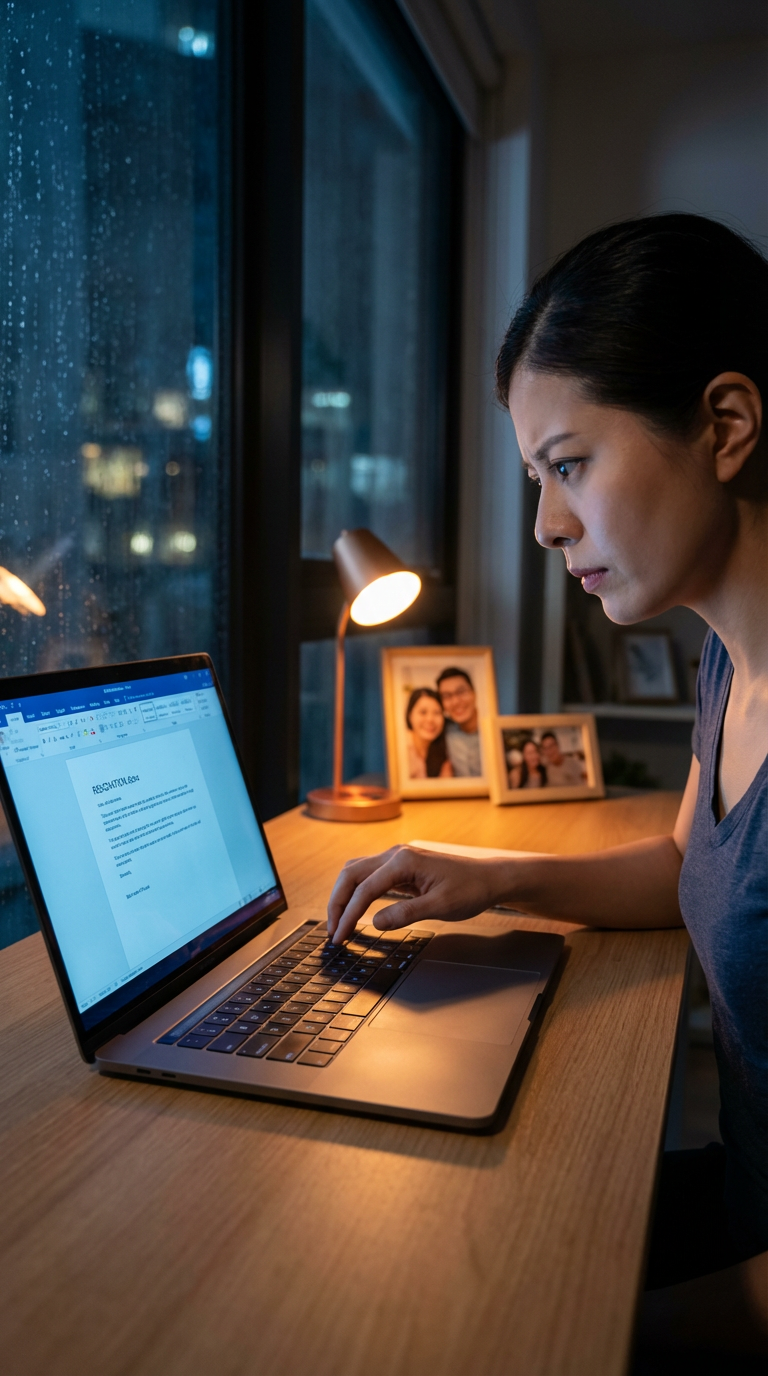
At 2 AM, I logged into the drive. The manuscript was there: “The Architect of Ruin – Final Draft.docx.”
I hovered my cursor over it. Deleting it felt nuclear, unforgivable. But so did writing it in the first place.
I thought about how he’d said I’d regret opposing his “future.” About how he’d accused me of being controlling and resentful. About how he’d turned three years of me sacrificing for his dream into proof of my villainy.
I deleted the file. Then I emptied the trash.
Three years of work. Ninety thousand words. His “masterpiece.” Gone.
Then I sent him a message: “You based your villain on me and planned to publish my humiliation as your debut novel. Now your novel is gone, just like your fiancée. We’re done.”
The response was immediate. Phone calls I didn’t answer. Text messages that escalated from confusion to rage to panic. He showed up at the apartment at 4 AM, pounding on the door.
“Olivia! Please! Tell me you didn’t! That’s three years of my life!”
I spoke through the door. “And you spent those three years turning me into a monster.”
“I have backups! I have the version from last month—”
“Not the final draft. Not the version you were about to send to agents. That’s gone.”
The pounding stopped. Then I heard him slide down the door, heard him crying.
“How could you do this? You know what that book meant to me!”
“How could you do that to me, Ryan? You know what our relationship meant to me!”
He stayed outside my door for an hour, alternating between begging, crying, and raging. I didn’t let him in. Eventually, he left.
The past two weeks have been a nightmare. Ryan’s writing group has vilified me online, posting about how I destroyed a brilliant novel out of spite. Friends are divided—some saying I went too far, others saying what Ryan did was unforgivable first. My social media is full of messages from strangers calling me everything from a vindictive harpy to an abusive controller, which is grimly ironic given what started this.
Ryan’s friends say I destroyed his dream over a fictional character. They call me controlling, vindictive, everything Vanessa was in his novel—proving that his characterization has poisoned how people see me, even though most of them never read the full manuscript.
But my friends, the ones who know me well, are horrified by what Ryan did. They’ve read the excerpts he shared with his writing group—the scenes clearly based on our life—and they understand why I reacted the way I did.
My therapist says what Ryan did was a form of emotional abuse—using his art to reframe my legitimate needs as character flaws, documenting our relationship as evidence of my villainy. She says deleting his work was a boundary, perhaps an extreme one, but an understandable response to extreme violation.
Ryan has tried to recover the file through technical means but hasn’t succeeded. He’s rebuilt about 30,000 words from earlier drafts and his memory, but the final version—the polished draft he was about to send to agents—is gone. He blames me for destroying his career before it could begin.
But here’s what I keep coming back to: he was willing to publish that book. He was willing to send my worst moments, twisted into fiction, out into the world with my identifiable details attached. He was willing to let agents, publishers, and eventually readers see a version of me designed to be hated.
And when I objected, he told me I was being dramatic and that maybe I should look in the mirror.
People ask if I regret it. Honestly? Some days I do. Deleting someone’s work feels like a line I never thought I’d cross. I know how devastating it must have been for him, and I’m not proud of causing that pain.
But most days, I think about living in a world where that book existed. Where people who knew us could read it and see me as Vanessa. Where my nieces might someday pick up their uncle’s debut novel and meet a villain based on their aunt. Where every future relationship I have would be shadowed by people wondering if I was really like that.
Ryan stole my character to create his villain. I deleted his characters to protect my character. Maybe we both crossed lines. Maybe we both betrayed each other. But he did it first, methodically, over three years, while I supported him and loved him and believed in his dream.
I’ve blocked Ryan everywhere. I’ve started therapy. I’ve thrown myself into work and reconnected with friends I’d neglected during the years I was supporting his writing career. I’m slowly rebuilding the parts of myself that got lost in being the supportive fiancée to a creative genius.
I’ve also started writing—journaling at first, but it’s evolved into something more. Turns out I do have creativity of my own, despite what Ryan claimed. I’m writing my version of our story, not for publication but for processing. For reclaiming my own narrative from someone who tried to rewrite me as a villain.
To anyone supporting a creative partner: your sacrifice matters, but so do your boundaries. If they’re using their art to punish you, to reframe your needs as character flaws, to document your relationship as evidence against you—that’s not art, that’s abuse disguised as creativity.
And to any artists reading this: using real people in your work is delicate. Turning someone who loves and supports you into your villain, using their real details and real moments twisted just enough to make them monstrous—that’s not inspiration, that’s cruelty.
Ryan’s novel is gone. So is our relationship. He’s rebuilding his book, and I’m rebuilding my life. We’ll both move forward, separately, with different stories about what happened and why.
But I know my truth: I wasn’t Vanessa. I was just someone who loved a writer, supported his dreams, and asked for basic consideration in return. That shouldn’t have made me his villain.
And I refuse to let his fiction become my reality.