Remaining Time -9:14Close Player

When the automatic gate slid open, the dark frame of the Bentley mirrored the sky, and Julian Hawthorne finally breathed out. He had just secured a major deal, yet the success felt hollow.
The quiet inside the car matched the stillness of the house. As he parked, Julian checked his emails out of habit—an old shield. Then he heard laughter.
It wasn’t polite or restrained. It was full, unfiltered, alive. He looked up, and everything shifted.
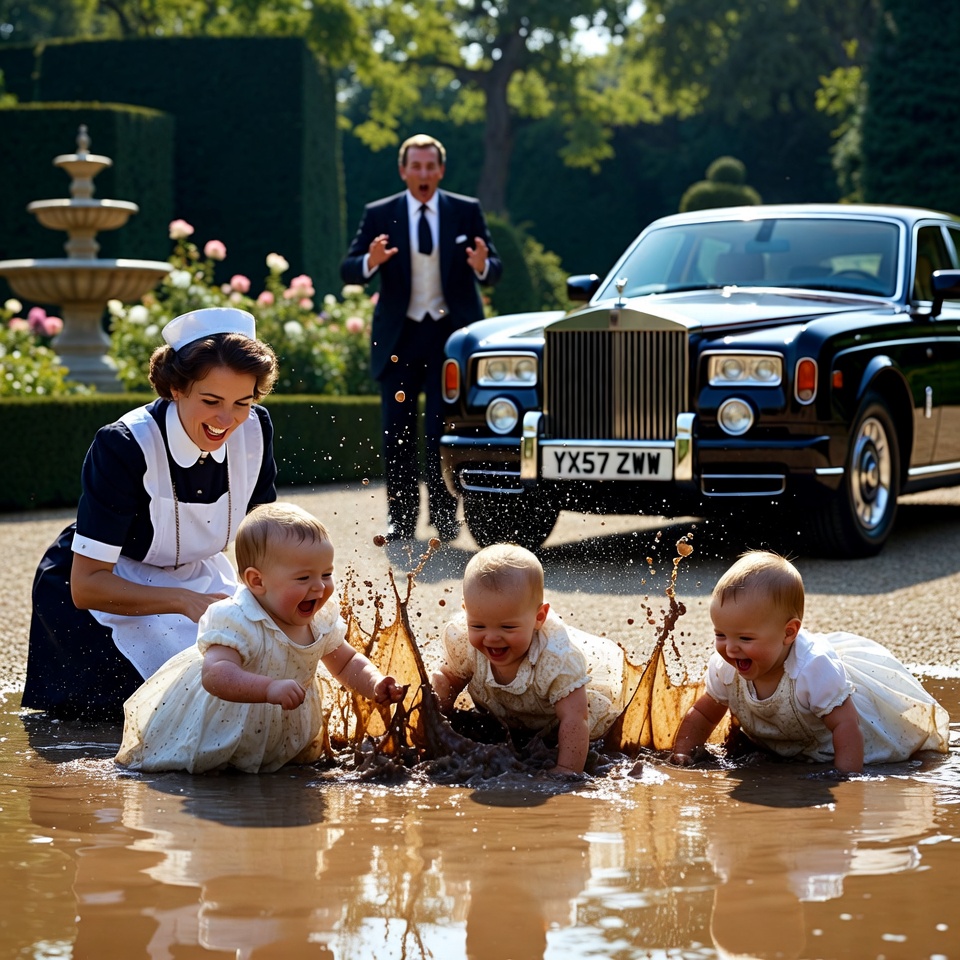
Three children, soaked in mud, were cheering in a wide puddle, splashing across an immaculate lawn.
Nearby, kneeling beside them, the nanny—wearing a navy uniform and white apron—smiled as if witnessing something sacred.
“My God…” he murmured, frozen in his seat. His pulse quickened, dragging an old memory to the surface.
“Hawthornes do not get dirty,” his mother’s voice echoed in his mind, sharp and unyielding.
Julian stepped out of the car. The smell of wet soil hit him first, followed by the brightness in the children’s eyes. The four-year-old twins, Leo and Miles, clapped at every splash.

Their older sister, Ava, laughed freely, hair stuck to her forehead, dimples deep. The nanny—Clara Bennett, newly hired—raised her hands in encouragement, her words lost to the breeze.
Julian walked closer. Training cones and stacked tires interrupted the pristine garden. With each step, he counted losses: carpets, stone floors, image, control. Yet something in the children’s joy cracked his composure.
“Clara,” he called, sharper than intended. The laughter softened but did not stop.
Clara turned calmly, knees muddy, uniform damp. She met his gaze with quiet confidence. Julian stopped at the edge of the puddle.
Between his polished shoe and the murky water lay a boundary he’d lived with his entire life. On the other side stood his children—and her.
He straightened, voice firm. “What exactly is happening here?”
May you like
The garden fell silent except for dripping water. Clara lifted her head, sunlight catching loose strands of hair. She looked unashamed. Certain.
“Mr. Hawthorne,” she said evenly, “they’re learning to work together.”
Julian frowned. “Learning? This looks like chaos.” She gestured toward the children.
“Watch them. No tears. No shouting. When one slips, another helps. It’s discipline—just wrapped in joy.”

The words lingered. Julian scanned the scene: the manicured hedges, the luxury car, the disorder at its center—alive, unrestrained.
“This is negligence,” he said coldly. Clara held his gaze.
“They can get dirty. Their hearts don’t. Because no one tells them they’re not allowed to fail.”
The sentence pierced deeper than he expected. Memories surfaced—pressed clothes, no play, fear of stains. He shut it down.
“You’re here to follow rules,” he snapped. “Not lecture.”
“And you’re here to be a father,” she replied softly. “Not just a provider.”
Time seemed to pause. The children watched him, hopeful. Clara didn’t back down. Julian couldn’t respond.
A drop of mud landed on his shoe. He stared at it, then at his children. Something small and alive stirred in his chest. Clara wasn’t afraid—and her courage unsettled him.
He retreated indoors. Laughter followed him, echoing like something he had never been allowed to keep.
Inside, marble floors amplified his steps. Family portraits lined the hall—perfect, distant, untouched. He paused at a photo of himself at eight: stiff posture, tiny suit, no smile. The same standard he now imposed on his children.

Later, Clara approached quietly. “Mr. Hawthorne, may I say something?” He didn’t look up.
“Discipline without love creates fear. Fear creates distance. Distance destroys families.”
He set the tablet down. “I didn’t hire you to analyze me.”
“I know,” she said gently. “But care sometimes reveals what’s missing.”
The words cut deeper than anger ever could.
“You don’t learn to love by staying clean,” she added softly, then left.
That night, dinner was silent. Crystal glasses, no laughter. Across the table sat his mother, Eleanor Hawthorne—elegant, cold.
“I hear your nanny encourages inappropriate behavior,” she said.
“She believes children learn through mistakes,” Julian replied.
Eleanor smiled thinly. “We don’t make mistakes. We are not like others.”
The phrase weighed on him, just as it had all his life. “Dismiss her today,” she ordered.
He nodded, watching fear flicker across his children’s faces—his own reflection.
The next morning, gray skies hung low. Julian held the dismissal letter as Clara brushed Ava’s hair in the garden.

“This isn’t working,” he said. “They need stricter structure.”
Clara nodded. “I understand.” Ava’s voice trembled.
“Is she leaving?” Julian couldn’t meet her eyes. Clara knelt.
“Promise me something. Don’t be afraid to get dirty learning something beautiful. Mud washes away. Fear doesn’t.”
The children clung to her, smearing her uniform. She laughed softly.
“Now I carry a piece of each of you.” At the door, she turned back.
“Raising children isn’t about keeping things perfect. It’s about teaching them how to begin again.”
That night, rain battered the house. Julian couldn’t sleep. Memories and regret tangled together.
A noise startled him. The twins’ beds were empty. He ran outside.

They stood barefoot in the storm, laughing in the mud. “We wanted Daddy to learn how to laugh too,” Leo said.
Miles slipped. Leo pulled him up. “I’ll protect you.”
Julian dropped to his knees, mud soaking his hands. He pulled them close, rain washing years of silence away.
Behind him, Eleanor gasped. “You’ll ruin them.” “No,” Julian said calmly. “I’m saving them.”
Morning came quietly. Muddy boots. Free laughter. The house felt lighter. Clara returned.
“You were right,” Julian told her. “I needed help remembering how to be a father.” “The children teach us,” she said.
As laughter filled the garden again, Julian understood: sometimes what looks like mess is the beginning of freedom.
Julian stood at the edge of the garden as the children ran ahead, their laughter no longer startling him, but guiding him. Mud still clung beneath his fingernails, and for the first time, he did not rush to wash it away.
Eleanor watched from the terrace, rigid and silent, her reflection fractured in the glass doors. “This will pass,” she said coolly. “Children forget.”
Julian shook his head. “No,” he replied, voice steady. “They remember who stood with them when it mattered.”
He turned away from her certainty and followed the sound of joy instead.
Later that afternoon, he canceled two meetings. The assistant hesitated. “They’ve waited weeks.”
“So have my children,” Julian said, and closed the laptop.
Clara noticed the change not in grand gestures, but in small ones. Julian knelt when the twins spoke. He listened when Ava hesitated. He let silence exist without filling it with control.
That evening, they planted new flowers where the puddle had been. Julian pressed seeds into soil beside his children, hands clumsy, imperfect. “What if they don’t grow?” Miles asked.
“Then we try again,” Julian answered, surprising himself. At sunset, the garden was quieter, but fuller. Not pristine. Not controlled. Alive.
From the house, Eleanor watched the scene she could not command. For the first time, her rules held no power there.
Julian understood then that wealth could build walls, but love required openings. And sometimes, the first crack came not from rebellion—but from laughter, mud, and the courage to kneel.
He looked at Clara. “Stay,” he said simply.
She smiled—not triumphant, not relieved—just present. “That,” she replied, “is how families begin again.”
And in the garden, where order once ruled without warmth, freedom took root quietly— one muddy step at a time.
My husband had just left the house for a business trip, when my six-year-old daughter whispered: “Mommy… we have to run – bichnhu

My husband had just left the house for a business trip, when my six-year-old daughter whispered: “Mommy… we have to run. Right now.” I asked, “What? Why?” She trembled and said, “There’s no time. We have to get out of this house immediately.” I grabbed my bag and reached for the door— and that’s when it happened.