The positive pregnancy test trembled in my hands as I stared at those two pink lines that would change everything. After three years together, Jake and I had been trying for a baby for the past six months. This was supposed to be our moment — the beginning of our family, the next chapter in our love story. I couldn’t wait to tell him.
I planned the perfect reveal. I bought a tiny pair of baby shoes, wrapped them in tissue paper, and placed them in a gift box with the pregnancy test tucked inside. That evening, when Jake came home from work, I handed him the box with shaking hands and tears already forming in my eyes.
His reaction wasn’t what I expected.
Jake opened the box slowly, pulling out the little shoes first. Confusion crossed his face before he saw the test underneath. For a moment — just a brief, beautiful moment — I saw joy flash across his features. Then something shifted. His expression went cold, his jaw tightened, and he set the box down on the coffee table like it contained something toxic.
“We need to talk,” he said, his voice flat and emotionless.
The Accusation That Changed Everything
What happened next felt like an out-of-body experience. I watched myself sitting on our couch, my hand instinctively moving to my still-flat stomach, as the man I loved and planned to marry looked at me with suspicion in his eyes.
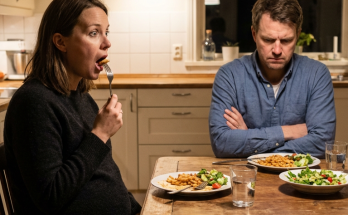
“I want a paternity test,” Jake said, crossing his arms. “Before the wedding. Actually, as soon as possible.”
The words hit me like a physical blow. “What? Jake, what are you talking about?”
“I’m not signing a birth certificate or marrying you until I know for sure that baby is mine,” he continued, his tone matter-of-fact, as if he were discussing dinner plans rather than destroying our relationship.
I felt my world tilting. “You think I cheated on you? Are you serious right now?”
He shrugged — actually shrugged — like my devastation was an overreaction. “I’m just being smart. Guys get trapped like this all the time. I need to protect myself.”
“Trapped?” The word came out as a whisper. “You think I’m trapping you?”
“Look, it’s nothing personal,” Jake said, and I almost laughed at the absurdity of that statement. “It’s just the logical thing to do. Any smart man would do the same.”
The Internet Influence
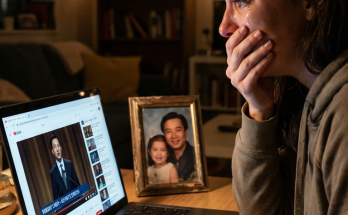
Over the next hour, as I sat there in shock, the full picture emerged. Jake had been spending time on certain corners of the internet — forums and subreddits filled with men convinced that women are inherently deceitful, that paternity fraud is rampant, that every man needs to “protect himself” regardless of the relationship he’s in.
He pulled up statistics on his phone, showing me numbers about paternity fraud that he’d found in some online echo chamber. He talked about “men’s rights” and “being smart” and “not being a fool.” He spoke about our relationship, our love, our future child, as if it were all a potential scam he needed to guard against.
“Thirty percent of men are raising kids that aren’t theirs and don’t even know it,” he said, quoting a figure that’s been thoroughly debunked by actual researchers.
“Jake, those statistics aren’t real. And even if they were, what does that have to do with us? With our relationship?”
“It has everything to do with us. I’m not going to be another statistic.”
I looked at this man — the one who had proposed to me on a beach at sunset, who had cried when we talked about having children someday, who had spent three years building a life with me — and realized I didn’t know him at all.
The Principle of the Matter
My initial shock gave way to anger, then to a deeper hurt that settled in my chest like a stone. Jake couldn’t understand why I was so upset. In his mind, he was being “rational” and “protective.” He insisted it wasn’t about trust — it was about “verification.”
“Don’t you watch the news?” he asked. “This happens all the time. I’m just being careful.”
“Careful about what, exactly? When have I ever given you a reason not to trust me?”
He couldn’t answer that question. Because there was no answer. In three years together, I had never been unfaithful. I had never lied to him about where I was or who I was with. My phone was always available. My social media was transparent. I had introduced him to every friend and colleague. There was literally zero evidence of infidelity because there had been zero infidelity.
But that didn’t matter to Jake anymore. He’d been convinced by strangers on the internet that all women are potential threats, that trust is foolishness, that love without “verification” is weakness.
“If you have nothing to hide, why won’t you just take the test?” he demanded, using the same flawed logic that justifies all kinds of violations of privacy and dignity.
“Because relationships are supposed to be built on trust,” I said, my voice breaking. “Because when you love someone, you don’t treat them like a criminal who needs to prove their innocence. Because I shouldn’t have to undergo a medical procedure to prove something you should already know.”
The Medical Reality
Jake didn’t seem to understand — or care — about what he was actually asking of me. Prenatal paternity testing isn’t just a simple cheek swab. The safest method, non-invasive prenatal paternity testing (NIPP), requires blood draws and costs between $1,500 and $2,000. The older methods, amniocentesis and CVS, carry actual risks to the pregnancy, including miscarriage.
He was asking me to undergo an expensive, uncomfortable, and potentially risky medical procedure because he’d spent too much time on toxic internet forums.
“I’ll pay for it,” he offered, as if money was the issue.
“It’s not about the money, Jake. It’s about what this means for us. If you don’t trust me now, when have you ever trusted me? And if you don’t trust me now, how are we supposed to raise a child together?”
He seemed genuinely baffled by my resistance. In his mind, he’d made a reasonable request. He couldn’t grasp that he’d essentially accused his pregnant fiancée of infidelity and betrayal without a shred of evidence.
The Breaking Point
I gave Jake time to come to his senses. I thought maybe after sleeping on it, after the shock of the pregnancy news wore off, he would realize how hurtful and absurd his demand was. I thought he would apologize, we would talk through whatever insecurities had driven him to this point, and we would move forward.
I was wrong.
The next morning, he doubled down. He’d spent the night researching paternity tests, finding the most affordable options, and making plans. He’d even called a testing facility to ask about their procedures. He treated the whole thing like a business transaction.
“I found a place that does it for $1,400,” he announced over breakfast, as if he were sharing good news. “We can go this weekend.”
I set down my coffee cup slowly. “Jake, I’m not taking a paternity test.”
“Why are you being so difficult about this?” His frustration was evident. “If the baby is mine, the test will prove it, and we can move on. What’s the big deal?”
“The big deal is that you don’t trust me. The big deal is that you think I’m capable of lying to you about something this important. The big deal is that you’re treating me like a suspect instead of your partner.”
“I’m treating you like… this is just how it’s done now. Smart guys do this. It’s not personal.”
“How can you say it’s not personal? We’re engaged, Jake. I’m carrying your child. This is literally as personal as it gets.”
The Final Straw
The conversation — if you could call it that — went in circles. Jake couldn’t understand why I wouldn’t just “prove” my fidelity with a test. I couldn’t make him see that asking for the test was itself a relationship-ending betrayal of trust.
Then he said something that made my decision crystal clear.
“You know what? If you won’t take the test, maybe you do have something to hide. An innocent person would just do it to put my mind at ease.”
That was it. That was the moment I knew our relationship was over.
“Get out,” I said quietly.
“What?”
“Get out of my apartment. We’re done.”
“You’re breaking up with me because I want to be sure the baby is mine? That’s insane!”
“No, I’m breaking up with you because you’ve accused me of cheating with no evidence. I’m breaking up with you because you trust random men on the internet more than you trust me. I’m breaking up with you because you’re willing to risk our baby’s health to satisfy your paranoia. I’m breaking up with you because you’ve shown me exactly who you are, and I don’t want to marry that person.”
Jake stood there, genuinely shocked. He’d expected me to eventually cave, to submit to his demand, to accept his new worldview where women are untrustworthy by default. He never expected me to choose my dignity over his suspicion.
“You’re throwing away our whole relationship over this?” he asked, still not getting it.
“You already threw it away when you accused me of cheating. I’m just acknowledging what you’ve already done.”
The Aftermath
Jake moved out that day. I called my family and close friends, explained what happened, and found myself surrounded by support. Every single person in my life — except for one of Jake’s friends who apparently frequented the same toxic forums — agreed that Jake’s demand was outrageous and that I’d made the right choice.
My mom came over that night, held me while I cried, and said something I needed to hear: “If he doesn’t trust you now, it won’t stop with a paternity test. He’ll always find something to doubt, something to verify, something to hold over you. That’s no way to live, and that’s no way to raise a child.”
She was right. Even if I had taken the test, even if it had confirmed what we both already knew, the damage was done. Jake had revealed his true colors. He’d shown me that his internet echo chamber held more sway over him than three years of a faithful, loving relationship. He’d demonstrated that he was willing to hurt me and potentially risk our baby’s health to satisfy his paranoia.
That wasn’t the foundation for a marriage. That wasn’t the partner I wanted to raise a child with.
The Conversations That Followed
In the days after Jake moved out, he tried multiple times to contact me. His messages followed a predictable pattern: anger that I was “overreacting,” attempts to minimize his request, and eventual efforts to bargain.
“I’ll drop the test thing if you just let me move back in,” one text read.
But by then, I’d already made my decision. The paternity test demand wasn’t the problem — it was a symptom of a much deeper issue. Jake had fundamental trust issues, and he’d allowed toxic internet communities to amplify his insecurities rather than addressing them in healthy ways.
Some of my friends thought I should give him another chance. “He’s just scared about becoming a father,” they suggested. “Men deal with pregnancy anxiety differently.”
But anxiety doesn’t manifest as baseless accusations. Fear doesn’t justify treating your partner like a criminal. There’s a difference between normal parental nervousness and demanding medical proof that your faithful partner hasn’t betrayed you.
I talked to a therapist during this time, someone who specialized in relationship issues and prenatal mental health. She validated what I already knew: Jake’s demand wasn’t normal or acceptable, and my refusal wasn’t an overreaction.
“Trust is the foundation of any relationship,” she explained. “When one partner demands ‘proof’ of faithfulness without cause, it creates an impossible dynamic. Because if you comply, you’ve set a precedent that you need to constantly prove yourself. And if you refuse, you’re painted as suspicious. It’s a no-win situation.”
The Social Media Storm
Inevitably, word got out. In our circle of friends, people took sides. Most supported me, but a few — mostly Jake’s buddies from online spaces — thought I was being unreasonable.
One of them actually had the audacity to message me: “You know, paternity fraud is a real thing. Jake was just being smart. You’re going to regret this when you’re a single mom.”
I blocked him immediately.
But the comment stuck with me, not because it held any truth, but because it revealed the depth of the problem. These men genuinely believed that skepticism and suspicion were virtues, that treating your partner like a potential criminal was “smart,” that trust was weakness.
What kind of relationships were they building? What kind of partners were they being? And most importantly, what kind of fathers would they become if they started their children’s lives assuming the worst about the mothers?
Moving Forward Alone
As I write this, I’m four months pregnant. My little bump is showing now, and I’ve started feeling those first flutters of movement. Every doctor’s appointment, every milestone, every moment of joy is bittersweet because I’m experiencing it alone.
This wasn’t how I imagined becoming a mother. I pictured Jake beside me at ultrasounds, holding my hand during contractions, crying with me when we first held our baby. I imagined co-parenting, sharing responsibilities, building a family together.
Instead, I’m preparing to be a single mother by choice — not because I wanted to be, but because I refused to stay in a relationship devoid of trust and respect.
Jake has reached out a few more times. He’s apologized, sort of — mostly in the “I’m sorry you were upset” way rather than actually taking responsibility for his actions. He’s offered to be involved with the baby, though he still maintains he “wasn’t wrong” to ask for a paternity test.
I’ve told him he can have a relationship with our child if he wants one, but only after the baby is born and only through proper legal channels. If he wants a paternity test at that point, fine — but he’ll be getting it through the court system as part of establishing custody and child support, not as a condition of my worth or faithfulness.
My lawyer has advised me to document everything, to keep all communications in writing, and to prepare for the possibility that Jake might fight for custody while simultaneously questioning whether the child is his. It’s a messy, painful situation, but I’m prepared to handle it.
What I’ve Learned
This experience has taught me several painful but important lessons:
First, trust cannot be demanded or proven through tests. It’s either present in a relationship or it’s not. The moment one partner requires “verification” of faithfulness without cause, trust is already broken.
Second, the internet can be a toxic influence on relationships. While online communities can offer support and perspective, they can also create echo chambers that amplify insecurities, normalize suspicion, and promote deeply unhealthy relationship dynamics.
Third, some betrayals are subtle. Jake never cheated on me, never physically harmed me, never even raised his voice. But his accusation, his lack of trust, his willingness to believe strangers over me — those were betrayals just as devastating as infidelity.
Fourth, choosing yourself isn’t selfish. Walking away from a relationship that requires you to constantly prove your worth, your faithfulness, your honesty isn’t giving up — it’s self-respect.
Fifth, and perhaps most importantly, the person you choose to have children with matters immensely. I’m grateful that Jake revealed his true nature before we got married, before our baby was born, before I was legally tied to someone who fundamentally didn’t trust or respect me.
The Question of Paternity Testing
I want to be clear: I’m not against paternity testing in all circumstances. If there’s genuine reason for doubt, if infidelity has occurred, if the relationship situation is complicated, then testing can provide clarity and peace of mind.
But demanding a paternity test from a faithful partner, with no evidence of wrongdoing, purely based on internet-fueled paranoia? That’s not about protecting yourself. That’s about controlling and demeaning your partner.
The men who advocate for universal paternity testing, who claim that “all men should do this regardless,” fundamentally misunderstand what relationships are supposed to be. They’ve confused vigilance with wisdom, suspicion with intelligence, and isolation with safety.
Yes, paternity fraud exists. It’s rare, but it happens. So does infidelity, financial deception, and countless other betrayals. But we don’t build healthy relationships by assuming the worst about our partners. We build them by choosing trustworthy people, by being trustworthy ourselves, and by addressing actual problems rather than hypothetical ones.
To Other Women in Similar Situations
If you’re reading this because you’re facing a similar demand from your partner, please know: your feelings are valid. You’re not overreacting. You’re not being “difficult” or “suspicious” by refusing to prove something that should already be assumed in a healthy relationship.
Consider carefully what accepting this demand means for your future. If you take the test, you’re setting a precedent that you need to constantly prove yourself. You’re signaling that baseless accusations are acceptable, that your partner’s paranoia outweighs your dignity, that trust is conditional and must be earned repeatedly.
On the other hand, refusing the test and ending the relationship is incredibly difficult, especially if you’re pregnant or already have children together. But it may be necessary for your own mental health and for modeling healthy relationships for your children.
There’s no easy answer. Every situation is unique, and only you can decide what’s right for your circumstances. But please don’t let anyone convince you that submitting to baseless suspicion is “no big deal” or “just being smart.”
Trust your instincts. Value your dignity. And remember that you deserve a partner who believes in you, who trusts you, and who wouldn’t dream of treating you like a suspect in your own relationship.
Looking Ahead
My baby is due in five months. I’ve been preparing the nursery, taking prenatal classes, reading parenting books, and building a support network of family and friends. I’m scared, but I’m also excited. This baby deserves a life filled with love, trust, and respect — even if that life looks different from what I originally imagined.
Jake and I will figure out co-parenting eventually, assuming he wants to be involved. I won’t keep him from his child, but I also won’t tolerate being treated with suspicion and disrespect. Our romantic relationship is over, but we’ll need to find a way to work together for our baby’s sake.
As for me, I’m learning to envision a different future. Maybe someday I’ll meet someone who understands that trust is freely given, not constantly tested. Someone who would never demand proof of my faithfulness because my character and our relationship speak for themselves. Someone who wants to build a partnership based on mutual respect rather than verification and vigilance.
Or maybe I’ll raise my child alone and find fulfillment in single parenthood, friendships, career, and personal growth. That’s okay too.
Either way, I know I made the right choice in walking away. I chose dignity over degradation, self-respect over submission, and a healthy example for my child over a toxic relationship.
And I would make the same choice again.