I was eight years old when my father died for the first time.
At least, that’s what my mother told me.
I remember the way she sat me down on the edge of my twin bed, my Power Rangers blanket pulled up to my chest like it could protect me from bad news. She took my hands in hers and said the words no child ever forgets:
“Sweetheart, Daddy’s gone. There was an accident.”
No funeral. No casket. No relatives flying in in black suits and dark dresses. Just a framed photo of him in his army uniform placed on the mantel, a flickering candle, and a new rule: “We don’t talk about Daddy too much. It’s too hard for Mommy.”
So I grew up fatherless. Or at least, I thought I did.
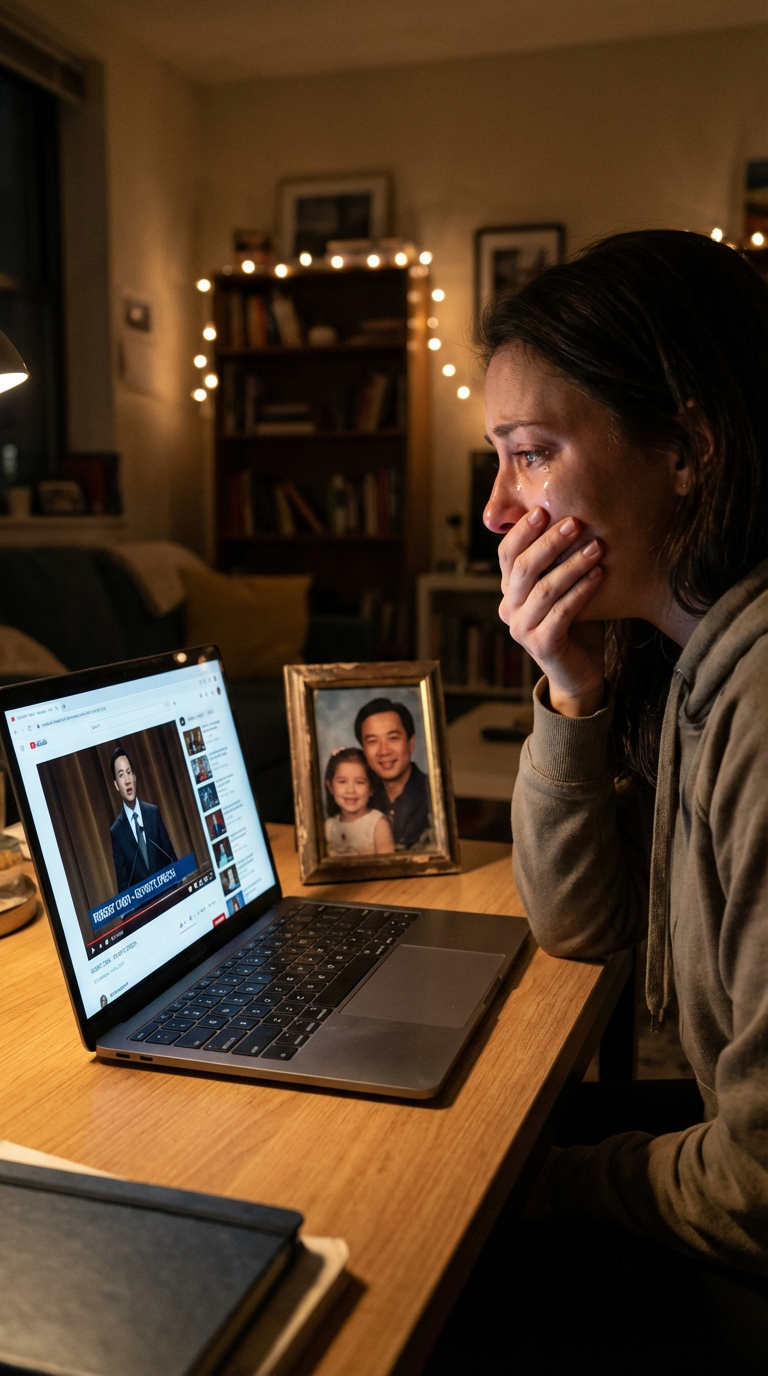
Twenty years later, I opened my laptop and watched my “dead” father give a keynote speech on YouTube.
The Lie That Built My Childhood
My childhood felt like an after-school special about grief.
Other kids had father–daughter days at school; I had “write about someone you miss” essays. When teachers asked where my dad was, Mom would step in: “He passed when she was young.” Everyone lowered their voices around us, suddenly gentler.
We lived in a small town where people minded their own business as long as you minded yours. My grandparents—Mom’s parents—were around, but they never spoke about him either. If I asked about my father’s family, Mom shut it down instantly.
“They’re complicated people,” she’d say. “We don’t have contact.”
So I learned not to ask.
Instead, I collected fragments:
- A photograph of him holding me as a baby, his face half-turned toward the camera.
- A watch in Mom’s jewelry box, too big for her wrist, with his initials engraved.
- A shoebox of old letters in the back of her closet, always locked.
If I cried on Father’s Day, Mom would hold me and say, “I wish I could bring him back for you.” I believed her.
I built my entire identity around being “the girl whose dad died young.” It explained everything: the tight finances, the way Mom worked late, the empty seat at recitals, the dull ache when I saw other kids’ dads cheering in the bleachers.
I never imagined the truth was worse than death.
The Trigger
It started with a work event.
I’m 28 now, working in marketing for a mid-sized tech company. One Tuesday, my boss emailed the team: “Please watch this leadership talk before Friday’s meeting.” It was a 45-minute keynote from a retired military officer turned consultant talking about “resilience and decision-making.”
I clicked the link at my desk, half watching, half answering emails—until the speaker walked onto the stage.
I froze.
The man on-screen had my eyes. My jaw. The same way of pinching the bridge of his nose I’d seen in that one baby photo. His voice was deeper than I remembered, but the cadence—the laugh lines crinkling at the corners of his eyes—hit me like a truck.
His name flashed across the lower third: Colonel Daniel Cross (Ret.).
My father’s name.
I paused the video. Zoomed in. My heart pounded so hard I could hear it in my ears.
It had been twenty years since my mom told me he was dead. Twenty years of birthdays, graduations, tears, and milestones under the assumption that this man no longer existed.
And here he was, alive enough to give corporate talks in a nice suit with perfect lighting and a clip-on mic.
I went into the bathroom and threw up.
The First Search
When my hands stopped shaking, I did what anyone would do: I Googled him.
Pages and pages came up. He had a consulting firm, a LinkedIn profile, articles quoting him as an expert. There were photos from recent events—him shaking hands with CEOs, smiling at conferences, posing with groups of veterans.
One photo stopped me cold: him standing next to a woman and two teenage boys. The caption: “Daniel Cross with his wife and sons at the Veterans’ Gala.”
The wife—blonde, elegant, my mother’s opposite. The boys—16 and maybe 14, both with faint versions of my eyes.
My father hadn’t just been alive. He’d built an entire new family while I grew up thinking he was in the ground.
My vision blurred. Years of moments flashed: Dad–daughter dances I’d skipped, the time I wrote a letter to the sky on his “death anniversary,” Mom’s tight voice whenever his name came up.
Had she known all along? Had she lied the whole time?
Deep down, I already knew the answer.
Confronting My Mother
I didn’t call. I drove.
Mom still lived in the same small house I grew up in, down to the faded curtains and the dent in the garage door. I sat in the driveway for a full minute, breathing, trying not to cry.
She opened the door before I knocked, wiping her hands on a dish towel. “Hey, honey! This is a nice surprise.”
I walked past her into the living room and put my laptop on the coffee table. My hands shook as I opened the paused video.
“Is this him?” I asked.
She glanced at the screen and went absolutely still. The color drained from her face.
“Where did you get that?” she whispered.
“Answer the question,” I said. “Is this my father?”
She sat down like her legs had given out. “It’s… complicated.”
“No, it’s not,” I said, voice shaking. “Is. He. My. Father.”
She stared at the image for a long moment, then nodded once.
“Yes.”
The word dropped like a bomb between us.
“So he’s alive,” I said. “He’s been alive this whole time. And you told me he was dead.”
Tears filled her eyes. “I can explain.”
“You’d better,” I said. “Because right now, I can’t think of a single explanation that makes this okay.”
Her Story
According to my mother, the story went like this:
She and my father met in their early twenties when he was stationed near our town. They married quickly, had me soon after. Then he deployed overseas.
While he was gone, their marriage fell apart. Long-distance fights. Suspicions. A letter from another woman. By the time he came back, he wanted out. He’d met someone else—someone “more stable,” in his words.
“He said the army had taught him about making hard choices,” Mom said bitterly. “Apparently, we were the choice he discarded.”
They separated when I was three.
“He wanted joint custody,” she said. “But he also wanted to move across the country with her. I was terrified of losing you. I hired a lawyer, but he had more money, more connections. He said if I didn’t agree to his terms, he’d fight until he got full custody. He told me I was unstable. That no judge would give you to me.”
Her eyes hardened. “So I did the only thing I thought I could. I ran.”
She told him she was taking me to visit her parents two states over. Instead, she never came back. Changed her number. Moved in with my grandparents. Filed for sole custody in a new jurisdiction, where his military schedule made it hard for him to appear.
“He tried at first,” she admitted. “There were calls, letters. But I never answered. I returned everything unopened. Eventually, he stopped.”
“And the part where you killed him?” I asked. “When did that happen?”
She flinched. “You were eight. You kept asking questions. Where was he? Why didn’t he call? Why didn’t he love you? Every answer hurt you. Every time I said ‘I don’t know’ or ‘He’s busy,’ you looked more broken. So I decided to give you closure.”
“By telling me he was dead,” I said flatly.
“I thought it would be easier,” she whispered. “For both of us.”
“For you,” I shot back. “You thought it would be easier for you.”
She burst into tears. “I was scared! I’d built a life for us. I didn’t know if he’d come back and rip you away. If you knew he existed, you might go looking. I couldn’t risk losing you.”
“So you stole him from me instead,” I said. “To protect yourself.”
We sat in silence. She sobbed. I stared at the man on the screen—older now, but alive. Someone who could have been at my graduations. My birthdays. My first heartbreak.
“Did he know you told me he was dead?” I asked.
She shook her head. “No. I never spoke to him again after we left.”
I believed her on that point. The fear in her voice was too raw. But it didn’t soften the betrayal.
The Emails
Back home, I spent three nights drafting an email I rewrote a dozen times.
Subject: You don’t know me.
Body: I think you might be my father.
I attached a photo: me at eight, missing front teeth, holding a stuffed bear. Then a current photo: me at twenty-eight, eyes haunted.
I gave minimal details at first. His name, my name, my mother’s maiden name. Enough to jog his memory, not enough to invite immediate denial.
I hovered over “Send” for a long time. Then I clicked it.
He replied in under an hour.
Subject: I think I do.
He asked if we could schedule a video call. “If you’re willing,” he wrote. “If it’s really you.”
We scheduled for Saturday morning. I barely slept.
Meeting My “Dead” Father
He appeared on my screen in a simple navy polo, no stage lights, no mic. Just a man in his fifties with wary eyes and lines carved deeper since the last public photo.
“Hi,” I said.
His face crumpled. “You look just like her,” he said. “And a little like me, poor kid.”
I laughed, then cried. He cried too.
We spent two hours unraveling two decades of silence.
He told me his version.
He’d come home from deployment to find us gone. No note, no forwarding address. Mom had disappeared off the face of the earth. He contacted her parents; they claimed not to know where we were. He filed missing persons reports that went nowhere.
“I tried to track you,” he said. “But without a starting point… I was still active duty, constantly being moved. Eventually, my lawyer said I had to accept she didn’t want to be found. And when I reenlisted, I told myself I’d ruined it. That maybe you were better off without me.”
He said he wrote me a letter every birthday until I turned eighteen. Kept them in a box. “I never knew where to send them.”
After he left the military, he built his consulting career, married his current wife, had two sons. “I always told them they had a sister somewhere,” he said. “Didn’t know if you were alive, but I told them.”
We cross-checked details. Hospital where I was born. My grandparents’ names. Little memories I had of him reading bedtime stories before he left.
There was no doubt. This man was my father.
Two Truths, Both Ugly
After that call, I was left holding two heavy, conflicting truths:
- My mother lied for twenty years, depriving me of any relationship with my father to protect herself.
- My father did not do everything he could to find me. At some point, he moved on and built a new family without me.
People love neat narratives: villain and victim, good parent and bad one. Real life isn’t neat.
My mother’s fear was real—but so was her selfishness. My father’s grief was real—but so was his decision to stop searching.
I spent months in therapy trying to untangle the knot.
The Confrontation Round Two
I decided to meet my father in person before involving my mother again. We chose a neutral city halfway between us. Public place. Midday.
He brought a stack of letters in a shoebox—the ones he’d written me each birthday. They were clumsy, earnest, heartbreaking.
“Dear Lily,” one said, “you’re eight today. I hope you like dogs as much as you did when you were three. I hope you have a dog. I don’t know if your mom will ever let me see you again, but I pray you’re safe.”
Reading those letters broke something loose in me. A part that had always wondered if I’d been easy to forget.
“You could have gone to court,” I said. “Hired private investigators. Posted online. Something.”
“I know,” he said quietly. “I was a coward. I told myself you were better off than being dragged through a custody war. It was easier to believe that than to face the fact I was giving up.”
He didn’t justify. Didn’t call my mother names. Just owned his failure.
It didn’t erase twenty years. But it meant something.
Telling My Mother I’d Found Him
When I told my mother I’d met him, her reaction was instant and visceral.
“You what?” she cried. “After everything I did to protect you?”
“Protect me from what?” I shot back. “From having a father? From knowing the truth?”
“He would have taken you,” she insisted. “Ripped you away from me.”
“You don’t know that,” I said. “You decided for both of us.”
She paced the kitchen, hands in her hair. “He’s manipulating you. He’s good at that. Don’t let him rewrite history.”
“He didn’t have to,” I said. “You wrote it for him when you told me he was dead.”
She deflated, leaning against the counter. “You’re my whole life. I couldn’t risk losing you.”
“So you risked losing me now,” I said softly. “Because that’s what might happen.”
She started to cry again. “Don’t say that.”
“I don’t know what our relationship looks like after this,” I said. “I need space. I need time. And I need you to understand that what you did was not okay, no matter how scared you were.”
She begged. Bargained. Blamed. Then finally: “I’m sorry. I was wrong.” The words came out like stones.
I heard them. I noted them. But forgiveness doesn’t switch on like a light.
Meeting His New Family
Six months later, I met my father’s wife and sons.
We chose a casual restaurant. His wife—Caroline—hugged me like she’d known me forever. “I’ve been waiting twenty years to meet you,” she said, eyes wet.
His sons were awkward, kind. The older one, Josh, said, “We always wanted a sister. This is weird, but… cool?”
We took a photo together. I looked at it later—my father in the middle, arms around all three of us. I saw something I’d never seen before: myself in a family group shot with a father.
It felt good.
It also felt like betrayal of my mother.
Both could be true.
Going No Contact (For a While)
Eventually, I made a decision that shocked my mother: I went low-contact with her.
Not no-contact forever. But enough distance to breathe without her guilt suffocating me.
“I need time,” I told her. “Time without you telling me how to feel, or what to do with him, or framing yourself as the hero.”
She accused me of choosing him over her. “After everything I sacrificed!”
I said quietly, “You didn’t sacrifice. You stole. And I’m allowed to be angry about that.”
We limited communication to occasional texts about logistics. No emotional dumping. No demands about my relationship with my father.
Meanwhile, I slowly built something with him. Not a replacement childhood—that’s gone. But an adult connection. We talk about books, movies, his military stories. He sends me photos from his hikes. I send him drafts of my writing.
It’s messy. It’s imperfect. But it’s real.
What I Lost
Finding out my “dead” father was alive cost me:
- The story of my childhood. Every memory that involved grief now has a second layer: unnecessary grief, engineered grief.
- Blind trust in my mother. She was my anchor. Now I know she can be both loving and dangerously dishonest.
- The illusion of simple victimhood. It was easier when my father was just “dead” and my mother was the tragic widow. Now everyone is flawed.
I also lost the ability to say “my dad died when I was eight” without flinching. The truth is more complicated: “My mom told me he died when I was eight. He didn’t.”
Try dropping that at a party.
What I Gained
But I gained things too:
- A father—late, imperfect, remorseful—but here.
- Two brothers who text me memes and ask for advice.
- A more honest relationship with reality, even if it hurts.
Most importantly, I gained agency. For twenty years, my parents decided my story. Now I get to decide who is in my life, on what terms.
Do I Forgive My Mother?
Not fully. Not yet.
Forgiveness, if it comes, will be because I choose it—not because she demands it, or because “she did her best.”
Her best included lying about death for two decades. That matters.
I can empathize with her fear and still hold her accountable. I can recognize that she was a young, scared woman trapped in a bad marriage and still insist that what she did to me was wrong.
Both can be true.
Do I Blame My Father?
Also yes.
He didn’t forge my birth certificate or fake his obituary. But he stopped fighting. Stopped searching. Let years pass without hiring every PI he could afford.
He told himself I was better off. That might have been easier than living with the guilt of abandoning the fight.
He’s trying now. Showing up now. That counts for something—but doesn’t erase the absence.
Where Things Stand Now
Today, my life looks like this:
- Weekly calls with my father.
- Group chat with my brothers.
- Occasional, cautious coffee with my mother—with clear boundaries.
- Ongoing therapy, because untangling 20 years of deception takes more than a few deep breaths.
I don’t know yet what the final shape of these relationships will be. Maybe my mother and I will rebuild something smaller but honest. Maybe my father and I will never have an effortless bond, but we’ll have an honest one.
What I do know is this:
I’d rather live with a painful truth than a comforting lie.
My father has been alive for 20 years. My mother lied to me. Those two facts coexist, whether anyone likes them or not.
The little girl who cried over a man she thought was in the ground deserved better. The adult woman telling this story is determined to give her that—starting now.