I never thought I’d be writing this, but I need to get this off my chest because I honestly don’t know if I’m the villain in my own story anymore.
My name is Sarah, and I’m 42 years old. I’ve been married to my husband Mark for eight years now. He has a daughter from his first marriage, Emma, who’s 16. When Mark and I got together, Emma was just 8 years old, and her biological mother had passed away two years before that from cancer. I knew from day one that stepping into this role would be complicated, but I genuinely loved Mark, and I wanted to be there for both of them.
The thing is, I also had a son from my previous marriage. His name was Dylan, and he was the light of my entire existence. Dylan died in a car accident when he was 14, just six months before I met Mark. The grief was absolutely devastating. There were days I couldn’t get out of bed. Days where breathing felt like too much effort. My ex-husband and I had already been separated when it happened, and Dylan’s death just finalized what was already broken between us.
When I met Mark, he was understanding about my grief. He never pushed me to “move on” or “get over it.” He let me cry when I needed to cry. He held me during the anniversaries. He understood that Dylan would always be part of my life, even in death. That’s one of the reasons I fell in love with him.
I tried so hard with Emma. I really did. I went to every school play, every parent-teacher conference, every soccer game. I learned to braid her hair the way she liked it. I made her favorite meals. I helped her with homework. I listened to her talk about boys and friends and all the drama that comes with being a teenage girl. I never tried to replace her mom because I knew that was impossible and unfair. I just wanted to be someone she could count on, someone stable in her life.
But Emma never warmed up to me. Not really. She was polite enough in front of her dad, but when it was just the two of us, there was this coldness. She’d make little comments about how I didn’t understand her because I “wasn’t her real mom.” She’d compare me to her biological mother constantly, always making sure I knew I didn’t measure up. She’d ignore my messages, roll her eyes at my suggestions, and generally make it clear that I was an outsider in her life.
I told myself it was normal. She was grieving. She was a teenager. She’d come around eventually. Mark would always say, “Give her time. She’s been through a lot.” So I gave her time. Years of it.
I kept a memorial space for Dylan in our home. It wasn’t a shrine or anything overwhelming, just a small corner in our living room with his photo, some of his favorite books, a few of his drawings from art class, and a candle I’d light on special occasions. It was my way of keeping his memory alive, of feeling like he was still part of our family. Mark was completely supportive of this. He’d even sit with me sometimes and let me tell him stories about Dylan, what he was like, the funny things he’d say.
Emma knew how important this space was to me. We’d had conversations about it. I’d explained to her gently but clearly that this was sacred to me, that Dylan was my son and I’d never stop loving him or honoring his memory. She’d nod and say she understood, but there was always something in her eyes I couldn’t quite read.
Last month, Emma got into trouble at school. She was caught cheating on a major exam, and the school called both Mark and me in for a meeting. The teacher explained that Emma had been struggling academically but instead of asking for help, she’d copied answers from another student. As a consequence, she was going to receive a zero on the exam and a suspension.
Mark was furious. He grounded Emma for a month—no phone, no going out with friends, no social media. She had to come straight home after school every day. I supported his decision because, frankly, cheating is a serious matter, and she needed to understand there are consequences for dishonest behavior.
Emma was livid. She blamed us both but seemed to direct most of her anger toward me. She kept saying things like, “You’re not even my real mom, why do you get a say in this?” and “My real mom would have understood.” Mark would correct her every time, but it didn’t seem to matter.
Then came last Tuesday. I was at work when I got a call from our neighbor saying she’d heard crashing sounds coming from our house. My heart immediately sank. I called Mark, but he was in a meeting and couldn’t answer. I left work early and rushed home.
The moment I walked in, I knew something was wrong. The house was too quiet. I called out for Emma, and she came out of her room with this defiant look on her face that made my stomach turn.
I walked into the living room, and my entire world shattered all over again.
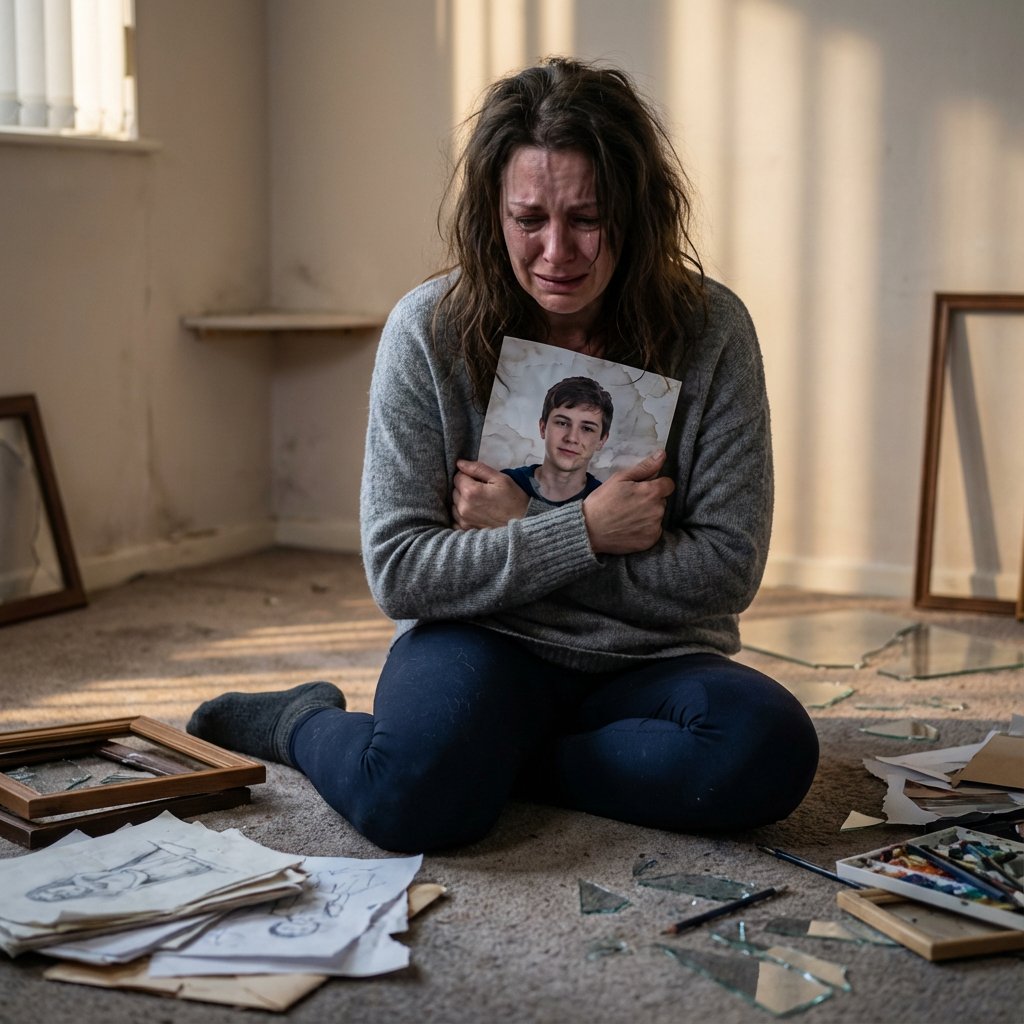
Dylan’s memorial was destroyed. The frame with his photo was smashed on the floor, glass everywhere. His books were torn apart, pages scattered like confetti. His drawings were ripped to pieces. The candle was melted and smeared across the wall. It looked like a tornado had torn through that one specific corner of the room.
I couldn’t breathe. I literally couldn’t breathe. I stood there staring at the destruction, and it felt like Dylan was dying all over again. Like someone had reached into my chest and ripped out what was left of my heart.
“What did you do?” I whispered.
Emma just stood there with her arms crossed. “I was angry,” she said flatly. “You both ruined my life with this stupid punishment.”
“So you destroyed my son’s memorial?” My voice was getting louder. “You destroyed the only physical pieces I have left of him?”
“It’s just stuff,” she said with a shrug. “You always said Dylan lives in your heart, so what does it matter?”
That’s when I lost it. Completely lost it. Years of patience, years of trying, years of biting my tongue all came rushing out in that moment.
“You want to know why I don’t feel like your real mom?” I screamed at her. “Because a real daughter would never do something this cruel. Because despite everything I’ve done for you, every soccer game, every late-night talk, every time I’ve defended you or supported you, you’ve made it crystal clear that I’m nothing to you. And you’re right, Emma. I’m not your real mom. Your real mom is dead, and I’m just the woman who’s been foolish enough to keep trying to love a girl who despises her.”
The look on her face changed. The defiance cracked, and something else showed through—shock, maybe hurt. But I was too angry, too devastated to care.
“I will never forgive you for this,” I continued. “My son is dead. I will never get to see him graduate, or go to college, or get married. I will never hold his children. All I had were those few things, and you destroyed them because you were angry about a punishment you deserved. That’s not just cruel, Emma. That’s evil.”
She started crying then, but I turned away. I couldn’t look at her. I went to our bedroom and locked the door.
When Mark came home, Emma told him what happened. He came upstairs and found me sitting on the floor of Dylan’s old room, which we’d kept exactly as it was. I was holding one of Dylan’s sweatshirts and sobbing.
Mark was horrified when he saw what Emma had done. He grounded her for the rest of the school year, took away everything, and made her start seeing a therapist immediately. But the damage was done.
Here’s where it gets complicated. Emma’s biological grandparents—Mark’s former in-laws—got involved. Emma called them crying, and they showed up at our house the next day demanding to talk. They said I had no right to tell Emma she wasn’t my daughter, that I was supposed to be the adult in the situation, that their granddaughter had been through enough losing her mother and didn’t need me “rejecting” her too.
Mark defended me, which I appreciate, but they basically said Emma should come live with them for a while because our home had become “toxic.” Emma agreed, and she’s been staying with them for the past three weeks.
My own parents are split. My mom says I had every right to be angry but that I shouldn’t have said those things to a grieving child. My dad says Emma needed to hear the truth and that she’s old enough to understand the consequences of her actions.
Mark is torn. He’s angry at Emma for what she did, but he’s also worried about our marriage. He says he understands why I snapped, but he’s asked me if I can ever forgive Emma and move forward. He wants family therapy. He wants us all to heal together.
But I don’t know if I can. Every time I look at that corner of the living room, even though I’ve tried to put things back together, I see the destruction. I see years of trying to be a good stepmother thrown back in my face in the cruelest way possible. I see my dead son disrespected.
I managed to salvage the photo of Dylan, though it’s scratched and damaged. Some of the book pages can be taped back together. But his drawings—the ones he made in art class that he was so proud of—are destroyed beyond repair. Those are gone forever, just like he is.
Emma has sent me a few text messages apologizing. She says she didn’t understand how much it would hurt me. She says she was angry and not thinking. She says she wants to come home and make things right. But her apologies feel hollow. How do you not understand that destroying a memorial to someone’s dead child would hurt them?
My relationship with Mark is strained. He’s trying to be supportive, but I know he’s caught between his daughter and his wife. He keeps saying that Emma is just a kid who made a terrible mistake, and while that’s technically true, it doesn’t make the pain any less real. It doesn’t undo what she did.
Part of me knows I shouldn’t have said what I said. I’m the adult. I should have handled it better. But another part of me feels like Emma needed to hear it. She needed to understand that actions have consequences, that you can’t just destroy something precious to someone and expect forgiveness because you’re angry.
I’ve been seeing my own therapist, and she’s been helpful in processing everything. She says I have every right to feel angry and betrayed, but she also says that if I want to keep my marriage intact, I need to find a way forward. She’s suggested family therapy, which Mark is all for, but I’m hesitant. I’m not sure I want to sit in a room with Emma and talk about feelings when what I really feel is rage and grief.
Some of my friends have been supportive. Others have been judgmental, saying I should never have married someone with a child if I wasn’t prepared for the complications. But it’s not like I didn’t try. I tried for eight years. I put in the work. I showed up. And this is what I get for it.
The worst part is the guilt. Because as angry as I am at Emma, I feel guilty for what I said to her. I know she’s a child who lost her mother. I know she’s struggling. I know that hurt people hurt people. But knowing all that doesn’t make my own pain disappear. It doesn’t bring back Dylan’s drawings or undo the violation I feel.
Mark wants Emma to move back home. He says she can’t live with her grandparents forever, that we need to face this as a family. But I don’t know if I can have her back in this house. I don’t know if I can sit across from her at dinner and pretend everything is okay. I don’t know if I can ever look at her the same way again.
I’m also worried about what this means for my marriage. Mark loves me, I know he does. But Emma is his daughter, his blood. If it comes down to choosing, I’m not naive enough to think he’ll choose me over her. And I don’t want to be the evil stepmother who forces that choice. But I also don’t want to live in a house where I feel disrespected and where my grief doesn’t matter.
The thing that keeps playing in my mind is that moment when Emma shrugged and said, “It’s just stuff.” The casual cruelty of that statement, the complete lack of empathy, the dismissiveness of my pain. That’s what I can’t get past. Because it wasn’t just stuff. It was my connection to my son. It was all I had left.
I’ve started looking at apartments, just in case. I haven’t told Mark yet because I don’t want to make any rash decisions, but I need to know I have an exit plan if things don’t improve. The thought of leaving makes me sad because I do love Mark, but I can’t sacrifice my own peace and dignity for a relationship that might be broken beyond repair.
So here I am, three weeks later, still processing, still grieving, still angry. I don’t have a neat ending to this story because I’m living it in real-time. I don’t know if Emma and I will ever repair our relationship. I don’t know if my marriage will survive this. I don’t know if I’ll ever feel at home in that house again.
What I do know is that I told my stepdaughter I’m not her real mom after she destroyed my late son’s memorial, and I can’t take those words back. They’re out there now, hanging between us like a wall. And maybe that wall is permanent. Maybe some things, once broken, can’t be fixed.
I guess I’m writing this because I need to know if I’m the terrible person everyone seems to think I am. Did I have the right to say what I said? Was I justified in my anger? Or did I irreparably damage a child who was already struggling?
I honestly don’t know anymore. All I know is that I’m tired. I’m tired of trying to be something I’m apparently not. I’m tired of my grief being minimized. I’m tired of being expected to be the bigger person when all I want to do is scream at the unfairness of losing my son and then having his memory desecrated.
If you’ve made it this far, thank you for reading. I know this is long and messy and complicated. But that’s what life is sometimes—long and messy and complicated. There are no easy answers, no clear villains or heroes. Just people doing their best and sometimes failing spectacularly.
I still don’t know what I’m going to do. But at least now I’ve gotten it all out. And maybe, just maybe, someone out there will understand.