— So I Contested the WillI’m writing this from my lawyer’s office, and my hands are shaking so badly I can barely type. But I need to tell this story because what happened to me is so beyond comprehal that I still can’t believe it’s real.
My name is Rebecca, I’m 34 years old, and three months ago, my husband Daniel died suddenly from a brain aneurysm. He was 36, healthy, active, and we’d just celebrated our seventh wedding anniversary two weeks before. We were trying for a baby. We’d just bought our dream house. We had plans—so many plans.
Daniel collapsed at work on a Tuesday morning. By Tuesday evening, he was gone. The doctors said it was instant, that he didn’t suffer, but I’ve suffered every single day since. The love of my life was just gone, and I didn’t even get to say goodbye.
But this story isn’t just about grief. It’s about what happened after Daniel died, and how his family turned my tragedy into a nightmare I’m still living through.
Daniel came from money. Not millionaire money, but comfortable upper-middle-class wealth. His father owned a successful construction company, and his mother came from old money. They lived in a gated community, belonged to a country club, and had very specific ideas about who was “suitable” for their family.
I was not suitable. I grew up working class. My dad was a mechanic, my mom was a hairdresser. I put myself through community college and worked as a nurse. When Daniel and I met at a friend’s barbecue seven years ago, it was instant chemistry. He didn’t care that I didn’t come from money. He loved me for who I was.
His family never accepted me. His mother, Patricia, made that clear from day one. She’d make comments about my “background,” my clothes, my education. She’d talk about Daniel’s ex-girlfriend, Olivia, who came from “a good family” and went to an Ivy League school. She’d ask when I was planning to “improve myself” or if I’d considered going back to school for a “real degree.”
Daniel always defended me. He’d shut down his mother’s comments and make it clear that I was his choice, his wife, and that was final. His father, Robert, was more neutral but never stood up to Patricia. His sister, Amanda, followed their mother’s lead and treated me like I was invisible most of the time.
We kept our distance from them. We’d show up for major holidays, stay for a few hours, and leave. Daniel would call his parents weekly out of obligation, but we built our life separate from them. It was better that way.
When Daniel died, I was destroyed. Completely, utterly destroyed. I called his parents from the hospital, sobbing so hard I could barely speak. Patricia answered, and I’ll never forget the coldness in her voice. No tears, no emotion, just: “We’ll handle the arrangements. I’ll call you later.”
I was too shocked to argue. I’d just lost my husband. I wasn’t thinking clearly. I assumed “we’ll handle the arrangements” meant we’d plan together as a family.
I was wrong.
The next day, I called Patricia to discuss funeral arrangements. I wanted to talk about what Daniel would have wanted, where he’d want to be buried, what music he’d want played. Patricia cut me off immediately.
“Rebecca, we’ve already made all the arrangements. The funeral is Saturday at 2 PM at St. Catherine’s Church, followed by burial at Greenlawn Cemetery. It’s all been handled.”
“But I’m his wife,” I said, confused. “Shouldn’t we discuss this together?”
“Daniel was our son before he was your husband,” she said coldly. “We know what’s best. We’ll send you the details.”
Something felt wrong, but I was so deep in grief I couldn’t process it. I just assumed I’d get the formal details later and we’d all be together to say goodbye to Daniel.
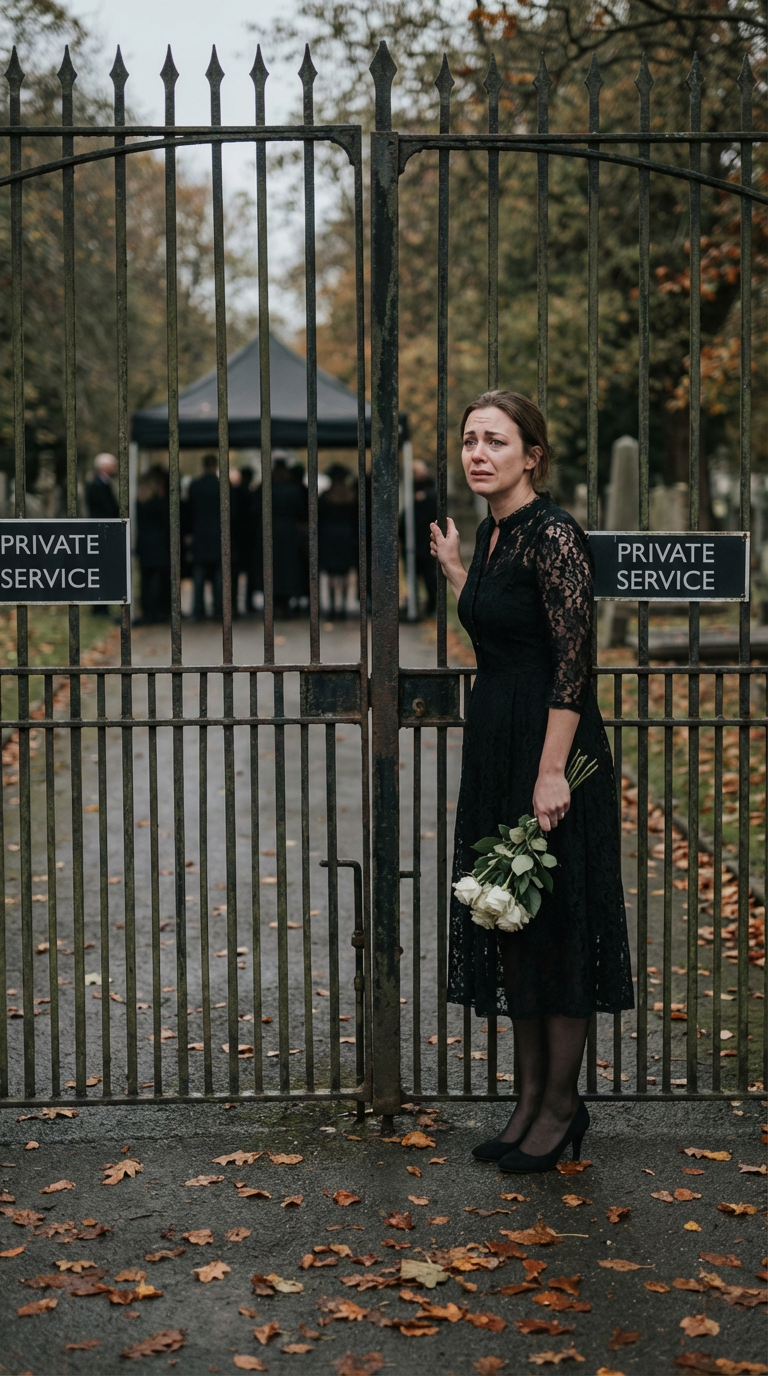
Friday afternoon, I got an email from Amanda. Not a call, not even a text—an email. It was formal, cold, and included the funeral details. The service was at 2 PM Saturday. There was a reception afterward at the country club. And then, at the bottom, one line that made my blood run cold:
“This is a private family service. We appreciate your understanding during this difficult time.”
I read it three times before it sank in. They were excluding me from my own husband’s funeral.
I immediately called Daniel’s phone, forgetting for a moment that he was gone, then called Patricia. She didn’t answer. I called Robert. No answer. I called Amanda. Nothing. I drove to their house, and the gates were closed. The security guard told me I wasn’t on the approved visitor list.
I sat in my car outside those gates and sobbed until I couldn’t breathe. My husband was dead, and his family was erasing me from his life like I’d never existed.
Friday night, I called my brother-in-law’s wife, Jessica, who had always been kind to me. She answered, and I could hear she’d been crying.
“Jessica, what’s happening? They’re not letting me come to the funeral.”
There was a long pause. “Rebecca, I’m so sorry. I tried to say something, but Patricia told the whole family that you and Daniel were having problems. She said you were separated, that Daniel was planning to divorce you, and that he wouldn’t want you there.”
I felt like I’d been punched in the stomach. “That’s a lie. That’s an absolute lie. We were happy. We were trying for a baby.”
“I believe you,” Jessica said quietly. “But Patricia has everyone convinced. She’s saying Daniel confided in her about wanting out of the marriage. She’s even saying there’s a will that reflects his wishes.”
“What will? Daniel and I made wills together three years ago. I have copies.”
“I don’t know,” Jessica admitted. “But Patricia has hired a lawyer. She’s moving fast on everything.”
I hung up and immediately called my own lawyer, Tom, who’d helped Daniel and me with our home purchase. I told him everything. He listened carefully and then said: “Don’t go to that funeral tomorrow. If they’ve explicitly excluded you and you show up, they could claim harassment. Document everything—every email, every text, every call. And let me start looking into Daniel’s estate immediately.”
Saturday afternoon, while Daniel’s family buried my husband without me, I sat alone in our house wearing the black dress I’d bought for the funeral I wasn’t allowed to attend. I looked at our wedding photos and cried until I had nothing left.
That evening, I got a text from an unknown number. It was a photo of the funeral program. Daniel’s face smiled up at me from the cover. Inside was his obituary. It mentioned his parents, his sister, his grandparents, his education, his job. At the very bottom, in small print: “Daniel is also survived by Rebecca Chen.”
Also survived by. Like I was an afterthought. Like seven years of marriage meant nothing.
The following Monday, Tom called me with news that made everything so much worse.
“Rebecca, Patricia filed paperwork with the probate court. She’s claiming there’s a new will, dated six months ago, that names her as executor and primary beneficiary of Daniel’s estate.”
“That’s impossible,” I said. “Daniel and I updated our wills three years ago. We left everything to each other.”
“Do you have copies?”
“Yes, in our safe.”
“Good. Get them to me immediately. Because according to the will Patricia filed, Daniel left the bulk of his estate—including his life insurance, his 401k, and his share of your house—to his parents. You’re entitled to a small monthly stipend for two years, after which you get nothing.”
I couldn’t speak. I literally couldn’t form words.
Tom continued: “There’s more. The will states that Daniel wanted to be buried in his family’s plot and that his funeral arrangements were to be handled exclusively by his parents. It also includes a letter claiming your marriage was troubled and that he’d planned to file for divorce but died before he could.”
“Tom, none of that is true. None of it. Daniel loved me. We were happy.”
“I believe you. And we’re going to fight this. But I need you to prepare yourself—this is going to get ugly.”
He wasn’t kidding.
Over the next several weeks, I learned the extent of Patricia’s planning. She’d hired an expensive estate attorney. She’d collected “witness statements” from family members claiming they’d observed problems in our marriage. She’d even produced emails allegedly from Daniel to his mother discussing his unhappiness.
I knew it was all fabricated, but proving it was another matter entirely.
Tom requested a handwriting analysis of the will signature. He subpoenaed Daniel’s email records. He interviewed Daniel’s friends, coworkers, and our neighbors. He pulled our financial records showing joint purchases and baby furniture we’d bought just days before Daniel died.
The evidence overwhelmingly showed a happy, committed marriage. Daniel’s best friend, Marcus, gave a statement saying Daniel had literally been talking about baby names the day he died. Our neighbor testified that she’d seen us kiss goodbye that morning and heard Daniel say “I love you” as he left for work.
But Patricia’s lawyer argued that people hide marital problems. That Daniel was protecting his image. That the will was legitimate and properly witnessed.
The case dragged on. In the meantime, I was locked out of Daniel’s bank accounts. His paychecks stopped. His life insurance company froze the payout pending the legal dispute. I had to use my own savings to pay our mortgage while fighting for my husband’s estate.
Patricia also began a smear campaign. She told everyone in their social circle that I was a gold-digger who’d trapped Daniel and was now trying to steal his money. She posted on social media about “protecting her son’s legacy from opportunists.” She even contacted my employer suggesting I was emotionally unstable and shouldn’t be working with patients.
I was grieving my husband while simultaneously fighting for my financial survival and my reputation. There were days I didn’t want to get out of bed. Days I considered just walking away from everything. But I couldn’t. Daniel deserved better. Our marriage deserved to be honored, not erased.
Tom suggested we contest the will based on several grounds: undue influence, lack of testamentary capacity, and fraud. He was confident we’d win, but it would take time.
The breakthrough came two months after Daniel’s death. Tom’s investigator found the notary who allegedly witnessed Daniel’s signature on the new will. Under deposition, the notary admitted she’d never actually seen Daniel sign anything. Patricia had brought her a pre-signed document and paid her $500 to notarize it without Daniel present.
That was illegal. It invalidated the entire will.
Tom immediately filed for the notary’s testimony to be entered into evidence. Patricia’s lawyer tried to block it, but the judge allowed it. Within a week, the judge ruled that the contested will was fraudulent and that Daniel’s original will—leaving everything to me—was the valid legal document.
I won. But it didn’t feel like winning.
Patricia was ordered to return all assets she’d taken from Daniel’s estate. The life insurance company released the payout to me. Daniel’s 401k was transferred to my name. The judge also ordered Patricia to pay my legal fees, which had exceeded $30,000.
But here’s what I didn’t get back: I didn’t get to say goodbye to my husband at his funeral. I didn’t get to be there when he was buried. I didn’t get those moments of closure that every widow deserves.
Patricia’s family has cut off all contact with me. They believe I’m the villain in this story, that I stole their son’s money. The truth doesn’t matter to them. They’ve rewritten history in their minds, and nothing will change that.
I did get one small victory though. As Daniel’s legal widow and executor of his estate, I had the legal right to make decisions about his memorial. I had a second, proper memorial service for Daniel with his real friends, the people who actually loved him. We played his favorite music. We shared real stories about who he was. We celebrated his life honestly.
And I commissioned a bench in his favorite park with a plaque that reads: “Daniel Martinez, beloved husband, loyal friend, taken too soon. Forever loved by Rebecca.”
His family doesn’t get to erase me. They don’t get to rewrite our love story. The legal system confirmed what I always knew: I was Daniel’s wife, his partner, his choice. And no amount of money or social status changes that.
But the damage is done. I’m 34 years old, a widow, fighting PTSD from the trauma of losing my husband and then being victimized by his family. I’m in therapy twice a week. I have panic attacks. I have trust issues. I struggle to open up to people because I’m terrified of being hurt again.
The money from Daniel’s estate sits in my bank account, and I can barely look at it because it represents the price of his life. I’d give every penny back to have him here with me. I’d give everything to have had one more day, one more conversation, one more kiss goodbye.
People ask me if I regret contesting the will. They say maybe I should have just walked away, taken the high road, let Patricia have what she wanted. But I don’t regret it. Not for a second.
I didn’t fight for the money. I fought for Daniel’s dignity. I fought for the truth of our marriage. I fought because what they did was wrong, and somebody needed to stand up and say it.
Daniel’s family excluded me from his funeral, tried to erase me from his life, and attempted to steal everything we’d built together. They thought I’d just disappear quietly, that I’d be too intimidated or too broken to fight back.
They were wrong.
I’m still here. I’m still standing. And Daniel’s memory—the real Daniel, not the fabricated version his mother created—is protected.
So yes, I contested the will. I fought his family in court. I spent months in legal battles while grieving the love of my life. And I’d do it again in a heartbeat.
Because some things are worth fighting for. Love is worth fighting for. Truth is worth fighting for. And Daniel, wherever he is, knows that I never stopped fighting for us.
His family may have excluded me from his funeral, but they can’t exclude me from his life. I was his wife. I was his love. I was his choice.
And no one—not his mother, not his family, not anyone—can take that away from me.