I never thought I’d be the person to ruin someone’s wedding. I’ve always been the peacemaker in my family, the one who smooths things over and keeps everyone happy. But what my sister Emma did to me over the past decade finally pushed me to a breaking point I didn’t know existed.
This happened three weeks ago, and my entire family has turned against me. My phone won’t stop buzzing with messages calling me petty, vindictive, and cruel. My mother hasn’t spoken to me since the wedding day. But I need to tell this story because I’m starting to question my own sanity. Was I wrong? Or was this justice ten years overdue?
Let me start from the beginning.
Emma is two years younger than me. We’re 32 and 30 now, but this story really starts when we were 22 and 20. Growing up, we were close—not best friends, but typical sisters who fought over clothes and shared secrets. Our parents always compared us, which created tension, but nothing I thought was unusual for siblings.
Everything changed when I got into Cornell University for my master’s program in architecture. I had worked my ass off for that acceptance. Countless late nights, a stellar portfolio, recommendation letters I spent months cultivating. When that acceptance letter came, it was the proudest moment of my life.
Emma was finishing her undergraduate degree at a state school at the time, studying communications. She seemed happy for me. She helped me celebrate, posted congratulations on social media, even helped me apartment hunt in Ithaca over video calls.
Then the identity theft started. Small at first. So small I didn’t even notice.
It began with her LinkedIn profile. A friend from Cornell messaged me confused, asking why I had two profiles. I checked and found that Emma had created a LinkedIn account using a variation of my name—she added her middle initial in a way that made it look like a professional designation. Her profile claimed she had attended Cornell’s architecture program. She used photos from when she’d visited me on campus, carefully cropped to remove me from the images.
When I confronted her, she laughed it off. Said it was a “mistake,” that she’d meant to put her own school but auto-fill had glitched. She promised to fix it. She never did. Instead, she made the profile private so I couldn’t monitor it.
I was busy with graduate school, drowning in projects and thesis work. I let it slide. That was my first mistake.
Over the next year, I noticed more oddities. Family friends would mention seeing Emma’s “architecture work” online. My aunt asked why Emma never told her she’d also gone to Cornell. I investigated deeper and found Emma had created an entire shadow version of my professional life.
She had an Instagram account under a slightly different name showcasing “her” architecture designs—they were my projects from school, my thesis work, everything. She’d watermarked them with her name variation. She’d built a portfolio website that was basically a clone of mine, with my project descriptions slightly reworded.
The most chilling part? She’d created a narrative where she was the successful architect sister, and I was… what? She told people I’d “changed careers” or was “taking time off.” She literally erased me while wearing my accomplishments like a costume.
I confronted her again. This time she cried. Said she was struggling, that she felt like a failure compared to me, that she’d made mistakes but was “trying to build confidence.” She promised to take everything down. My parents got involved and backed her up—told me to be understanding of her struggles, that she was going through a hard time, that I should be the bigger person.
Like an idiot, I believed the tears. I wanted to believe my sister wasn’t intentionally sabotaging me.
She took down the Instagram. The website went dark. I thought it was over.
It wasn’t over. It was just going underground.
For the next eight years, Emma continued stealing my identity in ways I only discovered through accident or coincidence. A colleague once told me they’d seen my “sister’s amazing TED talk about sustainable architecture.” I never gave a TED talk. Emma had, using my research, my thesis data, everything—and introduced herself with that name variation that sounded just enough like mine.
She joined professional architecture groups on Facebook using my credentials. She networked at conferences claiming to be a Cornell graduate. She even applied for jobs using a resume that was 80% my actual experience with just enough changes to be deniable.
Every time I caught her, the same cycle repeated: denial, then tears, then my parents pressuring me to forgive her because “she’s family” and “she’s struggling with self-esteem issues.” My father even suggested I was being “selfish” with my success, that I should be happy to “share” my achievements with my sister.
Share? She wasn’t borrowing a dress. She was stealing my entire professional identity.
The worst part was how it affected my actual career. I lost job opportunities because hiring managers would find her profiles and think I was running some kind of scam with multiple identities. I had to add disclaimers to my website. I paid for reputation management services. One potential client straight-up ghosted me after finding Emma’s fake portfolio and thinking I’d stolen her work—when it was literally my own designs she’d stolen from me.
I went to therapy. My therapist told me I needed to establish boundaries, possibly cut Emma out of my life entirely. But every time I tried, my family intervened. Holidays became hostage negotiations where I was expected to play nice for the sake of “family harmony.”
Then, six months ago, Emma got engaged to her boyfriend Derek. He’s a nice guy, a little oblivious, but genuinely kind. I actually liked him. Emma called me crying happy tears, asking me to be her maid of honor. Despite everything, she was still my sister. I said yes.
The wedding planning was exhausting. Emma wanted everything perfect, and I helped coordinate vendors, managed the bridal party, organized the bachelorette weekend. I was trying. I really was trying to rebuild our relationship.
Three months before the wedding, I got a call from a reporter at Architectural Digest. They wanted to feature me in an article about emerging architects under 35. It was a huge opportunity—career-defining, the kind of press that leads to major commissions.
I was thrilled. During our preliminary interview, the reporter mentioned she’d been following my work for a while and was impressed by my “unique journey.” Something in her phrasing felt off. I asked what she meant.
She mentioned the “inspiring story” about how I’d overcome a setback and rebuilt my career, how I’d “recently” graduated and was already making waves. My blood went cold. That wasn’t my story. That was Emma’s fabricated timeline from her fake profiles.
I did some digging. Emma hadn’t just maintained her fake identity—she’d expanded it. She had a Medium blog under her name variation where she wrote about “her” architecture career, posting photos from my actual projects and writing about them in first person. She’d created an entire alternate reality where she was living my life.
The blog had thousands of followers. She’d even monetized it.
And then I found the worst part: Emma had submitted an application to Architectural Digest herself, using my portfolio, trying to get featured as an emerging architect. The reporter had contacted me because during her fact-checking, she’d discovered discrepancies and found my actual information—but she’d initially been pursuing Emma’s submission.
My sister had literally tried to steal a career-defining opportunity from me by pretending to be me.
I didn’t tell Emma I knew. I didn’t tell anyone. I just quietly collected evidence. Screenshots of everything. Timestamps. Her fake accounts. The blog posts. Everything. I saved it all to a cloud drive with timestamps and backups.
I continued helping with the wedding planning like nothing was wrong. I smiled through dress fittings and menu tastings. I organized her perfect bridal shower. All while watching her live-tweet about “her architecture projects” to thousands of followers who believed her lies.
The wedding day came. It was beautiful—a garden ceremony at a vineyard, 200 guests, everything Emma had dreamed of. I stood next to her as her maid of honor in a lavender dress, holding her bouquet, watching her beam with happiness.
The reception started perfectly. Dinner was served. The best man gave a heartfelt toast about Derek. Then it was my turn for the maid of honor speech.
I started conventionally. Talked about growing up with Emma, shared a funny childhood story, mentioned how excited I was for her future with Derek. Everyone was smiling. Emma was crying happy tears.
Then I shifted gears.
“But before I finish, I need to share something important about the bride,” I said. “Emma has always been someone who reaches for what she wants. Sometimes, she reaches for things that belong to other people.”
I watched Emma’s smile freeze.
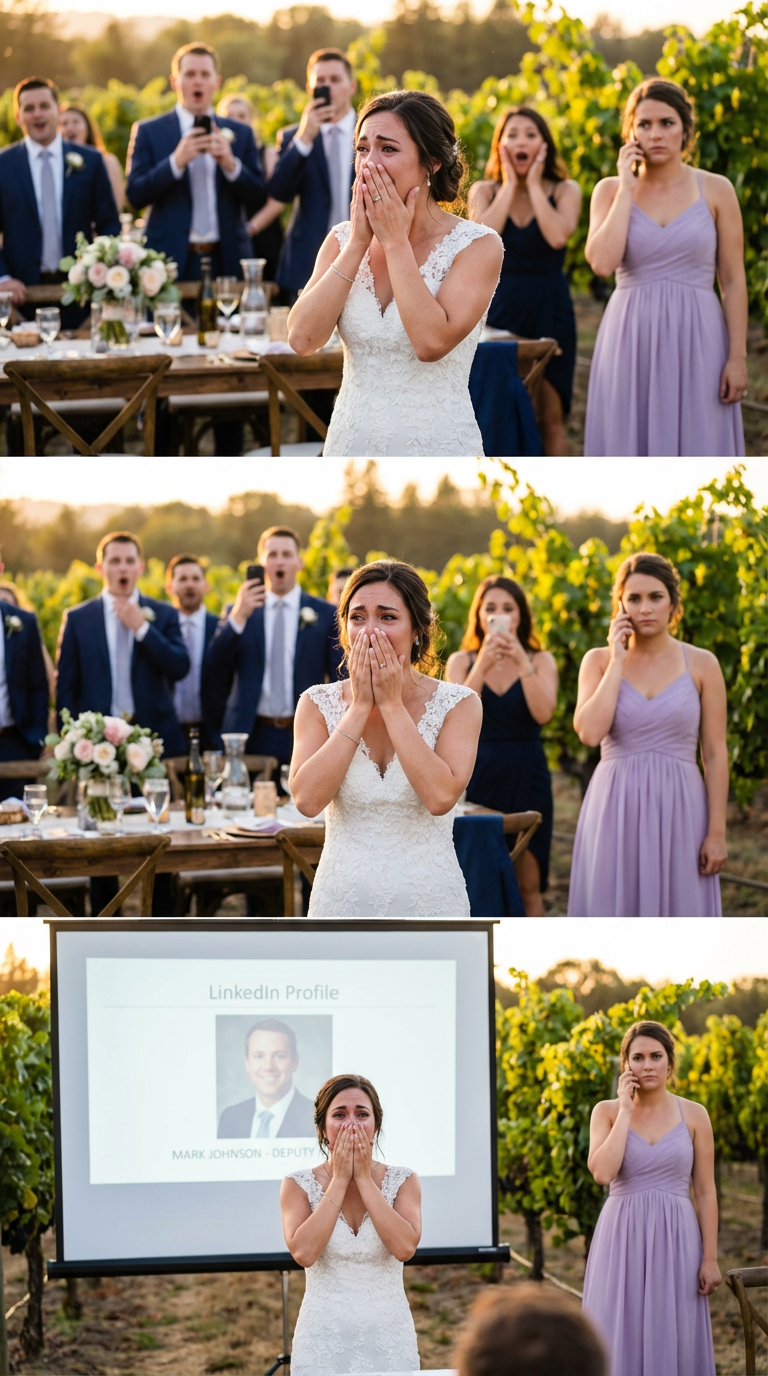
I pulled out my phone and brought up the first screenshot on the reception’s projection screen—the one they’d been using for the slideshow. It was Emma’s fake LinkedIn profile claiming she’d graduated from Cornell with my degree.
“This is my sister’s LinkedIn profile, where she’s pretended to be me for the past ten years,” I said calmly. “She’s stolen my identity, my education credentials, my professional work, and my career opportunities.”
The room went silent. I clicked to the next image—her Instagram with my architecture projects. Then her Medium blog. Then screenshots of her using my thesis research in her fake TED talk. Then the email from Architectural Digest showing her submission using my portfolio.
I narrated each one. Calmly. Factually. No emotion. Just evidence.
Emma was screaming at me to stop. My mother tried to grab my phone. Derek sat frozen, staring at the screen in shock. Guests were pulling out their own phones, some recording, some checking Emma’s social media in real-time.
“For ten years, Emma has stolen my identity while our family told me to be understanding,” I continued. “She’s monetized my work, stolen my opportunities, and damaged my professional reputation. She’s lied to everyone here about who she is and what she’s accomplished. I tried handling this privately. I tried boundaries. I tried forgiveness. But she never stopped.”
I clicked to the final screenshot—a text message from Emma to her friend from two weeks earlier, where she called me a “stupid bitch” and bragged about how she was “so much better at selling the Cornell brand” than I ever was. How she’d “turned my boring work into something people actually care about.”
“So here’s my wedding gift to my sister,” I said. “The truth. Congratulations, Emma. I hope your marriage is built on more honesty than your career.”
I walked out. Didn’t stay for cake. Didn’t wait for the aftermath. I just left.
My phone exploded. Hundreds of messages. My parents disowned me. Emma had a complete breakdown—the wedding ended early with her hysterical and Derek leaving separately. Half the guests left immediately. The other half apparently stayed and got very drunk while discussing the drama.
Derek called off the wedding the next day. Not canceled—they’d already married in the ceremony—but he apparently filed for annulment based on fraud. He’d met Emma through her fake professional identity, and finding out she’d lied about literally everything was too much.
My extended family is split. Some think I’m a vindictive monster who destroyed my sister’s happiness. Others have quietly reached out saying they’d suspected something was off for years but didn’t know how to address it.
Emma has deleted all her fake profiles. The Medium blog is gone. She’s apparently in intensive therapy. My mother sent me a five-page letter about how I’ve “destroyed this family” and ruined Emma’s life. My father wants me to pay for the wedding costs since I “ruined it.”
Professional colleagues have been supportive. The Architectural Digest article is moving forward—they were horrified by Emma’s deception. Several people who’d been following Emma’s fake accounts have reached out to apologize for not realizing.
But I can’t sleep. I keep replaying that moment—Emma’s face when the first screenshot went up, the gasps from the guests, my mother’s betrayed expression. Part of me feels justified. She’d stolen a decade of my life. She’d tried to steal my career-defining opportunity. She never stopped, never showed real remorse, never faced real consequences.
But another part of me wonders if I went too far. Could I have handled this differently? Was public humiliation at her wedding the answer? Did I become the villain in my quest for justice?
My therapist says I finally set a boundary that stuck, that I protected myself after years of abuse. But setting that boundary blew up my entire family. Was it worth it?
I don’t know. I honestly don’t know anymore.
So Reddit, tell me: Am I the asshole for destroying my sister’s wedding after she tried to steal my identity for ten years?
Update: Thank you all for the overwhelming support. I’ve been reading every comment and crying (good tears, mostly). A few clarifications:
- Yes, I consulted a lawyer before the wedding. I have a cease-and-desist ready if Emma tries this again, and I’m considering further legal action for the financial damages to my career.
- Derek reached out. He thanked me. Said he’d had doubts about inconsistencies in Emma’s stories but chalked it up to him misremembering. He feels like an idiot but appreciates the truth.
- My parents are still not speaking to me. I’ve accepted this might be permanent. It hurts, but I’m learning to be okay with it.
- Several of Emma’s fake account followers have become real followers of mine, which is weirdly vindicating.
- I don’t regret it. I wish it hadn’t been necessary, but I don’t regret finally standing up for myself.
Thank you all for helping me process this. Sometimes you need thousands of strangers to tell you that you’re not crazy for protecting yourself.