
Because They Don’t Think I’m Fit to Be a MotherMy name is Rebecca, I’m 29 years old, and six weeks ago my in-laws attempted to take my three-year-old daughter Lily from daycare without my permission. They believed they were “rescuing” her from me because, in their words, I’m not a proper mother. This is the story of how my husband’s family nearly destroyed our lives because they couldn’t accept that I parent differently than they did.
I met my husband James when we were both 25, working at a nonprofit in Seattle. He was kind, funny, and shared my values about making the world a better place. We dated for two years before getting married in a small outdoor ceremony that focused more on meaning than extravagance. Everything about our relationship felt right—we communicated well, supported each other’s goals, and genuinely enjoyed being together.
The first red flag about his family came during wedding planning. James’s mother, Patricia, and his father, Robert, had very specific ideas about how a “proper wedding” should look. When we told them we wanted something small and intimate, Patricia actually cried and said we were embarrassing the family. When we held firm on our plans, she boycotted several planning meetings and made passive-aggressive comments about how “some people have no sense of tradition.”
But we got through it, and I told myself that wedding stress brings out the worst in everyone. Surely once we were married, things would smooth out.
They didn’t.
Patricia had opinions about everything—where we should live, what kind of furniture we should buy, how we should spend our money, when we should have children. James was used to this and had developed decent boundaries over the years, politely deflecting her input while doing what we wanted anyway. I tried to be patient and understanding, reminding myself that she just wanted to be involved in her son’s life.
Then I got pregnant with Lily, and Patricia’s involvement intensified to an unbearable degree.
She had opinions about my prenatal care, my diet, my exercise routine, my birth plan. She was horrified that I wanted a midwife instead of an OB-GYN, that I was planning for minimal medical intervention, that I wanted to breastfeed. She sent me articles about the “dangers” of my choices, called James to express her concerns, and told anyone who would listen that I was being reckless with her grandchild’s safety.
When Lily was born healthy and perfect after an uncomplicated birth, Patricia took credit for “praying me through it” despite her disapproval of my choices.
The real problems started once we brought Lily home.
Patricia and Robert lived about forty minutes away, and Patricia expected to visit multiple times per week. She would show up unannounced, let herself in with the key James had given her “for emergencies,” and immediately start critiquing my parenting. I was holding Lily wrong, feeding her wrong, dressing her wrong, responding to her cries wrong. Everything I did was apparently a disaster waiting to happen.
James tried to set boundaries, but Patricia would cry that we were keeping her from her granddaughter, that she just wanted to help, that all new mothers need guidance. Robert would call James and guilt trip him about “respecting his mother” and “family being important.”
I tried different approaches—being firm, being diplomatic, trying to educate them about current parenting practices. Nothing worked. Patricia was convinced that her way was the only right way, and any deviation was evidence of my inadequacy as a mother.
The specific issues she had with my parenting were numerous and exhausting. We practiced gentle parenting and positive discipline—no spanking, no yelling, lots of patience and explanation appropriate for Lily’s developmental stage. Patricia was horrified. She insisted children needed “firm discipline” and that we were raising a spoiled brat who would “walk all over us.”
We did baby-led weaning when Lily started solids, letting her explore different foods at her own pace. Patricia was convinced Lily would choke or starve and tried to secretly feed her purees against our wishes whenever she babysat.
I breastfed until Lily was two, which Patricia found “disgusting” and “inappropriate.” She made comments in public, covered us with blankets without asking, and told relatives I was “too attached” to Lily.
We didn’t let Lily watch screens before age two, following pediatric recommendations. Patricia said we were depriving her and would sneak her iPad to Lily during visits.
We bed-shared safely for the first eighteen months, which Patricia claimed would “suffocate” Lily or “create dependency issues.” She actually called CPS once with an anonymous tip about our sleeping arrangements, though nothing came of it because we weren’t doing anything wrong or unsafe.
Every single parenting choice we made was met with criticism, boundary violations, and behind-the-scenes attempts to undermine us. But James and I presented a united front. We researched our decisions, consulted with our pediatrician who supported our approach, and trusted ourselves as Lily’s parents.
Lily thrived. She was healthy, happy, hitting all her milestones, securely attached to both of us, and developing beautifully. Our pediatrician regularly commented on what a well-adjusted child she was. But none of that mattered to Patricia, who saw only that we weren’t parenting the way she had.
Things escalated when Lily turned two and we enrolled her in a progressive daycare that aligned with our parenting philosophy. The daycare focused on play-based learning, emotional intelligence, and respecting children’s autonomy. They had amazing reviews, qualified teachers, and we loved their approach.
Patricia was furious. She insisted Lily needed a “traditional” daycare with more structure, discipline, and academics. When we didn’t change our minds, she started making ominous comments about how we’d “regret this” and how Lily “deserved better.”
A few months after Lily started daycare, Patricia asked to be added to the approved pickup list “just in case of emergencies.” James and I discussed it and decided against it—Patricia had already shown she didn’t respect our boundaries, and we didn’t trust her not to use emergency access for non-emergencies. We told her no, explaining that we had backup plans already in place with trusted friends.
She did not take it well. She cried about being excluded from Lily’s life, accused us of being paranoid and controlling, and said we were punishing her for “caring too much.” Robert called to tell James he was being disrespectful and that we’d regret alienating family.
But we held firm. Our instincts told us it was the right call, and after everything that had happened, we trusted those instincts.
Then came the incident that changed everything.
Six weeks ago, I was at work when I got a frantic call from Lily’s daycare director, Michelle. She was calling to verify that Patricia—who had shown up with Robert claiming there was a family emergency—was authorized to take Lily.
My blood ran cold. “Absolutely not. Do not release my daughter to them under any circumstances.”
Michelle assured me she hadn’t—the daycare had strict policies and Patricia wasn’t on the approved list. But Patricia had been insistent, claiming I’d been in a car accident and was in the hospital, and that she needed to get Lily immediately.
I left work immediately and drove to the daycare, my hands shaking on the steering wheel. When I arrived, Patricia and Robert were still there, arguing with Michelle and the assistant director. Patricia was in tears, Robert was red-faced and angry, and they were demanding to see Lily.
The moment Patricia saw me walk through the door—clearly uninjured and definitely not in the hospital—her face went through several emotions. Surprise, then embarrassment, then defiance.
“Rebecca! Thank God you’re okay. We heard there was an accident—”
“There was no accident,” I said coldly. “You lied to try to take my daughter.”
“We were just worried—someone called and said—”
“No one called you. You made that up. You attempted to kidnap my child.”
Robert stepped forward, his face furious. “Now you wait just a minute. We’re Lily’s grandparents. We have rights—”
“You have no rights,” I cut him off. “You’re not on the approved pickup list. You lied about an emergency. You tried to take my daughter without permission. That’s attempted kidnapping.”
Patricia started crying harder. “We were trying to save her! You’re not fit to be her mother! You’re ruining that child with your ridiculous ideas and your refusal to discipline her properly. She needs structure, she needs proper guidance, and you’re failing her!”
The mask had finally slipped completely. This wasn’t about an emergency or worry—this was about Patricia’s conviction that she knew better than me how to raise my own child.
“Get out,” I said quietly. “Get out now, or I’m calling the police.”
“James will side with us,” Robert threatened. “He knows we’re right. He’s just been too weak to stand up to you.”
“James will side with his wife and daughter,” I replied. “And you’re about to find out exactly how much he supports me.”
I pulled out my phone and called James right there. I put it on speaker so everyone could hear. When he answered, I calmly explained what had happened—that his parents had lied about an emergency and tried to take Lily from daycare without permission.
There was a long silence. Then James’s voice came through, cold and hard in a way I’d never heard before.
“Are my parents still there?”
“Yes.”
“Put them on the phone.”
I held out my phone to Patricia. She took it with shaking hands.
Whatever James said to his parents in that conversation, I couldn’t hear his side. But I watched Patricia’s face crumble. She tried to argue, to explain, to justify. Robert grabbed the phone at one point and started yelling, but I could hear James’s raised voice even from several feet away.
The call ended. Patricia handed my phone back to me, mascara running down her face. “He’ll come to his senses,” she said weakly. “He’ll realize we were just trying to help.”
“You need to leave,” Michelle said firmly. “You’ve been told multiple times that you’re not authorized to pick up this child. If you don’t leave immediately, we will call the police.”
They left. I sat in Michelle’s office, shaking with adrenaline and rage, while she explained that everything had been documented—their arrival, their false claim about the emergency, their insistence on taking Lily, and my explicit denial of permission. She also mentioned that they had security camera footage of the entire incident.
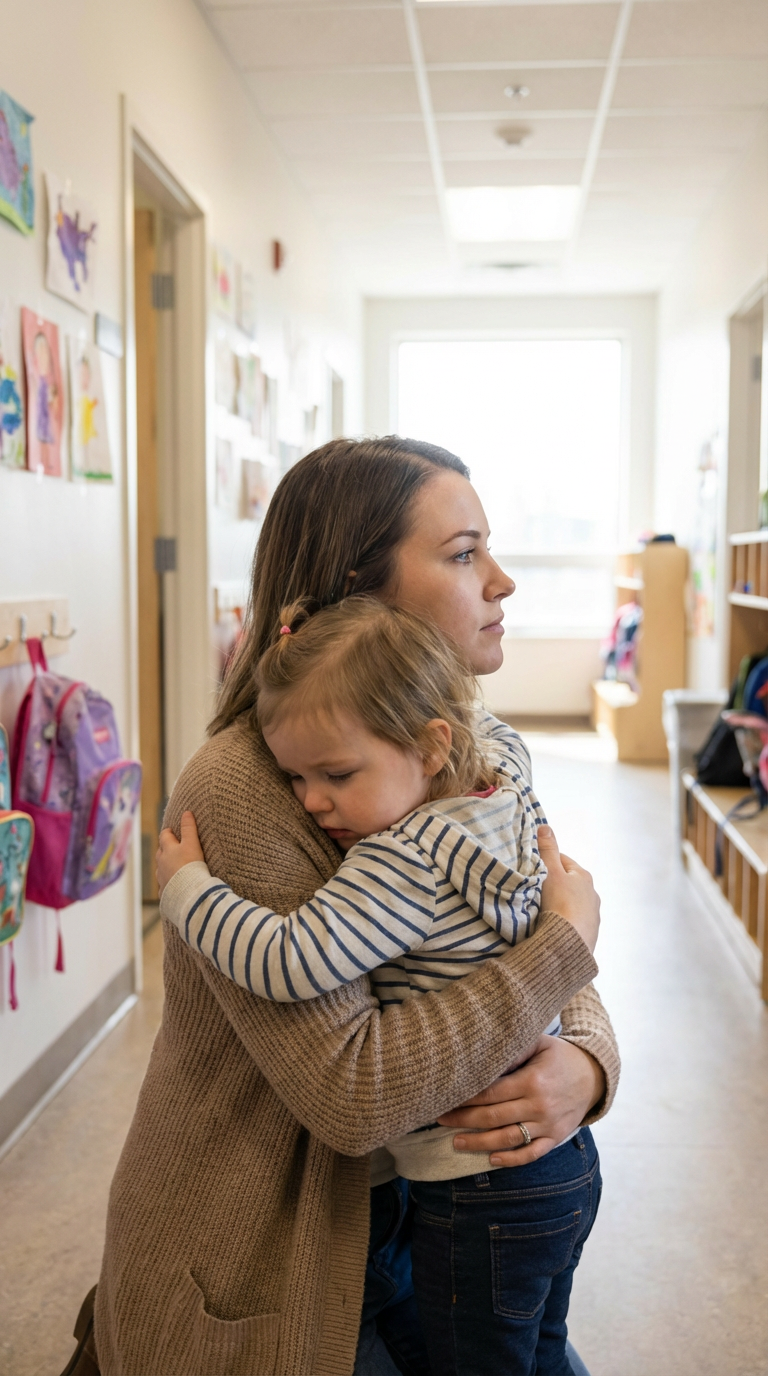
I picked up Lily, who had been kept safely in her classroom away from the drama. She was completely fine, happily playing with blocks, unaware that her grandparents had just tried to take her. I held her tight and drove home, my mind racing through everything that had just happened.
James came home early from work. We sat down after putting Lily down for her nap and talked for hours. He was devastated, angry, and deeply ashamed of his parents’ behavior. But he was also crystal clear about his stance.
“They crossed a line that can’t be uncrossed,” he said. “They tried to take our daughter. They lied, manipulated, and attempted to kidnap her because they think they know better than us how to parent. I can’t forgive that. I won’t forgive that.”
We contacted a family law attorney the next day. She advised us to file a police report documenting the incident, even if we didn’t press charges immediately. We did. The police took our statement, reviewed the daycare security footage, and filed a report for attempted custodial interference.
Our attorney also helped us draft cease and desist letters to both Patricia and Robert, explicitly stating that they were no longer welcome in our home, around our daughter, or in our lives. Any attempts to contact us or Lily would be considered harassment and would result in a restraining order.
We sent the letters via certified mail. Patricia called James sixty-three times in one day. We blocked both their numbers. They showed up at our house twice—once we called the police who warned them about trespassing, and the second time we had them removed immediately.
Patricia’s sister, James’s aunt, reached out to “mediate.” She claimed Patricia was “devastated” and “never meant any harm.” When I explained exactly what had happened, she was silent for a moment, then said, “Patricia told us you were mentally unstable and abusing Lily, and that they were trying to protect her.”
The depth of the lies was staggering. Patricia had apparently been telling extended family for months that I was an unfit mother, that Lily was in danger, that someone needed to intervene. She’d painted herself as the concerned grandmother trying to save her grandchild from her unstable daughter-in-law.
We sent a group message to James’s extended family explaining exactly what had happened, including the police report number and our attorney’s contact information if anyone wanted verification. Several family members apologized and expressed support. Others stopped speaking to us entirely, choosing to believe Patricia’s version of events.
We also informed Lily’s daycare that if Patricia or Robert showed up again for any reason, they should call the police immediately. We provided copies of the cease and desist letters and the police report. Michelle assured us she would, and added extra notes to Lily’s file about the situation.
In the six weeks since the incident, Patricia has violated the cease and desist three times—once by sending letters to our home, once by showing up at James’s workplace, and once by approaching me in a grocery store parking lot. Each time, we’ve documented it. Our attorney is now preparing restraining order paperwork.
The emotional toll has been significant. James is grieving the loss of his parents, even though he knows cutting contact was necessary. He’s in therapy working through complex feelings about family, loyalty, and the reality that his parents valued control over relationship with their son and granddaughter.
I struggle with guilt, wondering if I could have done something differently to prevent this escalation. My therapist reminds me that I didn’t cause this—Patricia’s inability to respect boundaries and her conviction that she knew better than Lily’s actual parents caused this.
Lily, thankfully, is too young to fully understand what happened. She occasionally asks about “Grandma and Grandpa,” and we tell her simply that they made some choices that weren’t safe, and we’re taking a break from seeing them. Our child psychologist advised us on age-appropriate ways to discuss it without traumatizing her or teaching her that love is conditional.
The hardest part is the betrayal. I kept giving Patricia chances, kept trying to be understanding and compassionate, kept believing she would eventually respect our boundaries. James did the same with both his parents. We wanted Lily to have a relationship with her grandparents.
But Patricia and Robert made it clear that they valued being right over being in relationship with us. They valued control over connection. And ultimately, they were willing to traumatize their grandchild and commit a crime rather than accept that we had the right to parent our own child our own way.
People have asked if we’ll ever reconcile. Right now, the answer is no. The trust is completely destroyed. They attempted to kidnap our child. Even if they apologized—which they haven’t—I don’t know if I could ever feel safe having them around Lily again.
Some of James’s relatives think we’re overreacting, that “family is family” and we should forgive and move on. But attempting to take someone’s child isn’t a minor disagreement or a momentary lapse in judgment. It’s a fundamental violation of the parent-child relationship and a crime.
I think about what would have happened if Lily had been at a less vigilant daycare. If Michelle hadn’t called to verify. If Patricia had been on the pickup list like she’d wanted. My daughter could have been taken by her grandparents, who genuinely believe they have better judgment than her parents about how she should be raised.
The scariest part is that Patricia truly believes she was doing the right thing. In her mind, she was “rescuing” Lily from parents who were harming her with gentle parenting, extended breastfeeding, and progressive education. She sees herself as the victim in this situation—the loving grandmother being kept from her grandchild by an unstable daughter-in-law.
This is what happens when people are so convinced of their own righteousness that they can’t see the harm they’re causing. Patricia couldn’t hear us when we set boundaries. She couldn’t respect our choices even when our pediatrician confirmed Lily was thriving. She couldn’t accept that different doesn’t mean wrong. And ultimately, she couldn’t control her need for control, even when it meant losing her son and granddaughter entirely.
To anyone dealing with toxic in-laws: trust your instincts. If someone consistently disrespects your boundaries, undermines your parenting, and prioritizes their preferences over your authority as a parent, that’s not love—that’s control. And people who need to control you will eventually escalate.
We’re rebuilding our lives with clear boundaries and careful attention to who we allow around our daughter. Lily is thriving with parents who respect her, advocate for her, and protect her—even when that protection needs to be from her own grandparents.
Patricia and Robert chose their need to be right over their relationship with their son and granddaughter. They made their choice. We’re making ours—and our choice is to prioritize Lily’s safety and wellbeing over maintaining relationships with people who would try to kidnap her.
I never imagined I’d have to protect my child from her grandparents. But that’s exactly what I’m doing, and I have zero regrets.