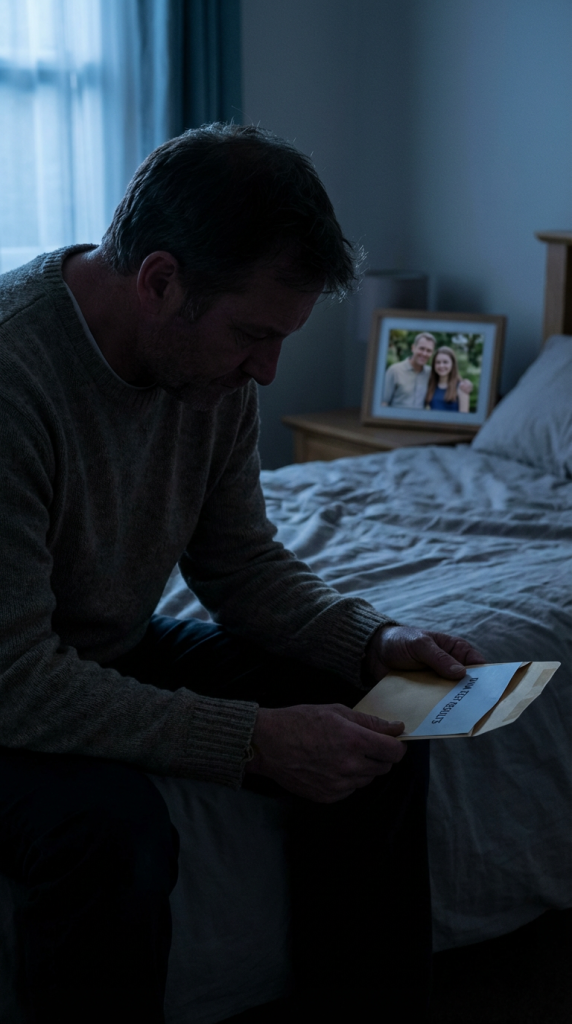
My name is David, I’m 42 years old, and three months ago my entire life revealed itself to be a lie. The daughter I’ve loved and raised for fifteen years isn’t biologically mine, and my wife knew from the moment she was conceived. This is the story of how a simple DNA test for a school project destroyed everything I thought I knew about my family.
I met Jennifer when we were both 24, working at the same marketing firm. She was beautiful, ambitious, and we connected instantly. We dated for two years before I proposed, and we got married in a small ceremony surrounded by friends and family. Everything felt perfect—we were building a life together, planning our future, talking about the family we’d create.
A year into our marriage, Jennifer got pregnant. I was overjoyed. I’d always wanted to be a father, and the idea of starting our family felt like the natural next step. I went to every doctor’s appointment, painted the nursery, read parenting books, and counted down the days until I could meet our daughter.
Emma was born on a rainy Tuesday in April, and the moment they placed her in my arms, I fell completely in love. She had dark hair and dark eyes, and while she didn’t look much like me, the nurses assured us that newborns change so much in their first years. I didn’t care about genetics anyway—she was my daughter, and that’s all that mattered.
I was a devoted father from day one. I did the 2 AM feedings, changed countless diapers, walked the floors with her when she was colicky. As Emma grew, I was there for every milestone—first words, first steps, first day of school. I coached her soccer team, helped with homework, attended every recital and school play. Being Emma’s dad became the core of my identity.
Jennifer and I had a solid marriage, or so I thought. We had the normal ups and downs—disagreements about finances, stress from work, the usual challenges of balancing careers and parenting. But we always worked through it. We were partners, a team, building a life for our daughter.
Emma grew into an incredible kid. She was smart, funny, compassionate, and talented. She excelled at school, played three instruments, and had a tight-knit group of friends. Everyone who met her commented on what a wonderful daughter we’d raised. I was so proud of her, so grateful to be her father.
As she got older, people would occasionally comment that she didn’t look much like me. Emma had olive skin, dark brown eyes, and thick dark hair, while I’m pale with light brown hair and blue eyes. Jennifer has lighter features too—blonde hair and green eyes. We’d joke about recessive genes, about how Emma must have gotten her looks from my Italian grandmother or Jennifer’s Greek great-grandfather. It never seemed like a big deal.
Then came Emma’s sophomore year biology class and their unit on genetics.
The teacher assigned a project about hereditary traits. Students were supposed to research their family history, create Punnett squares based on their parents’ traits, and analyze the probability of inheriting certain characteristics. It was a standard high school biology assignment that thousands of students do every year.
Emma was excited about the project. She asked Jennifer and me dozens of questions about our families—eye color, hair texture, height, blood type. She made elaborate charts and calculations, approaching it with the same enthusiasm she brought to all her schoolwork.
Then she came to me with a confused look on her face.
“Dad, what’s your blood type?” she asked.
“O positive,” I told her. “Why?”
“And Mom is A negative, right?”
“Yeah, that sounds right.”
Emma stared at her paper, her brow furrowed. “That doesn’t make sense. I’m AB positive. My biology teacher said that’s impossible if you’re O positive.”
I laughed it off. “Maybe the hospital got it wrong when you were born. Those records get mixed up sometimes.”
But Emma was a persistent kid, especially when something didn’t add up. She researched blood type inheritance extensively and became convinced something was wrong. She asked Jennifer about it, and my wife became immediately defensive, telling Emma not to worry about it and that genetics were more complicated than high school biology made them seem.
That response made Emma more suspicious, not less. A week later, she came to me privately.
“Dad, I want to do a DNA test. Just to settle this genetics thing for my project.”
I didn’t see any harm in it. I thought it would put her mind at ease and maybe correct whatever error had occurred with her blood type records. I was completely secure in my role as her father—biology was just science, and I’d been her dad in every way that mattered since the day she was born.
We ordered one of those ancestry DNA kits online. Emma swabbed her cheek, I swabbed mine, and we sent them off together. We were supposed to get results in 6-8 weeks.
Jennifer found out we’d done the test when the kit arrived. I’d never seen her react so strongly to anything. She went pale, started shaking, and demanded to know why we’d done it without telling her. I was baffled by her response—it was just a genetics test for a school project. Why was she so upset?
“You had no right to do that without discussing it with me first,” she said, her voice tight with anger.
“It’s just a DNA test, Jen. Emma wanted to verify some genetics information for school. What’s the big deal?”
She couldn’t give me a straight answer. She just kept saying I should have talked to her first, that I’d overstepped, that it was a violation of her privacy somehow. Her reaction was so out of proportion to what we’d done that I started to feel uneasy.
The next few weeks were tense. Jennifer was on edge, snapping at me and Emma over small things. She kept asking when the results would come, and I could see anxiety written all over her face. I tried to talk to her about what was bothering her, but she shut down every conversation.
Then the results came.
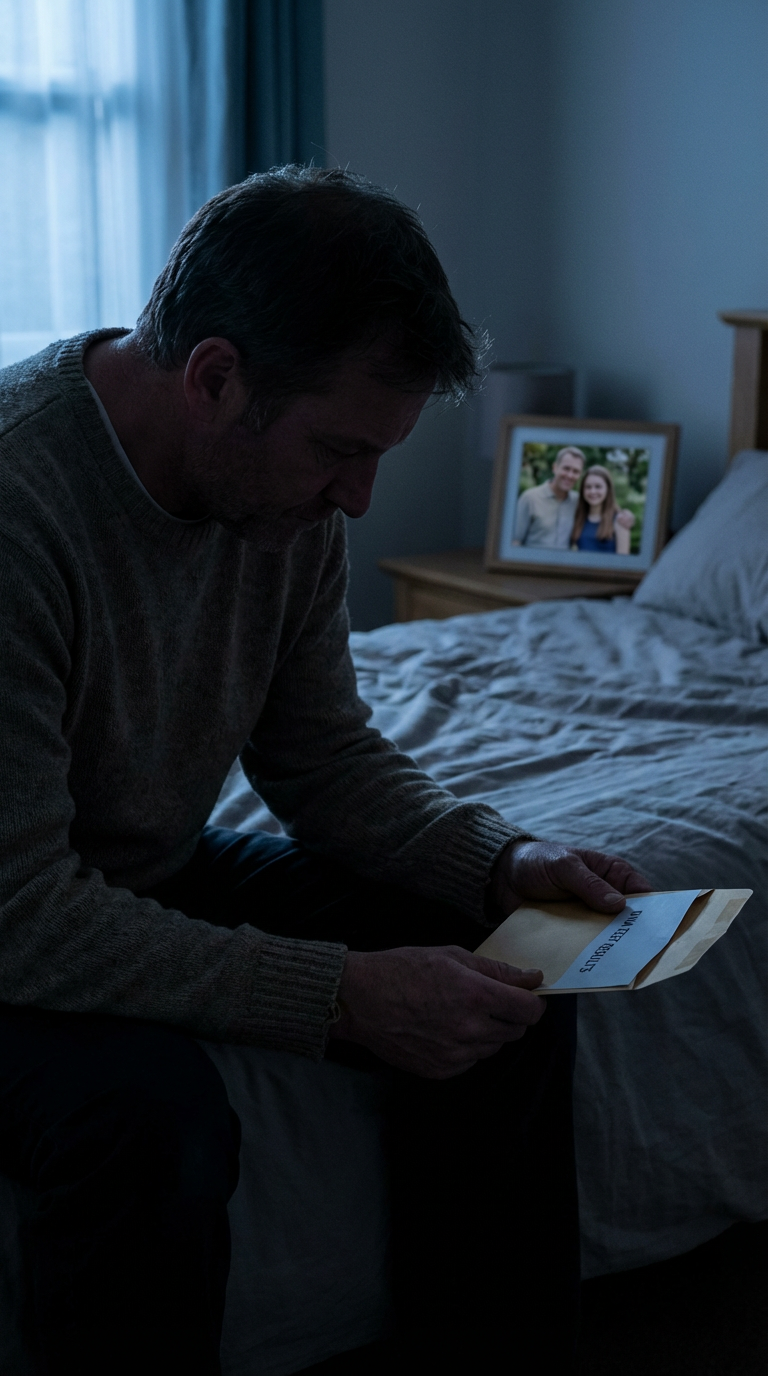
I opened them alone in my home office on a Saturday morning. Jennifer had taken Emma shopping, and I figured I’d review the results before we all looked at them together. I logged into the website, clicked on the relationship analysis, and my world stopped.
Probability of paternity: 0%
I stared at those words for what felt like hours. Zero percent. Not low probability. Not unlikely. Zero. There was no possibility that I was Emma’s biological father.
I felt like I’d been hit by a truck. My hands shook so badly I could barely hold my phone. My vision blurred. I couldn’t breathe. Everything I’d believed about my life, my family, my identity as Emma’s father—all of it was suddenly in question.
I must have sat there in shock for two hours before Jennifer and Emma came home. I heard them come through the door, heard Emma laugh at something, heard Jennifer call out asking if I wanted lunch. I couldn’t respond. I couldn’t move.
Jennifer eventually came to check on me. When she saw my face and the DNA results pulled up on my computer screen, she knew immediately what had happened. All the color drained from her face.
“David, I can explain—”
“Explain what?” My voice came out hollow, unfamiliar. “Explain how I’ve been raising another man’s child for fifteen years? Explain how you’ve been lying to me since before Emma was born?”
Emma heard us from downstairs. “Dad? Is everything okay?”
Jennifer’s eyes filled with tears. “Please, David. Not now. Not with Emma here. Let me explain everything, but please, not in front of her.”
I realized Emma couldn’t know about this yet—not like this, not without us figuring out what to say and how to handle it. I managed to pull myself together enough to go downstairs and pretend everything was fine, though I’m sure I did a terrible job of it.
That night, after Emma went to bed, Jennifer and I sat down in our living room and she told me the truth.
She’d had an affair in the months before Emma was conceived. It was with a colleague from work named Marcus—someone I’d met at company events, someone I’d shaken hands with and made small talk with, never knowing he’d slept with my wife.
The affair lasted three months. Jennifer said it was a mistake, that she’d been confused and unhappy about some things in our marriage, that it meant nothing. When she got pregnant, she knew there was a chance the baby wasn’t mine. She did the math on dates and realized it could go either way.
“Why didn’t you tell me?” I asked, my voice breaking. “Why did you let me believe she was mine?”
“Because I wanted her to be yours,” Jennifer sobbed. “Because I loved you and I wanted our family. Because I was terrified of losing you.”
“So you lied to me for fifteen years? You let me raise another man’s child? You watched me fall in love with her, dedicate my life to her, build my entire identity around being her father, and you knew the whole time that she might not be mine?”
“I didn’t know for sure—”
“Yes, you did!” I was shouting now, years of devotion curdling into rage. “You knew there was a real possibility, and you chose to hide it from me. You stole my right to make an informed choice about my own life!”
Jennifer admitted she’d suspected Emma wasn’t mine as she got older. The lack of physical resemblance, certain traits that didn’t match either of our families—she’d had doubts. But she’d convinced herself it didn’t matter because I was Emma’s father in every way that counted, and she’d justified the lie by telling herself she was protecting our family.
“Does Marcus know?” I asked.
She shook her head. “The affair ended before I knew I was pregnant. He moved to another city for a different job. I never told him.”
“So there’s a man out there who has a biological daughter he doesn’t know exists, while I’ve been raising her thinking she was mine. Does anyone else know?”
Jennifer admitted that her sister knew—she’d confided in her during the pregnancy. The betrayal expanded. Her sister had watched me be a father to Emma for fifteen years, had accepted my love and gifts and time at family gatherings, all while knowing I might be raising another man’s child.
I couldn’t stay in that house. I packed a bag and went to a hotel, telling Jennifer I needed time to process everything. She begged me not to leave, not to tell Emma, to give us a chance to work through this. I couldn’t even look at her.
The next few days were a blur. I couldn’t eat, couldn’t sleep, couldn’t focus on anything. I kept thinking about every moment of Emma’s life—her birth, her first Christmas, teaching her to ride a bike, helping her with math homework, cheering at her soccer games. All of it felt tainted now, like I’d been living in a play without knowing I was an actor.
But the worst part was thinking about Emma. She was still my daughter in every way that mattered. I’d raised her, loved her, been there for every moment of her life. Biology didn’t change the fact that I was her dad. But it changed everything about my relationship with Jennifer.
My wife had stolen fifteen years of truth from me. She’d watched me bond with Emma, watched me sacrifice and work and love with everything I had, all while hiding this massive secret. Every time someone commented that Emma didn’t look like me, Jennifer had lied. Every time I’d marveled at being Emma’s father, Jennifer had known there was a chance I wasn’t.
I consulted with a lawyer. In our state, because I’d been married to Jennifer when Emma was born and my name was on the birth certificate, I was legally Emma’s father regardless of biology. I had all the rights and responsibilities of paternity. That was some comfort—I couldn’t lose Emma legally. But it didn’t resolve the betrayal.
After a week, I came home. Not because I’d forgiven Jennifer, but because I couldn’t abandon Emma. She knew something was wrong—her parents were barely speaking, I’d moved to the guest room, the tension in the house was suffocating. She deserved to know the truth, but I didn’t know how to tell her.
Jennifer and I went to couples therapy. Our therapist said we needed to tell Emma the truth, that keeping it from her at this point would only make things worse. We needed to do it together, present a united front, and make it clear that this didn’t change how much I loved her.
Last month, we sat Emma down and told her everything.
I watched my daughter’s face as she processed the information. Confusion, disbelief, hurt, anger—every emotion played across her features. She looked at Jennifer with betrayal in her eyes, then turned to me.
“Does this mean you’re not my dad anymore?”
My heart shattered. “Emma, I will always be your dad. I’ve been your dad since the moment you were born. I’ve loved you every single day of your life, and that will never change. Biology doesn’t change who we are to each other.”
“But you’re not really my dad,” she said, tears streaming down her face. “All this time, I thought—and it was a lie. Everything was a lie.”
Jennifer tried to comfort her, but Emma pulled away. “How could you do this? How could you lie to both of us for my entire life?”
Emma locked herself in her room for hours. When she finally came out, she was cold and distant to Jennifer but sought me out specifically.
“Dad? Can we still do our Sunday morning pancakes?”
It was a tradition we’d had since she was five—every Sunday, just the two of us making elaborate pancakes and talking about whatever was on her mind.
“Of course,” I said, pulling her into a hug. “Nothing changes between us, Emma. I’m still your dad. I’ll always be your dad.”
The past few months have been the hardest of my life. Emma and I are okay—our relationship survived because it was never based on biology but on fifteen years of love and commitment. She’s in therapy, processing everything, but she’s made it clear that I’m her father and that doesn’t change.
My marriage, however, is probably over. I can’t look at Jennifer without seeing fifteen years of lies. Every moment of our marriage is now suspect—if she could lie about something this massive, what else has she lied about? The trust that’s supposed to be the foundation of a partnership is completely destroyed.
Jennifer keeps saying she did it to protect our family, that she was young and scared and made a mistake. She wants me to forgive her, to go to counseling, to try to rebuild. But I don’t know if I can. The betrayal is too deep, too fundamental.
I’ve also thought about Marcus—Emma’s biological father. Does he have a right to know he has a daughter? Does Emma have a right to know him if she wants to? These are questions I never imagined I’d have to consider. For now, we’re leaving that alone, but I know eventually we’ll have to address it.
The worst part is the what-ifs. What if Jennifer had told me the truth when she first got pregnant? Maybe I would have left, or maybe I would have stayed and raised Emma knowing the full story. But I would have had a choice. She stole that from me.
What if I’d insisted on a paternity test when Emma was born? Some of my friends had done that, and I’d thought it was paranoid and showed a lack of trust. Now I wonder if I was naive.
What if we’d never done that DNA test? I would have lived the rest of my life never knowing the truth. Part of me wishes that’s what had happened—that ignorance had remained bliss. But another part of me is grateful to finally know the truth, even though it’s destroyed everything.
People have asked me if I regret the fifteen years I spent raising Emma. I don’t. She’s my daughter, and being her father has been the greatest joy of my life. What I regret is being lied to. I regret that Jennifer valued her own fear and comfort over my right to know the truth about my own life. I regret that Emma has to deal with this trauma because her mother was too cowardly to be honest.
I’m still living in the house, but Jennifer and I are essentially separated. We’re co-parenting Emma but not functioning as a couple. I don’t know what the future holds—divorce seems inevitable, but I’m trying to move slowly for Emma’s sake. She’s already dealing with so much upheaval.
Emma asked me recently if I wish she wasn’t my daughter. I told her the absolute truth: being her father is the best thing that’s ever happened to me, and nothing—not biology, not lies, not betrayal—will ever change that. She’s my daughter in every way that truly matters.
But I also told her that honesty matters. That trust is the foundation of all relationships. That her mother’s decision to lie for fifteen years was wrong, and that actions have consequences. I want Emma to learn from this situation, to understand that love without honesty isn’t really love at all.
I don’t know what happens next. I’m taking it one day at a time, focusing on my relationship with Emma and trying to process the betrayal. Some days I’m angry, some days I’m just sad, and some days I’m numb. Therapy helps. Emma helps. But the pain of knowing my entire adult life was built on a lie doesn’t go away easily.
To anyone in a similar situation: your feelings are valid. The betrayal of parental fraud is real and devastating. But also know that if you’ve raised a child with love and dedication, you are their parent in every way that truly matters. Biology is just science—parenthood is about showing up, caring, sacrificing, and loving unconditionally.
I showed up for Emma every single day for fifteen years. I’m still showing up now. That makes me her father, no matter what any DNA test says. Jennifer’s lies can’t take that away from me, and they can’t take me away from Emma.
But those lies did take away my marriage, my trust, and my peace of mind. And for that, I don’t know if I can ever forgive her.