If you ask my parents, I’m the ungrateful, dramatic child who “turned their back on family” the second life didn’t go their way.
If you ask me, I spent three decades giving them chances they never earned—and finally drew a line when their behavior became a threat to my child, not just to me.
This is the story of how I told my parents they will never meet their grandchild, and why half my family thinks I’m a monster and the other half quietly tells me, “I wish I’d done what you did.”
Growing Up in Their House
I’m 30, pregnant with my first child, and currently no-contact with both of my parents.
On paper, my childhood looked “fine”:
- Two parents, still married.
- A small house in a safe neighborhood.
- Food on the table.
- Clothes, birthdays, holidays.
That’s the version my parents tell people.
They leave out the parts where:
My mom is a chronic martyr.
She’ll cook, clean, and “do everything for the family,” then explode if anyone doesn’t perform gratitude exactly the way she expects.
My dad is the silent enforcer.
He rarely yells, but when he does, it’s terrifying.
Most of the time, he just backs my mom up and makes her behavior “the rule.”
Growing up, the messages were clear:
- “We gave you everything, so you owe us everything.”
- “We sacrificed for you, so you don’t get to be upset.”
- “Respect” meant obeying without question, even into adulthood.
When I was a teenager, if I disagreed with them, they’d say things like:
- “As long as you live under our roof, you’ll do what we say.”
- “You’re lucky we’re not like other parents.”
- “We could have been worse.”
The baseline was never “healthy.”
It was “not as bad as it could be,” and we were supposed to be grateful for that.
The First Big Boundary
I moved out at 19 to attend college in another city.
It was the first time I could breathe without feeling monitored.
I still called, visited on holidays, and tried to maintain some kind of relationship.
But slowly, I started noticing things that had always been there, now from a distance:
- My mom guilt-tripping me every time I couldn’t visit exactly when she wanted.
- My dad calling to ask if my boyfriend was “appropriate husband material” like I was a project he was managing.
- The way they turned every conversation into a review of my choices.
At 25, I set my first real adult boundary:
“I will not discuss my weight, my appearance, or my reproductive plans with you,” I told them.
They had a habit of:
- Commenting on my body.
- Asking when I’d “finally give them grandkids.”
- Making snide remarks if I turned down certain foods.
My mom’s response:
“That’s not how family works. We’re allowed to have opinions. Don’t be so sensitive.”
My dad:
“You’re overreacting. Your mother is just concerned. If you didn’t have anything to hide, this wouldn’t bother you so much.”
Translation:
“We will continue doing exactly what we’ve always done.”
Meeting My Husband
I met my now-husband, Chris, when I was 26.
He’s calm, patient, and healthy in ways I didn’t know how to recognize at first.
He:
- Apologizes when he’s wrong.
- Talks things through instead of stonewalling.
- Believes “no” is a complete sentence.
The first time he heard my mom berate me on speakerphone because I didn’t come visit one specific weekend (I had a work deadline), he just looked at me and said, “You know that’s not normal, right?”
I shrugged and said, “That’s just how they are.”
He said, “Yeah. But that doesn’t mean it’s okay.”
He met them at a family dinner.
Within an hour, my mom was asking when we planned to get married and my dad was asking Chris how much money he made and whether he intended to “take proper care” of me.
Later, my mom whispered to me in the kitchen, “He seems nice… just make sure he can give you the life you deserve. Don’t settle. We didn’t raise you for that.”
What she meant was:
“Make sure he fits the image we want to show other people.”
The Engagement and the Escalation
When Chris proposed, we were excited and a little overwhelmed.
My parents turned it into a performance.
They:
- Tried to dictate the guest list.
- Insisted on inviting extended family members I barely knew.
- Criticized our plan for a small, intimate ceremony instead of a big event.
My mom said, “We have a lot of people to impress. Don’t you understand how this looks?”
Any time I pushed back—
on the dress, the venue, the size—
she’d cry and say, “After everything we’ve done for you, you can’t give us this?”
Chris started gently stepping in.
“We appreciate your input, but this is our wedding,” he’d say.
My dad did not like that.
One night, he pulled Chris aside and said, “In this family, we respect the elders. You don’t get to come in and change how things are done.”
Chris calmly replied, “With respect, sir, your daughter is starting her own family now. That means some things will change.”
I knew then that they wouldn’t just “adjust” when we got married.
They’d fight every inch of autonomy we tried to build.
We still went through with the wedding, but after one particularly bad blow-up (my mom screaming because we didn’t do a traditional church ceremony), I told them:
“If this continues, we will start seeing you less.”
They brushed it off.
They genuinely did not believe I’d ever follow through.
The Pregnancy Announcement
I found out I was pregnant eight months after our wedding.
It wasn’t an accident, but it also wasn’t a perfectly timed plan.
We were happy. Nervous, but happy.
We waited until I was out of the first trimester to tell our families.
We told Chris’s parents first.
They cried, hugged us, and said, “Whatever you need, we’re here.”
Then we told mine.
I should have known it would go sideways.
We invited them over for dinner.
I made their favorite dishes.
We printed a ultrasound photo and put it in a little “Best Grandparents” frame.
When my mom opened it, she gasped, covered her mouth, and started crying.
For a brief second, it felt normal.
Then she said, “Finally. I was starting to think you were barren.”
I froze.
My dad laughed like it was a joke.
“You took long enough,” he added. “We were wondering when you were going to stop being selfish.”
I forced a smile because I wasn’t ready to start a fight yet.
Chris squeezed my hand under the table.
My mom launched straight into plans:
- “I’ll be in the delivery room, of course.”
- “You’ll stay here for the first month; I know better than you how to take care of a baby.”
- “We’ll help you so you don’t ruin your body by breastfeeding too long.”
I said, slowly and clearly, “We have not made decisions about any of that yet. We will let you know what we’re comfortable with.”
Her face changed like I’d slapped her.
“What do you mean?” she said. “I’m the grandmother. Of course I’ll be there.”
Chris backed me up.
“We’re going to see how things go and decide what works for us. We might want the first few days to ourselves.”
My mom looked at me, eyes flashing.
“So he’s already turning you against your own mother,” she said.
My dad nodded. “You used to be so respectful,” he added.
The Gender Reveal That Turned Ugly
We didn’t want a big “gender reveal party,” so instead we invited immediate family over for a simple dinner and cut into a cake.
The cake was pink.
We were having a girl.
Chris’s family cheered.
His mom hugged me and whispered, “She’s going to be so loved.”
My mom’s first comment:
“Well, girls are harder. You’ll have to be stricter. You don’t want her turning out ungrateful like you.”
I laughed awkwardly and tried to move on.
But she kept going.
She started listing rules she expected us to follow:
- “She’ll stay with us every summer for at least a month.”
- “We’ll handle her religious education; you weren’t serious enough about it.”
- “Don’t raise her to be too independent. Women need family.”
I said, “We’ll decide what our daughter’s upbringing looks like. You can be involved as grandparents, not as third parents.”
My mom slammed her fork down.
“You are not going to keep my grandchild from me,” she said. “Don’t even think about it.”
My dad, quietly but firmly:
“You owe us this. After everything we did for you.”
That “owe” word hit something deep.
Because that’s what it had always been about.
Love as a debt, constantly collected.
Chris changed the subject to avoid a blow-up in front of everyone, but I didn’t forget.
The Baby Shower Incident
My best friend, not my mom, planned my baby shower.
My mom was offended from the start.
“I’m the grandmother,” she said. “Why didn’t you let me plan it?”
Because I didn’t want a 60-person event for her friends I’d never met, that’s why.
She showed up late, made pointed comments about the decorations, and then decided to give a speech.
In it, she:
- Repeated the “I thought she was barren” line as a “joke.”
- Talked about how she “suffered so much” raising us, but it was “worth it” because now she’d get a granddaughter.
- Mentioned several times how she “couldn’t wait to take the baby for weeks at a time so Mommy could rest.”
I pulled her aside afterward and said, “You need to stop assuming you’re going to have that level of control.”
She rolled her eyes.
“You say that now, but you’ll see. You’ll need me. Don’t forget who raised you,” she said.
Later that night, she texted me:
“You were very cold to me today. Remember, I won’t be here forever. Don’t make me regret everything I did for you.”
Fear and guilt—her favorite tools.
The Final Straw
The final straw came at 32 weeks.
I was exhausted, sore, and barely sleeping.
My doctor had flagged some blood pressure concerns and told me to avoid stress.
My parents wanted to “stop by” to see the nursery.
I told them, “Today’s not good. I’m really tired. Let’s do next weekend instead.”
My mom insisted, “We’ll only stay a few minutes.”
I held firm: “No. I need rest.”
An hour later, they showed up anyway.
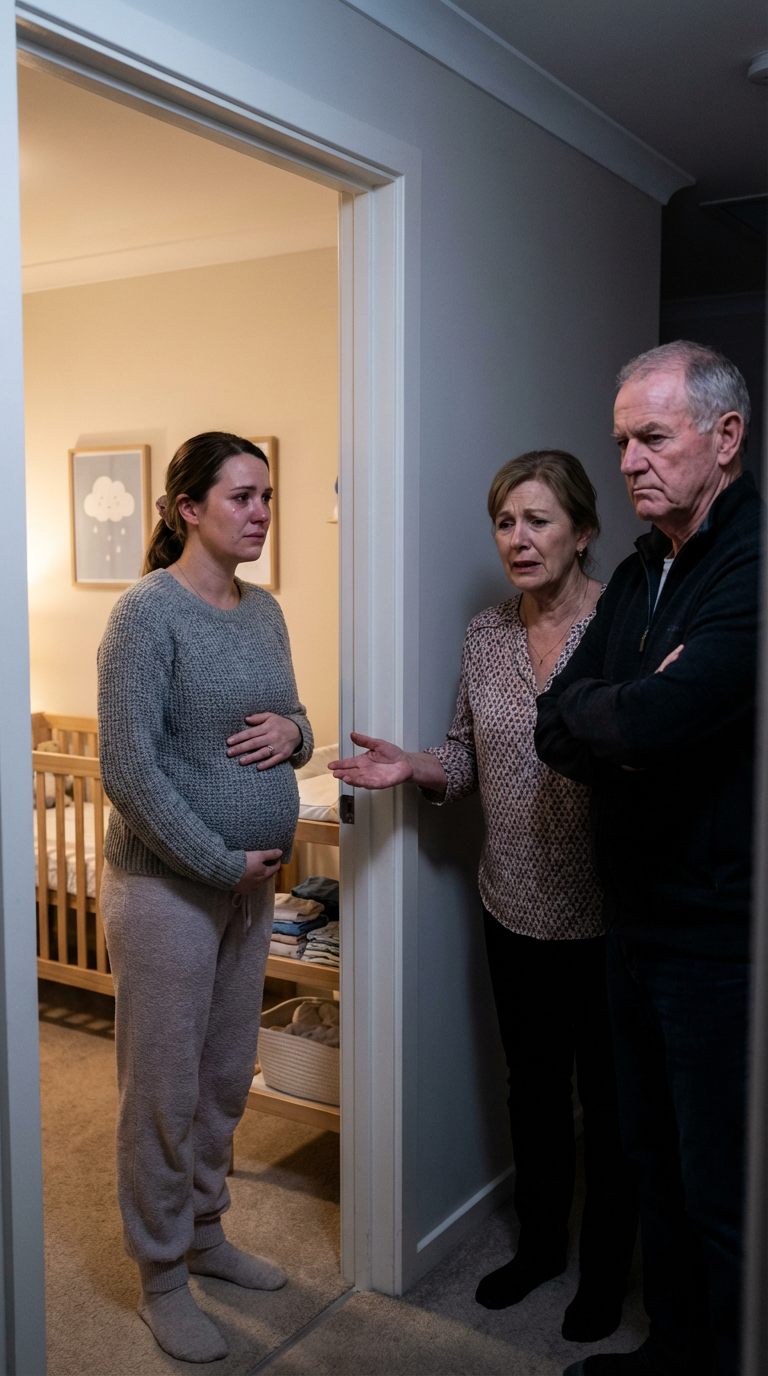
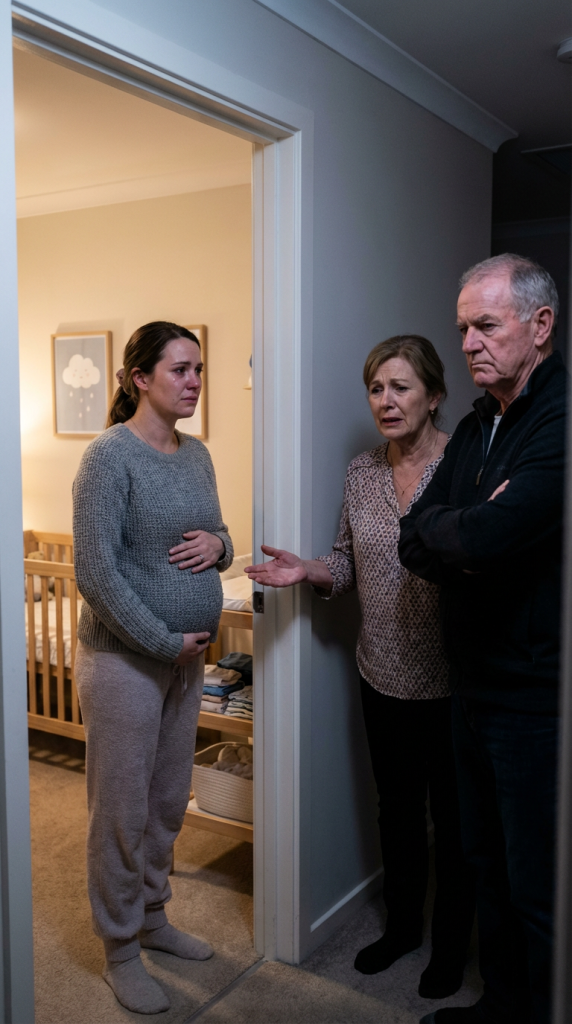
They used the spare key they still had from when we first moved in (we hadn’t changed the locks yet).
I walked out of the bedroom to find them in the hallway, my mom already opening the nursery door.
“What are you doing?” I asked, heart pounding.
“We weren’t going to bother you,” my mom said. “We just wanted to look. We’re family. Stop being so dramatic.”
Chris came out behind me, furious.
“You were told no,” he said. “You cannot just let yourselves in.”
My dad shrugged. “This is our grandchild’s house,” he said. “We’re not strangers.”
Something snapped inside me.
“This is MY house,” I said. “MY child. MY body. You do not get to violate my boundaries and then act like I’m the one in the wrong.”
My mom started crying immediately.
“There it is,” she said. “You’re choosing him over us. He’s turned you against your own parents.”
Chris looked at me and said quietly, “I’ll support whatever you decide. But this can’t keep happening.”
My heart was racing.
My baby kicked, and all I could think was, “Is this the environment I want her to grow up in?”
Parents who:
- Ignore consent.
- Weaponize guilt.
- Violate privacy.
Around a child, that doesn’t just become “annoying.”
It becomes dangerous.
Drawing the Line
I took a deep breath and said the words I’d been afraid to say for years.
“If you can’t respect our boundaries now, you will not be part of our daughter’s life,” I said. “I will not let you treat her the way you treated me.”
My mom gasped.
“You’re threatening to keep our grandchild from us?”
“Yes,” I said. “If that’s what it takes to keep her safe and to keep my own mental health intact, yes.”
My dad shook his head. “You’re cruel,” he said. “You’re going to regret this. Kids need grandparents.”
“Kids need safe adults,” I replied. “Title alone isn’t enough.”
My mom’s voice turned cold.
“If you do this,” she said, “don’t bother coming to us when you’re overwhelmed. Don’t expect help. Don’t expect support.”
“I’ve never truly had your support,” I said. “Not without a price tag.”
I asked them to leave.
Chris took the spare key from their hands before they walked out.
My mom texted later:
“I can’t believe you chose him over us. You’ll see what it’s like when your own child turns on you. Don’t come crying to me then.”
I blocked her number.
Then my dad’s.
Then muted the family group chat.
We changed the locks the next day.
Telling Them They’ll Never Meet Her
For a few weeks, there was silence.
Then the flying monkeys arrived.
Aunts, cousins, even my brother (who lives out of state and “doesn’t want to get involved”) started messaging:
- “They’re devastated.”
- “You’re really going to keep their first grandchild from them?”
- “You’re overreacting. They’re not perfect, but they love you.”
Love without respect isn’t love I want around my child.
Finally, my parents emailed.
A long, dramatic letter about how:
- They “only ever tried to do what’s best for me.”
- They “deserve” to be grandparents.
- They “have a right” to see their grandchild.
The word “sorry” never appeared once.
No acknowledgment of:
So I sent a response.
Shorter. Clearer.
“I am not comfortable having you in my life right now, and that includes my child’s life. Until you can acknowledge the ways you’ve hurt me, respect our boundaries without arguing, and take responsibility for your behavior, you will not meet your granddaughter.”
My mom’s reply:
“Then I guess we’ll never meet her.”
So that’s where we are.
Am I the A**hole?
Here’s what makes me question myself:
- Society loves the idea of grandparents.
- People assume “family is everything” no matter how they behave.
- I’m being told I’m “punishing” my parents by using my child as leverage.
Here’s what I know is true:
- My parents consistently ignore my boundaries.
- They frame any pushback as disrespect.
- They’ve already shown they don’t see my “no” as valid, even when my pregnancy and health are at stake.
Do I believe they’d:
- Show up uninvited to my house when I’m sleep deprived?
- Push unsafe or outdated practices because “we did it and you survived”?
- Bad-mouth me to my child if I ever challenged them?
Yes.
I do. Because they already do those things to me as an adult.
So I chose the smallest, simplest boundary that keeps my child safe:
“If you can’t treat me with respect, you don’t get access to my kid.”
Some people will always see that as cruel.
But I’m not cutting them off because they forgot a birthday or have annoying habits.
I’m protecting my child from the exact patterns that damaged me—and refusing to let “but they’re your parents” override that.
If that makes me the a**hole, I can live with it.
Because my daughter deserves better than “bare minimum love with strings attached.