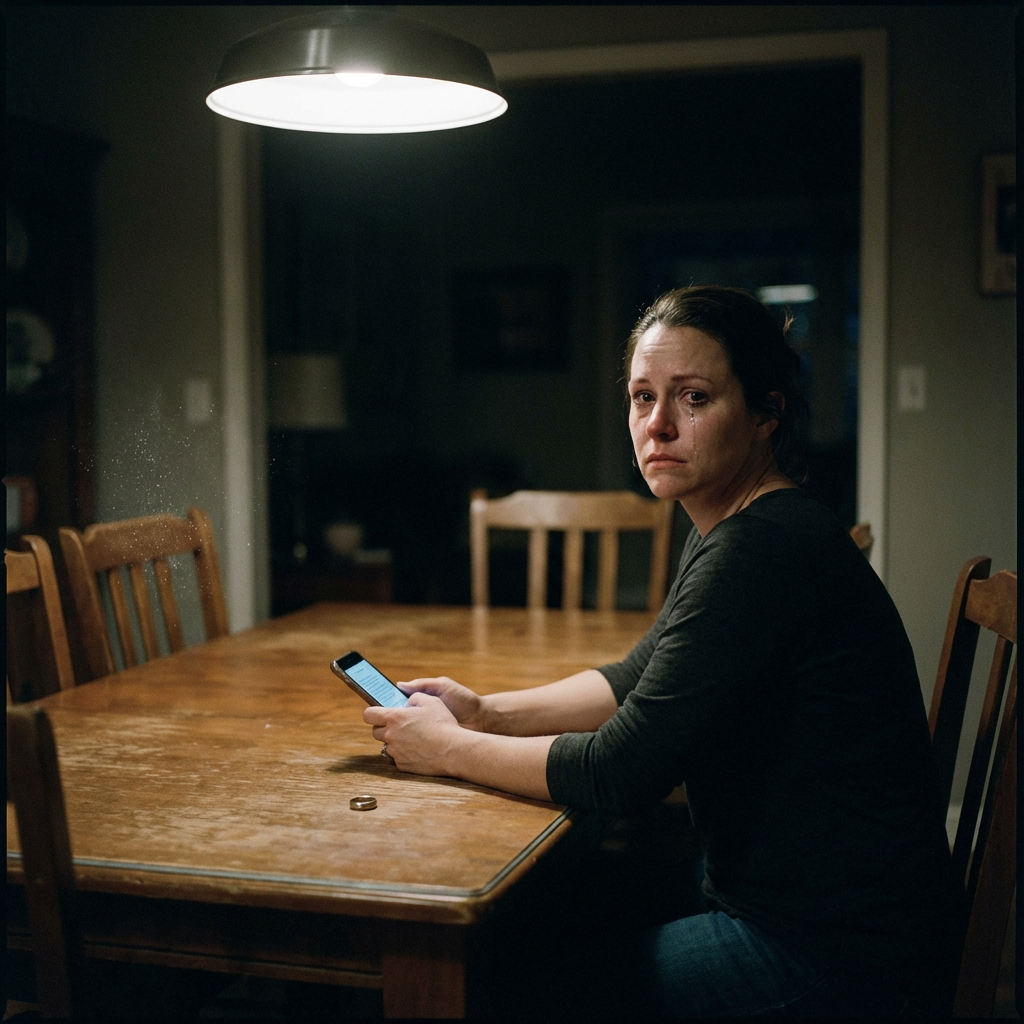
The text message wasn’t meant for me. It popped up on my husband Daniel’s phone while he was in the shower, and I glanced at it thinking it might be work. Instead, I read five words that destroyed my twelve-year marriage: “Can’t wait to see you tonight, baby.”
The number wasn’t saved. But the message history told me everything I needed to know. Six months of conversations. Photos. Plans. Lies. My husband of twelve years was having an affair.
I sat on our bed—the bed we’d shared, where we’d conceived our two children—and felt my entire world collapse. But that betrayal was nothing compared to what came next.
My own family took his side.
The Discovery
I wish I could say I handled the discovery with grace and dignity. I didn’t. I screamed. I threw his phone against the wall. When Daniel came out of the shower, wrapped in a towel and confused by the noise, I confronted him with evidence he couldn’t deny.
He went through the predictable stages. Denial—”It’s not what it looks like.” Minimization—”It didn’t mean anything.” Blame-shifting—”You’ve been so distant lately.” And finally, when I wouldn’t accept any of his excuses, he cried. He begged. He said it was a mistake, that he loved me, that he’d end it immediately.
“Her name is Vanessa,” I said, my voice eerily calm. “She works in your office. You’ve been sleeping with her for six months. You took her to the hotel where we spent our anniversary.”
Daniel’s face went white. “How did you—”
“I read everything. Every message. Every lie you told me while you were with her.” I felt numb, like I was watching this happen to someone else.
He reached for me. I stepped back. “Don’t touch me.”
“Please, we can fix this. I’ll do anything. Counseling, therapy, whatever you need—”
“What I need is for you to leave,” I said. “Pack a bag and get out of my house.”
Our house, technically. Both our names on the mortgage. But in that moment, I couldn’t stand to look at him another second.
Telling My Family
Daniel left that night. I waited until our kids—Mia, ten, and Jacob, seven—were at school the next day before I called my mother. I needed support. I needed someone to tell me I wasn’t crazy, that my world really had just imploded.
“Mom,” I said when she answered. “Daniel’s been having an affair.”
Silence. Then: “Are you sure?”
“I saw the messages. Six months’ worth. He admitted it.”
More silence. “Well. What are you going to do?”
That should have been my first warning. Not “I’m so sorry.” Not “Are you okay?” Just: what are you going to do?
“I told him to leave,” I said. “I’m talking to a divorce lawyer on Monday.”
“Divorce?” My mother’s voice sharpened. “Don’t you think that’s a bit extreme? These things happen in marriages, honey. You need to think about the children.”
I literally couldn’t believe what I was hearing. “The children? Daniel cheated on me for six months. He looked me in the eye every day and lied—”
“Men make mistakes,” she interrupted. “Your father and I went through a rough patch early in our marriage. You work through these things. You don’t just throw away twelve years.”
My hands were shaking. “Are you seriously defending him right now?”
“I’m not defending anyone. I’m being realistic. You have two children, a mortgage, a life together. You can’t just blow everything up because Daniel had a momentary lapse in judgment.”
I hung up on her. Then I called my sister, Rachel, certain she’d understand. Rachel was divorced herself—she knew the pain of betrayal.
“I heard,” Rachel said when she answered. “Mom called me.”
“Then you know what happened. Daniel’s been cheating—”
“For six months, yeah, Mom told me.” Rachel sighed. “Look, I get that you’re hurt. But honestly? I think you’re overreacting.”
“Overreacting?” My voice cracked.
“You guys have been together since college. Daniel’s a good father. He provides for you and the kids. So he screwed up. Is that really worth destroying your family?”
I couldn’t speak. My own sister—who’d cried on my shoulder through her own divorce, who I’d supported unconditionally—was telling me to accept my husband’s infidelity.
Family Dinner from Hell
It got worse. My parents invited me to dinner that weekend “to talk.” I should have known it was an ambush. When I arrived, Daniel was already there, sitting at my parents’ dining room table like nothing had happened.
“What is this?” I demanded.
“Sit down,” my father said. Not a request. A command.
I stayed standing. “If this is some kind of intervention—”
“We’re worried about you,” my mother said. “You’re not thinking clearly. You’re making decisions that will affect everyone in this family.”
Daniel looked at me with red-rimmed eyes. “I told them everything,” he said quietly. “How sorry I am. How much I love you. How I’ll spend the rest of my life making this up to you if you’ll just give me another chance.”
“How noble,” I said flatly.
My father cleared his throat. “Daniel made a mistake. A big one. But he’s owned up to it, and he’s committed to fixing it. The question is whether you’re willing to be an adult about this and try to save your marriage.”
I stared at him. “Be an adult? He had an affair!”
“And he’s apologized,” my mother said. “What more do you want? To punish him forever? To put your children through a divorce because your pride is hurt?”
“My pride?” I was shaking now. “This isn’t about pride. This is about trust. About respect. About the fact that he lied to me every single day for six months.”
Rachel, who’d been silent until now, spoke up. “Nobody’s saying what Daniel did was okay. But marriages go through rough patches. People work through infidelity all the time. You’re acting like you’re the first person this has ever happened to.”
I looked around the table at my family—my parents, my sister, my cheating husband—and realized I was alone. They had already decided. Daniel deserved forgiveness. I was being unreasonable.
“I can’t believe this,” I whispered.
“We’re trying to help you,” my mother said. “We don’t want you to make a mistake you’ll regret.”
“The only mistake I’m making is being here.” I grabbed my purse. “Daniel, I’ll see you in court. Mom, Dad, Rachel—lose my number.”
I left before anyone could respond. I sat in my car in their driveway and cried harder than I had since discovering the affair. My husband had betrayed me. And now my family had too.
The Reasons They Gave
Over the following weeks, various family members reached out with explanations, justifications, and pleas for me to “be reasonable.” Each conversation revealed another layer of betrayal:
My mother said Daniel had called her shortly after I kicked him out. He’d been “distraught,” saying he’d made the biggest mistake of his life and would do anything to fix it. She found him sincere. She also reminded me that divorce would be “financially devastating” and that I needed to think about my standard of living.
My father said he’d always liked Daniel. They golfed together, watched sports together. “He’s a good man who made a bad choice,” Dad said. “You’re throwing away a good husband over sex. Is that really what you want to teach your daughter about marriage?”
Rachel was more honest: “I forgave my ex for cheating, and he did it again. I should have left the first time. But Mom and Dad made me feel like I was giving up too easily, so I stayed and got hurt worse. Now they’re doing the same thing to you, and I’m going along with it because I don’t want to fight with them.”
At least Rachel was self-aware about her cowardice.
My brother, Tom, who lived out of state, called with perhaps the most infuriating take: “I don’t really understand what the big deal is. People cheat. It’s shitty, but it happens. You’re both adults. Figure it out and move on.”
The message was clear: my pain didn’t matter. My trauma didn’t matter. What mattered was maintaining the appearance of an intact family, protecting Daniel’s reputation, and avoiding the “embarrassment” of a divorce.
Daniel’s Strategy
I learned later that Daniel had been strategic about his outreach to my family. He’d called them individually before I could tell them my side. He’d positioned himself as the remorseful husband trying to save his marriage while I was the vindictive wife determined to destroy it.
He’d emphasized his role as provider—he made more money than me, covered most of our expenses. He’d reminded them of family memories—vacations we’d taken together, holidays, celebrations. He’d painted a picture of a marriage worth saving and positioned me as the obstacle.
And it worked. My family bought his narrative completely. When I tried to explain the depth of his betrayal—not just the affair, but the lies, the manipulation, the times he’d made me feel crazy for questioning him—they dismissed it as “emotional” or “dramatic.”
“You’re too close to see clearly,” my mother said. “You need to calm down and think rationally.”
I was thinking rationally. Rationally, I couldn’t stay married to someone who’d betrayed me so completely. Rationally, I deserved better than a husband who’d spent six months having an affair while coming home to kiss me goodnight.
But my family didn’t want rational. They wanted convenient. They wanted the status quo. They wanted to avoid awkward conversations about whose side to take at Thanksgiving.
The Kids
The worst part was how my family used my children as emotional leverage. “Think about Mia and Jacob,” they’d say. “They need their father. You’re being selfish.”
I was thinking about my kids. I thought about them constantly. I thought about what message I’d send them if I stayed with a cheating husband. I thought about teaching my daughter that she should accept betrayal to keep the peace. I thought about teaching my son that actions don’t have consequences as long as you apologize convincingly enough.
Research shows that staying in a marriage “for the kids” often does more harm than good, especially when there’s unresolved betrayal and resentment. Kids sense tension. They absorb unhappiness. They learn relationship patterns from watching their parents.
I wanted my children to see that trust matters. That self-respect matters. That love without honesty isn’t love at all.
But my family saw it differently. My mother started telling people I was “keeping the kids from Daniel,” which was a lie. We’d established a custody schedule through our lawyers. Daniel saw Mia and Jacob regularly. I never bad-mouthed him to them, never tried to turn them against him.
But because I wouldn’t reconcile, I was cast as the villain. The stubborn daughter who wouldn’t forgive. The bitter ex-wife making everything harder than it needed to be.
Making the Cut
Four months after discovering Daniel’s affair, I made a decision that shocked everyone: I cut off my entire family.
No more phone calls. No more family dinners. No more holidays together. I blocked my parents, my siblings, my aunts and uncles who’d weighed in with their “helpful” opinions. I told them clearly: until they could respect my decision and stop advocating for my cheating husband, I didn’t want contact.
My mother sent a letter. A physical letter, since I’d blocked her calls and emails. In it, she called me cruel, said I was punishing people who loved me, accused me of using her grandchildren as pawns.
I read it once and threw it away.
Rachel showed up at my house. I didn’t let her in. Through the door, she said, “You’re overreacting. You’re going to regret this.”
“No,” I said. “I’m going to regret staying in contact with people who thought I should accept infidelity to make their lives easier.”
My father tried a different approach—he cut me off first. Sent a text saying that if I was going to be “stubborn and vindictive,” he wanted nothing to do with me. I was no longer welcome in his home or his life.
I replied with one word: “Okay.”
The trash took itself out.
Life After the Cut
It’s been two years since I cut off my family. Two years of holidays spent with friends, of building a chosen family that actually supports me. Two years of therapy, healing, and learning to trust again.
The divorce was finalized eighteen months ago. Daniel has since gotten engaged to Vanessa, the woman he cheated with. My parents attended their engagement party. My sister sent them a gift. They’ve embraced her fully, proving that their defense of Daniel was never really about saving my marriage—it was about maintaining their relationship with him.
That hurt more than I expected. But it also confirmed I’d made the right decision.
My kids see my family occasionally—I’ve never prevented that. They spend time with their grandparents during Daniel’s custody weekends. Mia asked me once why I don’t come to Grandma’s anymore. I told her the truth, age-appropriately: “Sometimes adults disagree about important things. Grandma and I disagree about how people should treat each other. So we’re taking a break from seeing each other.”
She accepted that. Kids are more resilient than we give them credit for.
What I’ve Learned
Cutting off my family was the hardest decision I’ve ever made. It wasn’t impulsive or emotional—it was necessary for my mental health and self-respect.
I learned that blood doesn’t guarantee loyalty. Family isn’t just about genetics—it’s about who shows up for you in your darkest moments. My biological family failed that test spectacularly.
I learned that some people will always prioritize comfort over justice. They’d rather maintain the status quo than stand up for what’s right, even when someone they supposedly love is being hurt.
I learned that cutting off toxic family members isn’t cruel—it’s self-preservation. The constant pressure to forgive, to reconcile, to “move on” was preventing me from healing. Creating distance gave me space to breathe, to grieve, to rebuild.
Most importantly, I learned that I’m stronger than I thought. I survived my husband’s betrayal. I survived my family’s betrayal. I survived losing almost everyone I thought I could count on. And I came out the other side healthier, happier, and more at peace than I’d been in years.
The Unexpected Benefits
Cutting off my family had unexpected positive effects. Without their constant criticism and pressure, I thrived. I got a promotion at work. I started dating again—slowly, carefully, with clear boundaries. I developed deeper friendships with people who’d been acquaintances before but became my support system.
I stopped apologizing for my decisions. Stopped second-guessing myself. Stopped caring what people who didn’t respect me thought about my choices.
My kids adjusted better than I expected. They’re happy, healthy, well-adjusted. They see me modeling self-respect and healthy boundaries. They see that I’m okay on my own, that I don’t need someone who betrayed me to have a fulfilling life.
Therapy helped immensely. My therapist validated what I’d already known deep down: cutting off my family wasn’t me being vindictive or stubborn. It was me setting boundaries with people who’d demonstrated they couldn’t be trusted with my emotional wellbeing.
Do I Have Regrets?
People ask if I regret cutting off my family. The answer is complicated.
I regret that they put me in a position where cutting them off was necessary. I regret that they chose my cheating husband over their own daughter and sister. I regret that my kids don’t have the kind of grandparents who would support their mother unconditionally.
But do I regret the actual decision to go no-contact? No. Not for a second.
My mental health improved dramatically once I stopped engaging with people who invalidated my pain and defended someone who’d betrayed me. I stopped having anxiety attacks. I stopped questioning my worth. I stopped feeling like I was crazy for expecting loyalty from my spouse.
Would I reconcile if they apologized? Maybe. If the apology was genuine, if they acknowledged how badly they’d hurt me, if they demonstrated through actions—not just words—that they understood why I’d made the decisions I made.
But that hasn’t happened. And I’m not holding my breath.
For Anyone Considering Going No-Contact
If you’re reading this and considering cutting off family members who sided with someone who hurt you, here’s what I wish I’d known:
It’s okay to prioritize your healing. You don’t owe anyone access to you, even family. Especially family who’s made it clear they don’t respect your boundaries or validate your pain.
You don’t need anyone’s permission. You’ll get pushback. People will call you dramatic, vindictive, cruel. They’ll say you’re overreacting. Let them. Their opinion doesn’t matter as much as your peace of mind.
Grief is normal. Even when cutting off toxic people is the right decision, it still hurts. You’re allowed to mourn the family you wish you had while maintaining boundaries with the family you actually have.
Build your chosen family. Friends, support groups, therapy—invest in relationships with people who actually support you. You’ll be surprised how much love and loyalty exists outside of blood relations.
Your kids will be okay. If you have children, they’re more adaptable than you think. Model healthy boundaries and self-respect. That’s a better lesson than teaching them to accept mistreatment for the sake of family unity.
Trust yourself. If something feels wrong, it probably is. Your instincts are valid. Your pain is valid. Your decisions are valid.
Final Thoughts
I cut off my entire family after they sided with my cheating husband. It was the loneliest, most painful decision I’ve ever made. It was also the best decision I’ve ever made.
Two years later, I’m thriving. I’m in a healthy relationship with someone who treats me with respect and honesty. My kids are doing great. My career is flourishing. I have a circle of friends who’ve proven themselves loyal and supportive.
Meanwhile, Daniel is engaged to the woman he cheated with, and my family has fully embraced her. They post photos on social media—Daniel and Vanessa at family events, laughing with my parents, celebrating holidays together. It stings sometimes. But mostly it confirms I made the right call.
They chose him. I chose me. And I’m much happier for it.
If you’re in a similar situation—dealing with infidelity and family betrayal—please know you’re not alone. You’re not crazy. You’re not overreacting. Your pain is real, your anger is justified, and your decision to protect yourself is valid.
Sometimes the hardest part of healing isn’t leaving the person who betrayed you. It’s leaving the people who defended them.
But on the other side of that pain is peace. Freedom. Self-respect. And a life built on your own terms, surrounded by people who actually value you.
I cut off my entire family after they sided with my cheating husband. And I’d do it again in a heartbeat.
Because I finally chose myself. And that changed everything