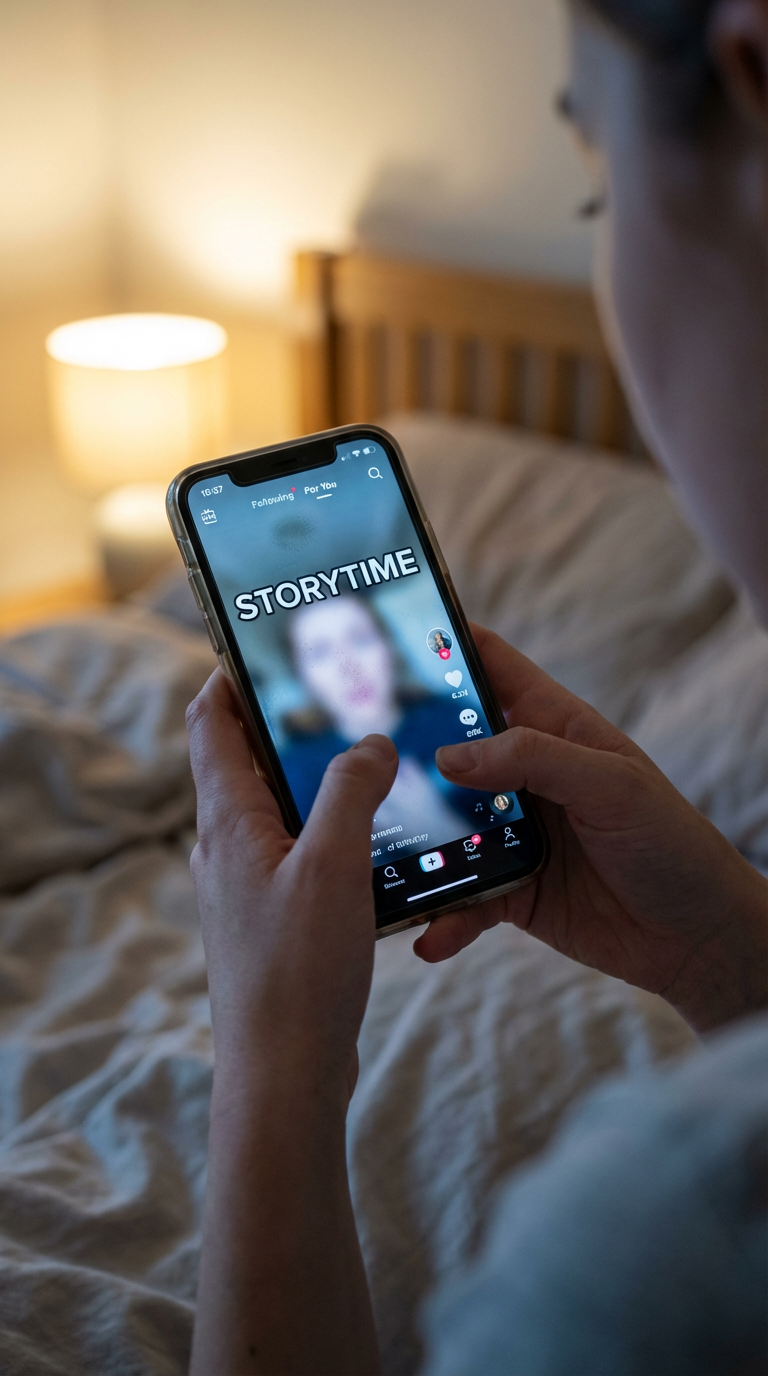

The first time I saw it, I was lying in bed at 11 PM, mindlessly scrolling through TikTok before sleep. Then my own life story appeared on my screen, narrated by someone I’d trusted with my deepest pain.
“STORYTIME: How my bestie survived the WORST first date ever that turned into a literal crime scene 🚨😱” The text overlay flashed across Mara’s face—my best friend of eight years—as she launched into what she called a “wild story” that had happened to “someone very close to her.”
Except it wasn’t just someone close to her. It was me. And it wasn’t just a story. It was the most traumatic night of my life.
My hands started shaking as I watched her recount—with dramatic pauses and perfectly timed reactions—how I’d been drugged at a bar, how I’d realized something was wrong, how I’d locked myself in a restaurant bathroom and called the police, how the man who’d drugged me was arrested that night with three other women’s IDs in his car.
She told it all. Every detail I’d shared with her during crying sessions in her apartment. Every fear I’d confessed. Every moment of terror that still gave me nightmares two years later.
The video had 2.3 million views. Fifteen thousand comments. Her follower count had jumped from 8,000 to 47,000 in three days.
She’d turned my trauma into her breakthrough viral moment.
The Story She Had No Right to Tell
Let me be clear about what happened that night, because I need you to understand why this wasn’t just “a crazy story” worth sharing for internet clout.
I was twenty-six years old, newly single after a difficult breakup, and finally ready to try dating again. I matched with someone on a dating app who seemed normal—good conversation, verified profile, public Instagram. We agreed to meet at a popular restaurant downtown at 7 PM on a Saturday.
Everything seemed fine at first. We ordered drinks at the bar while waiting for our table. He was charming, funny, attentive. I excused myself to the restroom after finishing my first drink—just a vodka soda I’d watched the bartender make.
When I came back, my second drink was waiting. He’d ordered for both of us. “Just another vodka soda,” he said with a smile.
I took three sips before my vision started blurring. Four sips before my words started slurring. Five sips before I knew—absolutely knew—that something was very wrong.
I’ve been drunk before. This wasn’t that. This was my body shutting down in a way that felt terrifying and unnatural. I told him I needed air. He immediately stood up, offered to help me outside, reached for my arm.
Some instinct made me pull away. Some voice in my head screamed danger even though I could barely form coherent thoughts. I stumbled toward the bathroom instead, locked myself in a stall, and with shaking hands managed to call 911.
I don’t remember much after that. The police reports filled in the gaps. The restaurant staff who helped keep me safe. The ambulance. The hospital. The rape kit. The detective who told me I’d probably saved my own life by trusting my gut.
And the man who’d drugged me? He was arrested in the parking lot with three other women’s driver’s licenses in his car. Three women whose cases were still open. Three women who might never have gotten justice if I hadn’t called for help when I did.
This wasn’t a “crazy first date story.” This was attempted kidnapping, possibly attempted murder, definitely attempted sexual assault. This was trauma that required months of therapy, medication for PTSD, a complete overhaul of how I moved through the world.
This was the story Mara told fifteen million people without asking me first.
The Betrayal Unfolds
I called her immediately after seeing the video. It was nearly midnight, but I didn’t care.
“Hello?” She sounded cheerful, probably still riding the high of her viral success.
“What the fuck, Mara?”
Silence. Then, cautiously: “What’s wrong?”
“The TikTok. The storytime. My story. What the actual fuck?”
“Oh.” Her voice changed. “You saw that.”
“Two point three million people saw that. Did you think I wouldn’t?”
“I didn’t use your name—”
“You used enough details that anyone who knows me would recognize it! The restaurant district, the date of the incident, the fact that he had other women’s IDs in his car—that was in the local news, Mara. People can figure it out.”
“I was trying to raise awareness about drink spiking—”
“By exploiting my trauma for views? You could have made a video about drink safety without telling my specific story. You could have asked me first. You could have done literally anything except what you did.”
She got defensive then. Told me I was being dramatic. Said she’d changed enough details that it was “basically fiction based on real events.” Insisted that the attention was actually helping people because so many commenters were sharing their own stories and discussing safety tips.
“This isn’t about helping people,” I said quietly. “This is about you getting famous off the worst night of my life.”
She hung up on me.
The Comments That Made It Worse
I couldn’t stop myself from reading the comments, even though I knew I shouldn’t. Even though my therapist had specifically told me to avoid anything that might trigger my PTSD.
Most were supportive of Mara, praising her for “spreading awareness” and “being such a good friend for sharing her bestie’s story.” But others made my stomach turn:
“Why didn’t she just leave when she felt weird? 🤔”
“Idk this sounds fake, like why would she lock herself in a bathroom instead of just going outside?”
“Not victim blaming but meeting someone from an app at a bar is literally asking for trouble”
“My friend got drugged once and she said it happened way faster than this, this timeline doesn’t add up”
People were dissecting my trauma like it was a plot hole in a TV show. Questioning my decisions. Debating whether it had even happened. And Mara was in the comments, responding with heart emojis and “Right??” and “It was SO scary for her” like she’d been there, like she had any right to discuss it publicly.
Then I saw the follow-up videos. Part 2, Part 3, Part 4. She’d turned my story into a series, each video revealing more details, each one racking up millions of views. In Part 3, she talked about how “traumatized” I’d been afterward, how I’d “basically become a hermit” for months, how I’d been “too scared to date for over a year.”
She described my therapy sessions. My nightmares. My panic attacks. Things I’d told her in confidence during my lowest moments, now packaged as content for strangers who left comments like “Omg poor girl 😭” and “This is why I never use dating apps.”
In Part 4, she talked about my recovery journey. How I’d “finally started dating again” recently. How I was “doing so much better” but still had “triggers.”
She’d documented my entire healing process without my consent, turning my private struggle into her public narrative arc.
When Everyone Found Out
It took less than forty-eight hours for people to figure out it was me.
Someone recognized the restaurant details and found the news article about the arrest. Another person knew we were best friends and put the pieces together. Soon my Instagram DMs were flooded with messages from strangers—some supportive, many invasive, a few absolutely vicious.
“Is it true you got drugged by a serial predator?”
“Wow you’re so brave for surviving that”
“Why are you mad at your friend for telling your story? She’s literally helping other women stay safe”
“Attention seeker much? Your friend didn’t even use your name”
“Can I interview you for my true crime podcast?”
My private trauma had become public property. People felt entitled to my story, to my reactions, to details I’d never chosen to share. My phone wouldn’t stop buzzing. My anxiety skyrocketed. I had to make my social media accounts private and change my settings so only people I followed could message me.
Work became awkward. Coworkers who’d seen the videos—or heard about them—looked at me with a mixture of pity and curiosity. My manager pulled me aside to ask if I was “okay” and whether I needed “any accommodations” because she’d “heard about what happened.”
What happened was two years ago. I’d processed it, healed from it, moved forward. Now I was right back in it, except this time with an audience of millions watching my pain like it was entertainment.
The “Apology” That Wasn’t
After a week of silence, Mara finally reached out. Not with a phone call or even a text message, but with a DM on Instagram.
“Hey girl. I’ve been thinking about everything and I want you to know I never meant to hurt you. I really was just trying to help other women stay safe by sharing important information about drink spiking. I’m sorry you’re upset but I hope you can see that the response has been overwhelmingly positive and people are learning from your experience. Maybe we can talk soon? Miss you ❤️”
I stared at that message for a long time, analyzing every word choice.
“I’m sorry you’re upset” wasn’t “I’m sorry I betrayed your trust.”
“People are learning from your experience” ignored that it wasn’t her experience to share.
“Maybe we can talk soon?” suggested that our friendship could just bounce back, that this was a minor disagreement rather than a fundamental violation.
I didn’t respond. Instead, I consulted a lawyer about my options.
The Legal Gray Area of Digital Betrayal
Here’s what I learned: Unless you live in a state with very specific privacy laws, there’s not much legal recourse when someone shares your story without your consent—as long as they don’t use your name or identifying information that directly violates privacy statutes.
Mara had been careful. She never said my name, never showed my face, never tagged my location. Legally, she’d created “content inspired by real events” rather than explicitly telling my story. The fact that people could figure out it was me through context clues didn’t meet the threshold for privacy violation in my state.
I could potentially pursue a civil case for emotional distress, but it would be expensive, time-consuming, and difficult to prove damages when she hadn’t technically identified me. The lawyer was sympathetic but realistic: “Your best option is probably a cease and desist letter asking her to remove the content and stop discussing your story. Whether she complies is up to her.”
I sent the letter through the lawyer. Mara took down the original four videos but left up dozens of others that referenced “the story” or showed her responding to comments about it. Her follower count stayed at 47,000. She’d already monetized several videos and landed a sponsorship deal with a personal safety app company, using her “viral storytime about her friend’s experience” as her claim to influence.
She’d built a platform on my trauma, and legally, there wasn’t much I could do about it.
The Friendship That Died
We haven’t spoken in four months now. She’s tried reaching out a few times—always with non-apology apologies, always suggesting I’m overreacting, always hinting that I should be grateful for the “awareness” she raised.
But here’s what she doesn’t understand: This was never about awareness or education or helping other women. If it had been, she would have asked me first. She would have protected my privacy. She would have told a generalized story about drink safety without mining my specific trauma for content.
Instead, she saw my pain as an opportunity. She took the most vulnerable moments I’d ever shared with another human being and turned them into entertainment. She prioritized views and followers over my consent, my privacy, my right to control my own narrative.
I’ve lost more than a friendship. I’ve lost the person I called when I was scared. The one who held me when I cried. The friend who knew all my stories because I’d trusted her with them—never imagining she’d see them as content to be extracted and monetized.
The worst part? She still doesn’t think she did anything wrong. In her mind, she’s a hero who “started important conversations” about women’s safety. The fact that she trampled my boundaries and violated my trust to do it doesn’t register as problematic in her worldview.
What I Want Everyone to Know
If you’re reading this and you have friends who’ve shared difficult experiences with you, please hear me: Those stories are not yours to tell.
It doesn’t matter how “important” the message is. It doesn’t matter how many people might benefit from hearing it. It doesn’t matter if you change names or leave out identifying details. If someone trusts you with their trauma, that trust is a responsibility, not a resource.
Before you post that “crazy story about your friend,” ask yourself: Have I asked their permission? Have they explicitly consented to me sharing this publicly? Would I be comfortable if they saw this video?
If the answer to any of those questions is no, don’t post it.
The internet has made it incredibly easy to turn other people’s pain into content. Trauma dumping has become an aesthetic. Vulnerability is currency. Everyone wants to be the person who goes viral for sharing a “powerful story” about someone else’s struggle.
But behind every viral storytime is a real person who might not have wanted their darkest moment broadcast to millions. A person who might not be ready for strangers to weigh in on their trauma. A person whose healing process might be derailed by suddenly having their private pain become public discourse.
Where I Am Now
I’m back in therapy, working through the layers of betrayal and violation that came from having my story stolen. My therapist says what Mara did is a form of secondary trauma—the violation itself becoming traumatic on top of the original event.
I’ve had to grieve the friendship, the trust, the version of Mara I thought I knew. The friend who sat with me in hospital waiting rooms has been replaced by the influencer who saw those moments as content opportunities.
I’ve also had to process my anger—not just at her, but at a culture that rewards this kind of behavior. Where “authenticity” means oversharing about other people’s lives. Where “awareness” is an excuse for exploitation. Where trauma becomes entertainment as long as it’s packaged with the right music and text overlays.
I’m more careful now about what I share and who I share it with. Maybe too careful. Maybe I’ve lost something valuable by becoming more guarded. But I’d rather protect my own stories than risk seeing them turned into someone else’s viral moment.
To Mara, if you’re reading this: You had a choice. You could have been the friend who protected my privacy, who asked before sharing, who put my wellbeing above your follower count. Instead, you chose views over values, engagement over ethics, virality over trust.
I hope those 47,000 followers were worth it.
Because you lost something you’ll never get back: a friend who would have trusted you with anything. Now you have an audience instead.
I know which one I’d rather have.