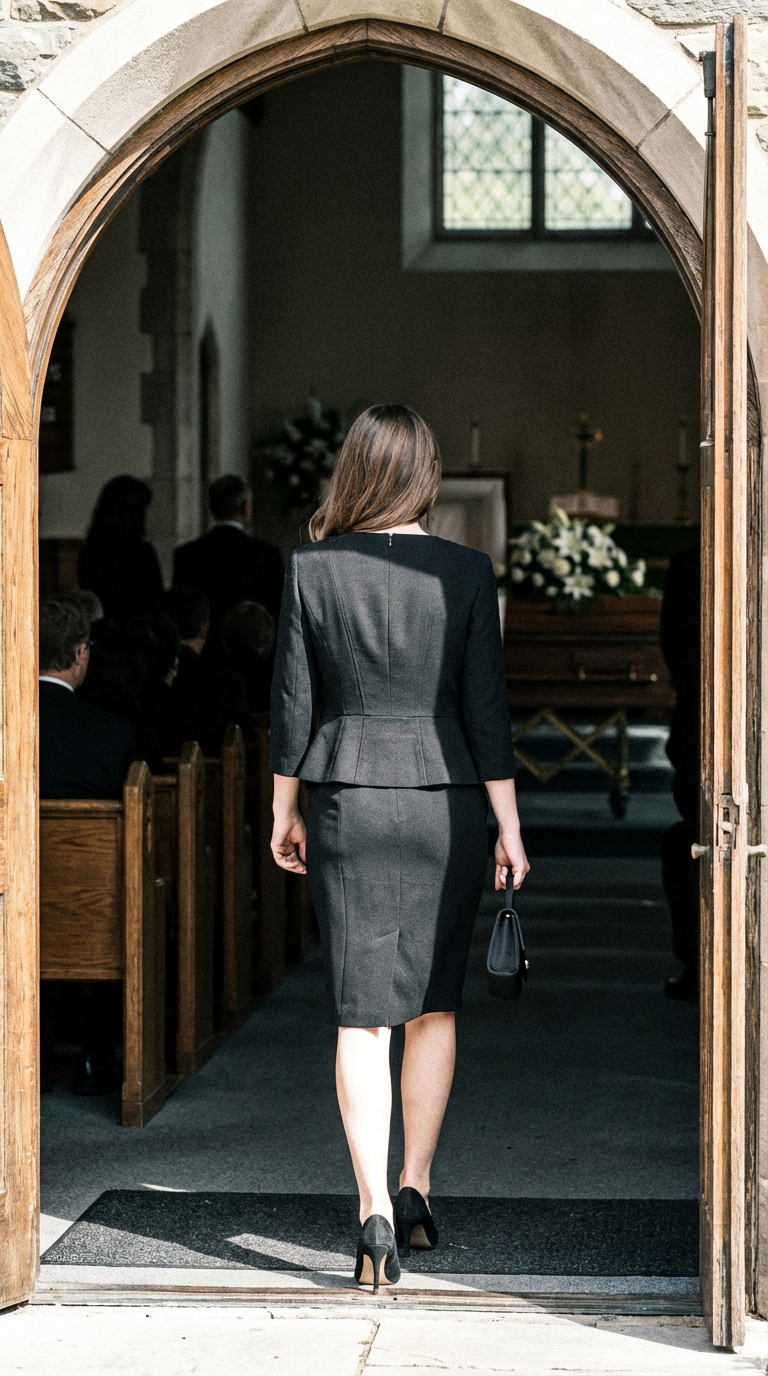
The funeral home was packed. Standing room only. People lined the walls and spilled out into the hallway, all there to pay respects to my father, the “pillar of the community,” the “devoted family man,” the “kind soul taken too soon.”
I sat in the front row between my older brother Marcus and my younger sister Claire, staring at the closed casket draped in white roses. My father had died of a heart attack at sixty-two, sudden and unexpected. The grief was supposed to be straightforward—lose your parent, mourn, eventually heal.
But nothing about my father had ever been straightforward.
The eulogy was delivered by my uncle Tom, my father’s younger brother and biggest cheerleader. He stood at the podium with tears in his eyes and a stack of note cards in his trembling hands, ready to paint a portrait of a man I barely recognized.
“Robert Martinez was the kind of man who would give you the shirt off his back,” Uncle Tom began. “A devoted husband to Linda for thirty-five years. A loving father to his three children. A mentor to countless young people in our community.”
I felt my jaw clench. Beside me, Marcus shifted uncomfortably. On my other side, Claire’s hand found mine and squeezed hard.
Uncle Tom continued: “He coached Little League for fifteen years, never missing a single game. He was always there for his kids, at every recital, every graduation, every important moment.”
That’s when I stood up and walked out.
The Man They Chose to Remember
Let me tell you who my father actually was, because the difference between the eulogy and reality was so vast it felt like gaslighting on a grand scale.
Robert Martinez did coach Little League for fifteen years—but he coached Marcus’s team, not mine or Claire’s. He went to Marcus’s games, Marcus’s tournaments, Marcus’s award ceremonies. When I played soccer in middle school, he came to exactly two games in three years. When Claire did gymnastics, he never showed up once. “Girls’ sports aren’t real sports,” he’d say with a laugh, like it was a joke we were all supposed to be in on.
He was there for Marcus’s high school graduation, taking a thousand photos and throwing a massive party. When I graduated two years later with honors, he showed up twenty minutes late and left early to watch a playoff game. Claire’s graduation? He had a “work emergency” and didn’t come at all.
The devoted husband part? My mother Linda stayed married to him for thirty-five years, yes. But devoted is not the word I’d use for a man who had at least two affairs that I knew about—one with his secretary that lasted three years, another with a woman from his gym. My mother knew. We all knew. We just didn’t talk about it because that’s what the Martinez family did: we kept secrets and maintained appearances.
The man who “would give you the shirt off his back” to strangers was the same man who told me I was wasting my life when I chose to study art instead of business. Who refused to help pay for my college when I wouldn’t switch majors. Who didn’t speak to me for six months when I moved in with my boyfriend before marriage because it was “disgraceful” and “what would people think.”
He was generous to his community and cruel to his daughters in ways that left no visible bruises but plenty of scars.
The Aftermath of Walking Out
I made it to the parking lot before Marcus caught up with me. I was leaning against my car, shaking with rage and grief and a decade of suppressed truth.
“Emma, what the hell?” Marcus grabbed my arm. “You can’t just walk out of Dad’s funeral.”
“Did you hear that eulogy? Did you hear Uncle Tom turn him into some saint?”
“It’s a funeral. People say nice things at funerals.”
“Nice things are one thing, Marcus. That was fiction. That was rewriting history like the rest of us didn’t live through it too.”
His face hardened. “So what, you wanted Uncle Tom to get up there and air all of Dad’s dirty laundry? To tell everyone he was a shitty father to his daughters and cheated on Mom? At his funeral?”
“I wanted someone to tell the truth. Or at least not lie so blatantly that I felt like I was losing my mind sitting there.”
“He’s dead, Emma. Can’t you just let it go for one day?”
That’s when Claire came out, still in her black dress and heels, mascara running down her face.
“I wanted to walk out too,” she said quietly. “I just didn’t have the courage.”
Marcus looked between us, frustrated and uncomfortable. “You two are being selfish. Mom is in there devastated, and you’re out here making Dad’s funeral about your issues with him.”
“Our issues?” I felt my voice rising. “Marcus, he treated you completely differently than us, and you know it. You were the golden child who could do no wrong. Claire and I were disappointments he had to tolerate.”
“That’s not true—”
“It is true!” Claire’s voice cracked. “He told me I was getting fat when I was twelve years old. Twelve, Marcus. He made comments about my body until the day he died. He told Emma her art degree made her a failure. He didn’t come to my college graduation because he said it ‘wasn’t worth the drive’ for a state school.”
Marcus’s face went pale. I don’t think he’d fully understood how different our experiences of our father were until that moment.
“I didn’t know it was that bad,” he said finally.
“That’s because it wasn’t that bad for you,” I replied. “And now everyone in there is going to remember him as this perfect man, and Claire and I are supposed to just smile and nod and pretend we lost the same father you did.”
The Family Meeting From Hell
The real explosion came three days after the funeral, when my mother called a family meeting at her house. My aunts and uncles were there, along with my grandmother, Marcus, Claire, and me. I knew it was going to be bad when I walked in and saw their faces.
“Emma.” My mother’s voice was cold. “I think you owe everyone here an explanation for your behavior at your father’s funeral.”
“My behavior?”
“Walking out during the eulogy was disrespectful, disgraceful, and humiliating to this entire family,” Uncle Tom said. “Your father deserved better.”
I looked around the room. Every face was set in judgment. Even Marcus wouldn’t meet my eyes.
“What exactly did my father deserve?” I asked carefully.
“He deserved to have his daughter sit through his funeral without causing a scene,” my grandmother said sharply. “Whatever issues you had with him died with him. You disrespected the dead.”
“I disrespected a lie,” I corrected. “Uncle Tom got up there and described a man who didn’t exist. A father who showed up for all his children equally. A husband who was faithful. A man who was kind and supportive. That wasn’t Dad. That was a fairy tale.”
“How dare you,” my mother whispered, but her eyes told a different story. She knew I was telling the truth. She’d lived it too.
“I’m not going to apologize for refusing to participate in rewriting history. Dad was complicated. He had good qualities, sure. But he also had serious flaws. He treated his daughters like second-class citizens. He had affairs. He was emotionally abusive in ways that were subtle enough that people like you—” I gestured at my aunts and uncles “—never saw it because he saved his best behavior for public consumption.”
“That is enough.” My mother stood up, her face flushed. “I will not have you slandering your father’s memory—”
“Is it slander if it’s true, Mom?”
The room went silent.
My Aunt Patricia finally spoke up. “Grief makes people say things they don’t mean, Emma. You’re upset and not thinking clearly—”
“I’m thinking more clearly than I have in years,” I interrupted. “I spent my entire childhood trying to earn Dad’s approval and never getting it. I spent my twenties angry at myself for not being enough. And I’ve spent the last five years in therapy unpacking all the ways his treatment shaped my self-worth, my relationships, my entire life.”
“And you think that’s an appropriate thing to bring up at his funeral?” Uncle Tom’s face was red now.
“I didn’t bring it up. I just refused to sit there and listen to lies. There’s a difference.”
Claire cleared her throat. All eyes turned to her. “Emma’s not wrong,” she said softly. “About any of it. Dad was… complicated. And the eulogy didn’t reflect that.”
“You too, Claire?” My mother looked betrayed.
“I’m not saying we should have aired everything publicly, Mom. But Emma’s not crazy for being upset about the whitewashing. It was pretty extreme.”
Marcus stayed silent, staring at his hands.
My grandmother stood up, leaning on her cane. “In my day, children respected their parents regardless of their flaws. You showed them honor, even when they didn’t deserve it. This generation has no sense of decorum.”
“With all due respect, Grandma, decorum is what kept Mom in a marriage where she was cheated on repeatedly. Decorum is what made Claire develop an eating disorder from Dad’s constant criticism of her body. Decorum is what taught me that my feelings and experiences mattered less than maintaining the family image.”
I grabbed my purse and stood up. “I loved my father. I also have complicated feelings about him. Both things can be true. I’m sorry if my walking out embarrassed you, but I’m not sorry for refusing to participate in a fictional narrative about who he was. He was human. He made mistakes. Pretending otherwise doesn’t honor him—it just makes it easier for you to avoid dealing with the reality of who he actually was.”
I left before anyone could respond. Claire texted me five minutes later: “I’m proud of you.”
Marcus texted three hours later: “We need to talk.”
My mother didn’t text at all.
The Conversations That Followed
Marcus came to my apartment two days after the family meeting. He looked exhausted, his usually confident demeanor shaken.
“I’ve been thinking about what you and Claire said,” he started. “About how differently Dad treated you. I always knew he was harder on you guys, but I thought it was just… I don’t know. Normal parent stuff. Being stricter with daughters.”
“It wasn’t strictness, Marcus. It was disinterest mixed with criticism. He didn’t care about our lives unless we were doing something he could brag about, and even then, it was about how it reflected on him, not about being proud of us.”
He nodded slowly. “I talked to Claire. Really talked. She told me things I never knew. About the eating disorder, about the comments, about how she used to make herself throw up before family dinners because she was so anxious about Dad commenting on what she ate.”
My heart broke. “I didn’t know that either.”
“She said she never told anyone because she thought that’s just how fathers were with daughters. That it was normal.” He looked at me with tears in his eyes. “Emma, I’m so sorry. I was so caught up in trying to live up to Dad’s expectations that I didn’t see how much he was hurting you and Claire.”
“It’s not your fault he played favorites.”
“No, but I could have done more. I could have stood up for you. I could have noticed. Instead, I just… enjoyed being the golden child and didn’t question why you guys seemed so different around him.”
We talked for three hours that night. About memories I had that he’d never noticed. About the way Dad’s favoritism had shaped all of our relationships with each other. About how grief was more complicated when you’re mourning someone who hurt you.
“I don’t think you were wrong to walk out,” he said finally. “That eulogy was bullshit. I just didn’t want to admit it at the time because it was easier to be mad at you than to deal with Dad not being who I thought he was.”
The Truth About Complex Grief
Here’s what no one tells you about losing a parent who wasn’t a good parent: You’re allowed to grieve, and you’re also allowed to be angry. You can cry over their death and still acknowledge that they caused you pain. You can love them and hate what they did to you. You can wish they were different and accept that they never were.
My father died, and I’m sad about it. I’m sad about the relationship we never had. I’m sad that he’ll never have the chance to apologize or change. I’m sad that any hope of reconciliation died with him.
But I’m also relieved. Relieved that I’ll never again have to brace myself before family dinners. Relieved that I won’t hear another passive-aggressive comment about my life choices. Relieved that Claire won’t endure more body criticism, and that any future children I have won’t be subjected to his blatant gender favoritism.
Both things are true. The grief is real, and so is the relief. Admitting that doesn’t make me a bad person or a bad daughter. It makes me honest.
Where Things Stand Now
It’s been six weeks since the funeral. My mother still isn’t speaking to me directly, though she communicates through Marcus when necessary. Most of my extended family has chosen sides, and I’m on the wrong one. Thanksgiving is going to be awkward, assuming I’m even invited.
But Claire and I talk every day now. We’ve started going to therapy together to process our shared experiences. She’s started eating regularly again, working with a nutritionist to repair her relationship with food. We’re both learning that the patterns our father instilled in us—the perfectionism, the constant need for external validation, the deep-seated belief that we’re somehow less than—don’t have to define us forever.
Marcus has become an unexpected ally. He’s been reading about family dynamics and golden child syndrome. He’s started questioning a lot of things about our childhood that he’d previously accepted as normal. Last week, he told our mother that he understood why I walked out, and that maybe the family needed to have honest conversations about Dad instead of just canonizing him.
She hung up on him.
As for me, I don’t regret walking out. Not even a little. Because here’s the thing about eulogies: They’re supposed to honor the dead, yes. But they’re also for the living. They’re meant to help us process loss, to find meaning, to remember and grieve.
How am I supposed to grieve a man who never existed? How am I supposed to find closure with a sanitized version of my father that bears no resemblance to the complicated, flawed, sometimes cruel person he actually was?
I can’t. So I walked out. I refused to participate in the collective delusion. And if that makes me the villain in my family’s story, so be it.
What I’d Say to Others in My Situation
If you’ve lost someone who hurt you, and everyone expects you to pretend they were perfect now that they’re gone, please know: You don’t owe anyone your silence about your pain.
“Don’t speak ill of the dead” is a rule designed to protect the feelings of the living who don’t want to confront uncomfortable truths. It’s not actually about respecting the deceased—it’s about maintaining comfortable narratives and avoiding difficult conversations.
You can acknowledge someone’s death and still be honest about who they were. You can attend a funeral and still refuse to participate in historical revisionism. You can love someone and still hold them accountable for the harm they caused.
Your truth matters. Your experience matters. The fact that someone died doesn’t erase what they did when they were alive.
I walked out of my father’s funeral because staying would have required me to betray myself, my sister, and every difficult year we spent trying to be enough for a man who’d decided we weren’t before we were even born. I walked out because sometimes the most respectful thing you can do is refuse to lie.
My family says I disrespected the dead. I think I finally respected myself.
And honestly? After thirty years of putting everyone else’s comfort before my truth, that feels like progress.