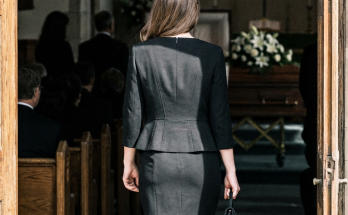
There are some lines you do not cross
For me, that line was my mother’s ring.
It wasn’t a flashy diamond or some massive gemstone. It wasn’t worth six figures or locked in a vault. It was a small, vintage gold ring with a delicate marquise-cut sapphire and two tiny diamonds on each side, worn soft at the edges from decades of love.
It was the ring my father gave my mother on their tenth anniversary.
It was the ring she promised I would have someday.
It was the ring I buried her with—except I didn’t, because she made me promise not to.
Instead, she pressed it into my palm in the hospital, her fingers thin and shaking.
“Don’t let anyone make you feel like this doesn’t matter,” she told me. “You wear it when you’re ready. And if you ever get married, I want you to have this as your ‘something old.’”
I didn’t know then that the person who’d end up disrespecting that last wish wouldn’t be some random stranger, but the woman who insisted on calling herself “Mom” to me: my mother-in-law.
This is the story of how my MIL threw away my late mother’s heirloom ring because it “didn’t fit her standards”—and how I made her pay for it in a way she never expected.
My Mother, My Ring, My Grief
My mom passed away when I was 24. At that point, I had been dating my now-husband, Mark, for about a year. He was supportive, kind, and showed up when I needed him. His family… was another story.
My MIL, Linda, is one of those women who lives for appearances.
Her house is spotless, she has seasonal throw pillows, and there is always some kind of scented candle burning. She dresses like she’s going to brunch with someone important every day, speaks in a soft but cutting voice, and has a way of turning compliments into insults.
“You’re pretty,” she once told me. “You’d be stunning if you lost just ten pounds. You have that kind of face.”
When my mom died, Linda sent flowers and a casserole, then immediately pivoted to talking about how “lucky” I was to have her now.
“You don’t have a mother anymore, but you’ll always have me,” she said with a teary smile.
I nodded because I didn’t have the energy to argue. But inside, I knew there was no replacement.
My mother was my anchor.
Linda was… a storm I tolerated for Mark’s sake.
The ring became my tether to my mom. I didn’t wear it every day at first because it hurt too much. I kept it in a small velvet box in my jewelry dish, sometimes taking it out, rolling it between my fingers, reminding myself that my mother’s love still existed in some physical form.
The Engagement and the Ring
Mark proposed two years after my mom died. He chose a simple but beautiful diamond ring that fit my style perfectly. I wore my engagement ring on my left hand and my mother’s sapphire ring on my right whenever I wanted to feel close to her.
When we announced the engagement, Linda went into overdrive.
“This wedding is going to be PERFECT,” she said. “We have a reputation in this town. People know us. We have to do things properly.”
By “properly,” she meant:
- She tried to control the guest list.
- She had strong opinions about the venue, the dress code, the menu.
- She frequently said, “You only get married once—well, in this family you should.”
She also had opinions about jewelry.
At one brunch, she took my hand and looked at my engagement ring critically.
“It’s very… modest,” she said. “Pretty. Classic.”
I could hear the unspoken “small.”
Then she noticed my mother’s ring on my right hand.
“And what’s this?” she asked, narrowing her eyes.
“This was my mom’s,” I said. “My dad gave it to her for their tenth anniversary. She left it to me before she died.”
Linda made a little face. “Oh. Vintage.” She said the word like it meant “used.”
“I’ll be wearing it on my wedding day,” I added, feeling strangely defensive. “It’s going to be my ‘something old.’”
Linda pursed her lips. “Well… that’s sentimental, I suppose. Just make sure it doesn’t clash with the rest of your look. We want everything to look cohesive in photos.”
I swallowed my annoyance.
The ring was non-negotiable.
My mother might not be there, but her memory would be—even if Linda didn’t like how it looked in pictures.
Moving In (Temporarily) with the In-Laws
About three months before the wedding, our apartment was affected by a burst pipe that ruined the flooring and some of our furniture. The repairs were going to take several weeks, and our landlord offered to put us up in a small hotel temporarily.
Linda had a different idea.
“You’ll stay with us,” she insisted. “It will be easier. We have plenty of space. And it will give us time to really plan things properly.”
I hesitated. I liked having physical distance from her.
But the idea of living in a hotel for weeks, trying to plan a wedding from a tiny room, wasn’t appealing.
Mark convinced me.
“It’s just temporary,” he said. “They mean well. We’ll keep our boundaries.”
We moved some essentials into their guest room:
- A few changes of clothes.
- Some files and wedding planning stuff.
- My jewelry dish, including my mom’s ring.
I remember holding the velvet box and considering putting it in a safer place. But Linda’s house felt secure, and I told myself I was being paranoid.
I placed the jewelry dish on the dresser in the guest room, the ring box nestled among other pieces.
If I’d known what would happen next, I would have locked it in a safe or worn it constantly.
Instead, I made the fatal mistake of trusting that my sentimental value meant something to everyone else.
The “Deep Cleaning” Incident
Linda is obsessed with cleanliness.
Not just normal cleaning—deep, invasive, borderline-obsessive “tidying.”
She doesn’t like “visual clutter.”
She doesn’t like “random things” on surfaces.
She likes spaces that look like they belong in a catalog.
One afternoon, I came home from work to find Linda in our guest room with trash bags, dusting cloths, and a bin.
“Oh, good, you’re here,” she said. “I’m just doing a little tidying. You two unpack like college students.”
My heart skipped a beat when I saw the top of the dresser was completely empty.
“Where’s my jewelry dish?” I asked.
Linda glanced over. “Oh, that little bowl? It was covered in dust and random bits. I sorted it.”
I felt cold. “What do you mean, you sorted it?”
“I put the nicer pieces in your travel jewelry pouch,” she said. “The rest was just… junk, honestly. Tarnished, mismatched, or cheap costume jewelry. I threw that away.”
My ears started ringing.
“What did you throw away?” I asked, my voice too calm.
She pointed to a white kitchen trash bag near the door. “That. Don’t worry, nothing important. Just clutter.”
I dropped to my knees and tore the bag open, ignoring how she gasped at the mess.
Inside were tissues, packaging, some broken earrings…
But not the velvet ring box.
“Where is the little navy velvet box?” I asked. “The one that was in the dish.”
She frowned. “There was nothing like that in there. Just some old ring that was scratched and discolored. It didn’t look like a real stone. I assumed it was fake.”
My stomach dropped.
“That was my mother’s ring,” I said. “Where is it?”
Linda rolled her eyes slightly. “Well, if it was that important, you shouldn’t have left it out in a dish like cheap mall jewelry.”
My vision blurred.
“I’m asking you,” I said slowly, “where is. The ring.”
She sighed. “If you’re talking about that ugly blue stone ring, I threw it out yesterday with the trash. It’s already been collected.”
The Break
Something inside me cracked.
“You threw away my dead mother’s ring,” I said, hearing my own voice shake. “Without asking me. Without even checking.”
“It looked cheap,” she said. “Old. Honestly, I thought it was something you picked up at a thrift store. It didn’t match your engagement ring at all. I was trying to help you curate a more sophisticated look.”
I stared at her in disbelief.
“It was just a ring,” she said. “You’re about to have a beautiful new life. You don’t need to cling to old, ugly things.”
I don’t fully remember what I said next. I remember yelling. I remember crying so hard my chest hurt. I remember Mark running in, confused, and Linda acting like I was overreacting.
“She’s hysterical,” Linda said. “I was just cleaning.”
I told Mark what happened.
He went pale.
“You… threw away her mom’s ring?” he asked his mother.
“Well, if she cared that much, she shouldn’t have left it in a pile of junk,” Linda snapped. “I’m not a mind reader.”
The Aftermath and the “Apology”
Once the initial shock settled into grief, I did the only thing I could think to do: I called the waste management company.
I begged them, sobbing, to check if the truck had unloaded yet, if there was any chance of retrieving a small ring from the trash. They were kind but realistic. The collection had already been compacted and processed. There was no way to find it.
The ring was gone.
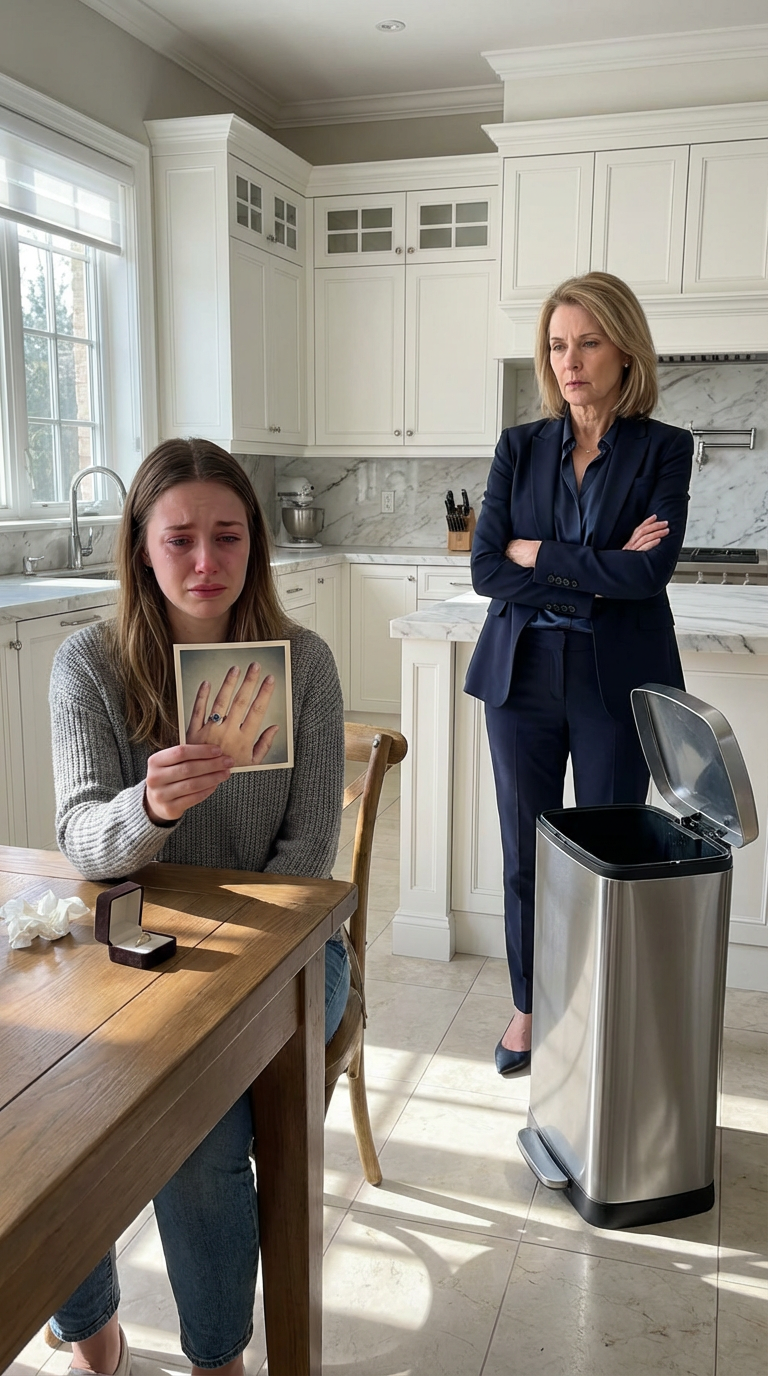
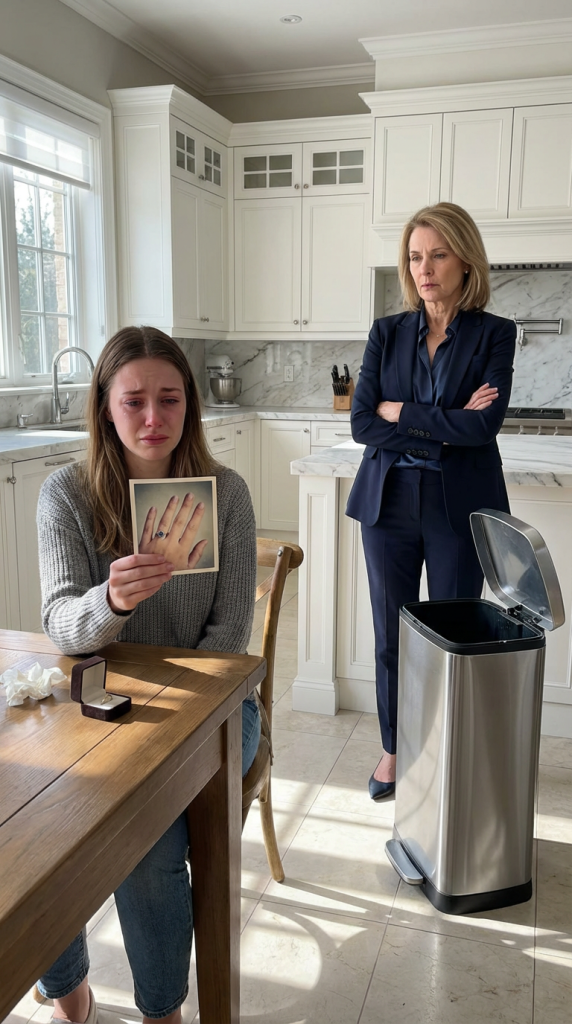
That night, I sat on the bed in the guest room and cried into a pillow, clutching a photo of my mom’s hands with the ring on them.
Linda knocked once and came in without waiting for an answer.
“I think you’re blowing this out of proportion,” she said. “I’m sorry you’re upset. I didn’t know it was sentimental. But it was an eyesore, and it’s gone now. You still have your nice ring from Mark.”
“That is not an apology,” I said hoarsely.
She folded her arms. “Well, I’m not going to grovel over an accident. I was trying to make this house comfortable for you. You should be grateful we took you in.”
Then she added, “You know, grief can make people act irrationally. Maybe you should talk to someone.”
She tried to pathologize my rage and sadness like it was a mental problem, not a reasonable reaction to her throwing away the last physical link I had to my mother.
At that moment, something went very, very still inside me.
“I’m not staying here,” I said. “Pack whatever you need, Mark. We’re leaving tonight.”
Linda sputtered. “Don’t be dramatic. Where will you go?”
“The hotel our landlord offered,” I said. “Anywhere that isn’t here.”
Mark didn’t argue. He just started packing.
Making Her Pay
For a few days, I was too numb to think about anything but the loss.
Then anger replaced the numbness.
And with anger came clarity.
Linda didn’t take responsibility.
She didn’t apologize.
She blamed me.
She threw away something irreplaceable because she decided it didn’t fit her aesthetic.
But this wasn’t just sentimental loss—it was also financial.
My father had the ring appraised when I turned 18, more out of curiosity than anything. He’d shown me the paperwork and said, “It’s not a mansion, but it’s worth taking care of.”
I dug through my old files and found the appraisal certificate:
The ring was valued at several thousand dollars.
Vintage, high-quality sapphire, small but genuine diamonds, solid gold band.
It wasn’t just “old junk.”
It was a piece of real, insurable jewelry.
So I did something Linda never expected: I called a lawyer.
I explained the situation:
- I had proof of ownership (the appraisal in my name and a note from my mom).
- The ring was in the guest room where we were staying.
- My MIL admitted she threw it away without my consent.
- I had text messages from her afterward essentially dismissing its value and calling it “clutter.”
The lawyer explained something Linda probably should’ve known:
- Destroying someone else’s property, even “by accident,” can result in liability.
- Especially when that property is valuable and the act was reckless—like throwing away jewelry without asking.
He said, very calmly, “If you want to pursue it, you can absolutely demand monetary compensation equal to or exceeding the ring’s appraised value.”
I didn’t want “blood.”
I wanted acknowledgment.
And I wanted her to feel even a fraction of the loss she had caused.
So we did.
The Legal Letter
My lawyer drafted a polite but firm letter addressed to Linda:
- It detailed what had happened.
- It attached a copy of the appraisal.
- It requested compensation equal to the appraised amount, plus legal fees if she refused and it went to court.
We had it formally delivered.
Apparently, she opened it at the kitchen table with my FIL present.
Within an hour, my phone blew up.
“How dare you?” she texted. “You’re SUING FAMILY over a RING?”
I replied:
“You destroyed my property. You refused to apologize. You insisted it was ‘junk.’ You made your choice. This is mine.”
Mark called his dad separately. His father, to his credit, sounded exhausted more than angry.
“I told her not to go through your things,” he admitted. “She wouldn’t listen. She never listens. If this is what it takes to make this right, I’ll make sure it happens.”
Within a week, the lawyer received a response from theirs.
Linda had retained counsel (of course she had), but the answer was simple:
They would pay the appraised value to “avoid further family conflict,” with a note heavily implying that I was the one causing the conflict.
I accepted.
I took the money.
I deposited it into a separate account labeled “Mom’s Ring Fund.”
And every time I saw that balance, I remembered that my grief had a cost someone else now had to carry, at least financially.
The Family Fallout
To say this caused drama is an understatement.
Linda told everyone who would listen that I “sued her over garbage.”
She conveniently left out the part where the “garbage” was my late mother’s heirloom ring she threw away without asking.
Some extended relatives took her side.
“You shouldn’t drag family into court,” they said.
“It was an accident.”
My response was simple:
“Accidents still have consequences. Especially when you refuse to admit they were wrong.”
We did not invite Linda to our small civil ceremony when we finally signed papers weeks later.
We postponed the big wedding celebration and scaled it down massively, partly for budget, partly because I couldn’t stomach looking at her across a dance floor.
Mark was torn, but ultimately stayed firmly with me.
“She crossed a line,” he said. “I’m sorry it took something this big for me to really see it.”
His father still sees us.
He comes quietly, without Linda, and apologizes again every time.
“I can’t bring it back,” he says. “But I can at least not pretend it wasn’t her fault.”
Why the Money Wasn’t “Enough”—But Still Mattered
No amount of money can replace that ring.
No check can restore my mother’s hands or rewind the moment Linda decided her taste mattered more than my grief.
But making her pay did three important things:
- It forced her to face real-world consequences.
For once, her “helpful tidying” had a price beyond hurt feelings. - It created a tangible acknowledgment of value.
She couldn’t dismiss it as “junk” anymore once she had to transfer thousands to replace it. - It reminded me I’m allowed to defend my boundaries, even against “family.”
Especially when that family repeatedly disrespects what matters to me.
I used part of that money later to design a new ring with a sapphire and two small diamonds, similar in style to my mom’s.
It’s not the same.
It never will be.
But it’s something I chose, something born from my decision not to let someone trample my memories without consequence.
I wear it on my right hand, next to my wedding band.
When people ask about it, I say, “This is in honor of my mother.”
Sometimes I tell the full story.
Sometimes I just say, “It cost more than money.”
Because in the end, the real payment wasn’t the check Linda wrote.
It was the relationship she burned in the process.
You don’t get to throw away a dead woman’s legacy and still pretend you’re the victim.
Not in my house.