My brother got down on one knee and proposed to his girlfriend less than ten feet from my husband’s casket. It felt like the world tilted on its axis. People talk about “surreal” moments, but this was something worse. It was like watching a nightmare unfold in slow motion while everyone pretended it was just an awkward family moment instead of one of the cruelest violations of basic respect I’ve ever seen.
I’m 34F, and my husband “Mark” died three months ago in a car accident. It was sudden, violent, and completely unexpected. We’d been married for seven years, together for ten. We were talking about trying for a second baby. One minute he was on his way home from work, the next I was getting a phone call that split my life into “before” and “after.”
The days that followed were a blur of logistics and grief. Police, hospital, funeral home, paperwork, insurance, relatives, casseroles. We have a 4-year-old daughter, Emma, who kept asking when Daddy was coming home. I was barely sleeping, barely eating, trying to plan a funeral that felt worthy of the man I’d loved for a decade while functioning on autopilot.
My brother “Jason” (31M) and I have never been super close, but we weren’t estranged either. Growing up, he was the “golden child” in my parents’ eyes—more social, more athletic, more “fun.” I was the responsible one. As adults, we saw each other on holidays, texted every few weeks, hung out with our parents. We weren’t best friends, but I thought we had a decent sibling relationship.
Jason has been with his girlfriend “Brittany” (29F) for about four years. She’s… fine. Very extroverted, very into social media, very into being the center of attention. We’ve never had any major conflicts, but she’s also never made much effort with me. We coexist at family events. Jason has talked off and on about proposing, and my parents have been gently pressuring him to “settle down” and “give us grandkids.”
When Mark died, Jason flew in the next day. He hugged me at the hospital, cried with me, told me he was “here for anything.” Brittany came a day later. She posted a black-and-white photo of a candle on her Instagram with a caption about “holding space for grief” and twenty hashtags. It rubbed me the wrong way, but I had bigger things to worry about.
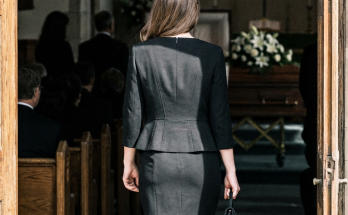
The funeral was held a week after Mark’s death, at the church where we got married. Everyone was there—my family, his family, our friends, coworkers. The sanctuary was full. I sat in the front row with Emma and my parents. Mark’s casket was open during the viewing and closed during the service. I hadn’t wanted an open casket, but his parents did, and I didn’t have the energy to fight them.
The service itself was beautiful. People shared stories about Mark—his kindness, his bad jokes, his loyalty, the way he always helped anyone who needed it. I cried through the whole thing. Emma sat on my lap clutching the stuffed bunny Mark had bought her last Easter. Jason and Brittany sat directly behind us, occasionally squeezing my shoulder.
After the service, there was a reception in the church hall—coffee, finger foods, people milling around sharing memories. I felt like I was floating outside my own body. Every conversation started with “I’m so sorry” and ended with “If you need anything, call me.” I smiled, nodded, thanked, went through the motions.
At some point, I lost track of Emma. She’d been with my mother-in-law, then my sister-in-law, then I saw her running around with my niece and nephew. People kept telling me “Don’t worry, we’ve got her,” so I let it go for a few minutes to talk to Mark’s boss, who’d flown in from out of state.
Then I heard gasps. A few scattered claps. Someone said, “Oh my God, is this really happening?” The tone was all wrong for a funeral.
I turned around.
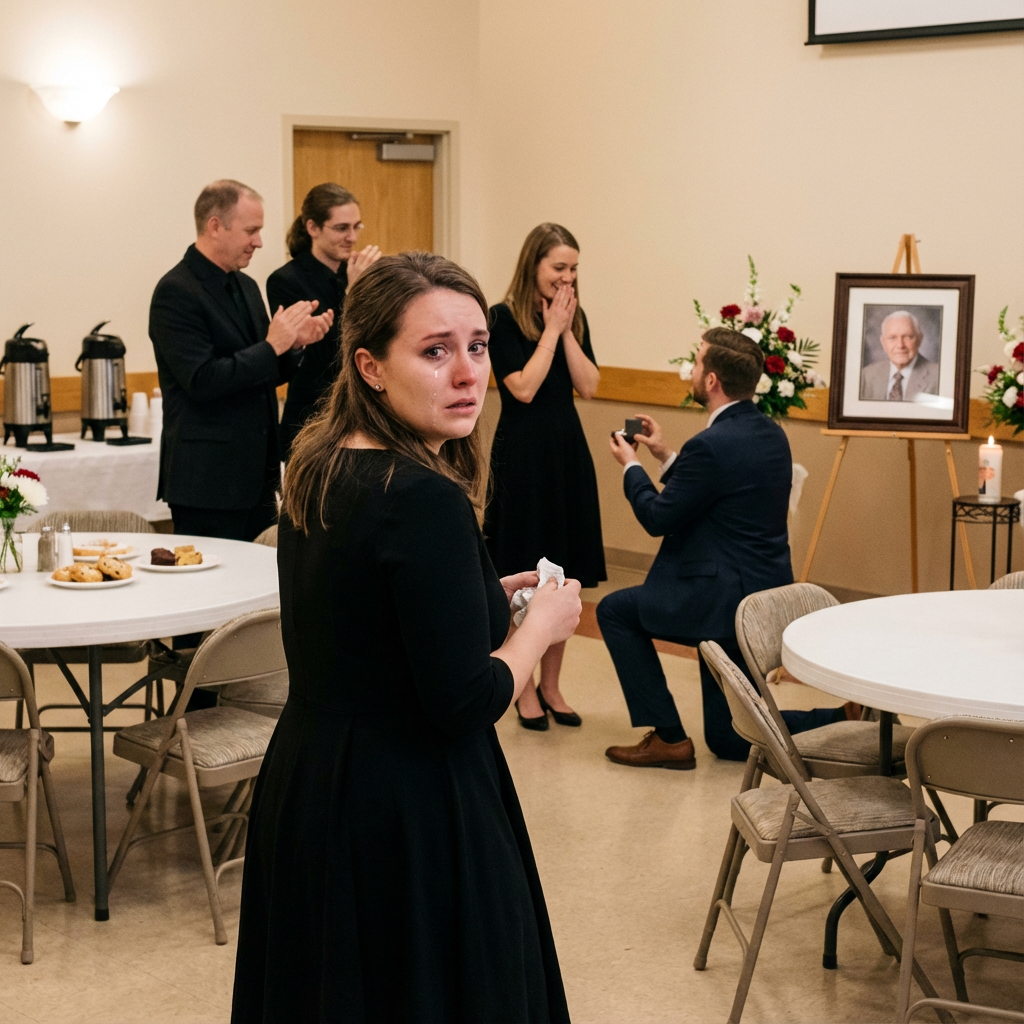
Jason was on one knee in the corner of the reception hall, right in front of the big floral arrangement that had been next to Mark’s casket during the service. Brittany had her hands over her mouth, doing the fake-surprised thing, mascara perfectly intact. People had formed a loose semi-circle around them. Someone was filming on their phone.
My brain couldn’t process it at first. It was like my eyes were lying. For a second I actually thought, “This must be a joke, some weird grief hallucination.”
Then I heard Jason say, loudly, “Brittany, you’ve stood by me through everything, and I can’t imagine my life without you. Will you marry me?”
I felt like all the air had been sucked out of the room. Mark’s parents were staring, stunned. My mom had this frozen smile on her face, my dad looked like he might faint. A couple of my husband’s coworkers were whispering frantically. Brittany squealed, “YES!” and threw herself at Jason.
They hugged. He put the ring on her finger. People clapped—some awkwardly, some enthusiastically. Someone yelled “Congratulations!” Someone else said, “Wow, what a beautiful moment in the middle of all this sadness.”
Meanwhile, my husband’s funeral reception was still happening. His photo board was literally five feet away. His parents were standing there in front of the coffee station watching their son-in-law’s funeral turn into an engagement party.
I don’t remember deciding to move. One moment I was standing next to the dessert table, the next I was in front of Jason and Brittany. The clapping had died down a bit. Brittany was showing her ring to a cluster of people, extending her hand to the camera. Jason looked up and saw me.
“Can I talk to you?” I said. My voice was surprisingly calm, considering I felt like I was going to throw up.
“In a minute, okay?” he said. “We just—”
“No,” I said, louder. “Now.”
The room went quiet. You could almost hear the collective inhale.
I led him a few feet away, near the doors to the hallway. Brittany hovered nearby, clearly not wanting to miss any drama.
“What the hell are you doing?” I asked, still keeping my voice low, but the edge was unmistakable.
“Look, I know the timing is unconventional,” he said, “but—”
“Unconventional?” I snapped. “Jason, this is my husband’s funeral. His body is literally in the next room. You just proposed to your girlfriend in front of his casket.”
“It’s a celebration of life,” he said, defensive. “I thought it would be… healing. Like, showing that life goes on, love continues, you know? Turning a sad day into something hopeful.”
I just stared at him. “You thought hijacking my husband’s funeral to make it about you would be healing?”
Brittany jumped in. “We wanted to honor Mark,” she said. “He loved love! He’d want us to be happy.”
In that moment, something in me snapped. I said, “You’re not honoring him, you’re using his death as a backdrop for your engagement photos.”
Brittany’s face changed. “Wow. That’s really harsh. We didn’t think you’d mind. You have your love story, we’re starting ours. We thought it would show that your family can move forward together.”
“Move forward?” I repeated. “Mark has been dead for seven days.”
Jason rolled his eyes. “You’re clearly still emotional.”
“No,” I said, my voice shaking now, “I’m not ‘emotional,’ I’m grieving. At my husband’s funeral. Where you just decided to propose like this is a destination wedding instead of a memorial.”
He started to argue, but Mark’s mom came over. She’s a quiet woman, rarely raises her voice. She put a hand on my arm and said to Jason, “That was unbelievably inappropriate. You need to leave. Both of you.”
Brittany looked offended. “We’re being kicked out? For getting engaged? On a day when everyone is already here? We were trying to save you another trip!”
I honestly thought Mark’s mom might slap her. She didn’t. She just said, “This is my son’s funeral. You made it about yourselves. Get out.”
Jason’s face went hard. “If you can’t see that we were trying to bring some happiness, that’s on you,” he said. “We’re not leaving.”
I turned to the room. Everyone was watching. I said, loud enough for everyone to hear, “This is not your engagement party. This is my husband’s funeral. If you want to celebrate your engagement, do it somewhere else. And not today.”
There was a long pause. Then Mark’s dad stepped in. He’s a big man, gentle but imposing when he wants to be. “Son,” he said to Jason (he still called him “son”), “you need to go. Now. We’ll talk another time.”
Jason muttered something about “overreaction” and “this family loves drama.” Brittany started crying—not pretty crying, but the loud, performative kind. “I feel so attacked,” she said. “We tried to do something beautiful and now we’re being punished.”
They left in a storm of wounded indignation. A few of my relatives followed them out. The rest of the reception was tense and awkward, the way a room feels after a huge argument in front of everyone. People didn’t know whether to stay, to go, to ask about what happened. I went into the bathroom and sobbed until I thought I would pass out.
Later that night, when it was just me and my parents in my kitchen, my phone started blowing up. Texts from Jason. From Brittany. From a couple of cousins who’d left with them. The narrative had already started to shift in their version:
- “You embarrassed us in front of everyone.”
- “You turned a happy moment into something ugly.”
- “We were trying to honor Mark and you made it all about yourself.”
- “Grief doesn’t give you the right to be cruel.”
My parents were horrified by what Jason had done, but they also started with the “he just didn’t think it through” and “he’s always been impulsive” and “he probably thought he was helping you.” My dad actually said, “He was trying to bring some light into a dark day.”
“By centering himself?” I asked. “By making sure people leave saying, ‘Remember Mark’s funeral? That’s when Jason proposed to Brittany’ instead of remembering Mark?”
I told Jason, in no uncertain terms, that I wanted nothing to do with him or Brittany for the foreseeable future. I said, “You turned the single worst day of my life into your engagement photo op. You disrespected me, Mark, and his entire family. I need space. Do not contact me.”
He shot back, “You’re going to throw away our sibling relationship over one bad call? If you keep this up, you’ll be all alone. Don’t push away the people who love you.”
The word “love” coming from him felt like a joke.
In the weeks that followed, the family split into camps:
- People who thought what Jason did was wildly inappropriate and were firmly on my side.
- People who agreed it was “tacky” but thought I was being “too harsh” by going no contact.
- A very small minority (mostly Jason’s friends and Brittany’s side) who thought it was “romantic” and “symbolic of love continuing after loss.”
Brittany, of course, posted a close-up of the ring the next day with a caption about “finding light in the darkest times” and “love always wins.” She didn’t mention that the “darkest time” was my husband’s funeral. Comments were full of “Congrats!” and “So happy for you!” from people who had no idea of the context. Mutual acquaintances who were at the funeral started DMing me saying, “Is this… about yesterday?” I didn’t respond.
About a week after the funeral, Jason asked to come over “to talk this out like adults.” Against my better judgment, I agreed, thinking maybe—maybe—he’d genuinely apologize and understand what he’d done.
He came alone. Sat on my couch. Looked around at the photos of Mark still all over the living room, the condolence cards on the mantle, the half-unpacked boxes from people bringing meals.
“I’m sorry you were upset,” he started.
That phrasing—“sorry you were upset,” not “sorry for what I did”—told me everything.
“I’m sorry you felt hurt,” he continued, “but I really think you’re blowing this out of proportion. It’s not like we got engaged during the service. We waited until the reception. And people were smiling! There was clapping! It gave people something happy to focus on. Isn’t that what Mark would’ve wanted?”
“No,” I said. “What Mark would’ve wanted is for his funeral not to be hijacked. He would’ve wanted his family to focus on comforting each other, not celebrating someone else’s milestone. He was always thoughtful about other people’s feelings. What you did was the opposite: thoughtless and selfish.”
Jason shrugged. “We disagree. I’m not going to grovel for the rest of my life because you couldn’t handle a little joy on a sad day.”
“A little joy?” I repeated. “Jason, you took a day that was supposed to be about saying goodbye to my husband and put yourself at the center of it. That’s not joy, that’s narcissism.”
He got angry then. “You know, ever since Mark died, it’s like you think you have a monopoly on suffering. You’re not the only one with feelings. Brittany and I have been through a lot too. We’ve had to postpone our own plans because your drama has taken over everything.”
I actually laughed—one of those disbelieving, hysterical laughs you can’t stop. “My drama? My husband died. That’s not drama. That’s tragedy.”
He rolled his eyes. “You know what I mean. Everything has been about you for weeks. We thought this could be a way to start moving the family forward. But if you’d rather wallow—”
I stood up. “Get out.”
He tried to argue. I opened the door. “Get. Out.”
He left, muttering something about me regretting this someday.
I’ve been no contact with him and Brittany since. My parents keep nudging me to “at least talk to him” or “not let this permanently divide the family.” I’ve told them the only version of “repair” I’d even consider starts with a real apology from Jason and Brittany, plus an acknowledgment that what they did was deeply wrong. So far, that hasn’t happened. All I’ve gotten are half-apologies laced with self-justification.
What hurts most—aside from the original stunt—is how many people seem more uncomfortable with my boundary than with their behavior. People say things like:
- “Grief makes everything feel bigger; maybe once some time passes you’ll see it differently.”
- “He picked a bad time, but his heart was in the right place.”
- “Do you really want your niece or nephew (that don’t even exist yet) to grow up with their aunt cut off from the family?”
What nobody seems to want to say to Jason is: “What you did was cruel.” They dance around it, call it “tone-deaf” or “tacky,” but not what it is: a blatant disrespect of the dead and of me.
Here’s the thing I keep coming back to: funerals are one of the few rituals we have that are purely about the person who died and the people closest to them. They’re not parties. They’re not PR opportunities. They’re not a convenient place to gather a crowd for your own announcement. There are literally 364 other days in the year Jason could have proposed. He chose that day because it was convenient and dramatic and guaranteed an audience.
People tell you grief reveals who people really are. I didn’t expect it to reveal this about my own brother.
I’m learning that part of grief is not just mourning the person who died, but also mourning the relationships that die with them—the ones that can’t withstand the pressure of tragedy. My relationship with Jason is one of those. Right now, I don’t miss him. I miss the idea of a brother I thought I had—someone who would have stood next to me at Mark’s funeral and protected the sanctity of that day, not turned it into content.
I don’t know what the future holds. Maybe years from now I’ll be in a place where I can sit in the same room as him without feeling rage. Maybe I won’t. What I do know is this:
- Mark deserved a funeral that was about him.
- I deserved a day of mourning that wasn’t hijacked.
- My boundaries are not less valid because I’m grieving.
If anyone reading this ever wonders, “Is it okay to propose at someone else’s major life event?”—wedding, graduation, baby shower, funeral—here’s the answer: No. It’s not your day. If you want your proposal to be unforgettable, find a way to do that without standing on someone else’s grief or joy to boost yourself up.
For now, I’m focusing on Emma, on putting one foot in front of the other, on paying bills and sorting paperwork and figuring out who I am without Mark. I don’t have the bandwidth to also manage my brother’s hurt feelings about not being allowed to recast my husband’s funeral as his love story.
He wrote me one last text before I blocked him: “One day you’ll realize you pushed away the people who were trying to help you the most.”
Maybe. Or maybe I’m finally drawing a line with people who only know how to “help” in ways that hurt.
My Brother Proposed to His Girlfriend at My Husband’s Funeral
My brother got down on one knee and proposed to his girlfriend less than ten feet from my husband’s casket. It felt like the world tilted on its axis. People talk about “surreal” moments, but this was something worse. It was like watching a nightmare unfold in slow motion while everyone pretended it was just an awkward family moment instead of one of the cruelest violations of basic respect I’ve ever seen.
I’m 34F, and my husband “Mark” died three months ago in a car accident. It was sudden, violent, and completely unexpected. We’d been married for seven years, together for ten. We were talking about trying for a second baby. One minute he was on his way home from work, the next I was getting a phone call that split my life into “before” and “after.”
The days that followed were a blur of logistics and grief. Police, hospital, funeral home, paperwork, insurance, relatives, casseroles. We have a 4-year-old daughter, Emma, who kept asking when Daddy was coming home. I was barely sleeping, barely eating, trying to plan a funeral that felt worthy of the man I’d loved for a decade while functioning on autopilot.
My brother “Jason” (31M) and I have never been super close, but we weren’t estranged either. Growing up, he was the “golden child” in my parents’ eyes—more social, more athletic, more “fun.” I was the responsible one. As adults, we saw each other on holidays, texted every few weeks, hung out with our parents. We weren’t best friends, but I thought we had a decent sibling relationship.
Jason has been with his girlfriend “Brittany” (29F) for about four years. She’s… fine. Very extroverted, very into social media, very into being the center of attention. We’ve never had any major conflicts, but she’s also never made much effort with me. We coexist at family events. Jason has talked off and on about proposing, and my parents have been gently pressuring him to “settle down” and “give us grandkids.”
When Mark died, Jason flew in the next day. He hugged me at the hospital, cried with me, told me he was “here for anything.” Brittany came a day later. She posted a black-and-white photo of a candle on her Instagram with a caption about “holding space for grief” and twenty hashtags. It rubbed me the wrong way, but I had bigger things to worry about.
The funeral was held a week after Mark’s death, at the church where we got married. Everyone was there—my family, his family, our friends, coworkers. The sanctuary was full. I sat in the front row with Emma and my parents. Mark’s casket was open during the viewing and closed during the service. I hadn’t wanted an open casket, but his parents did, and I didn’t have the energy to fight them.
The service itself was beautiful. People shared stories about Mark—his kindness, his bad jokes, his loyalty, the way he always helped anyone who needed it. I cried through the whole thing. Emma sat on my lap clutching the stuffed bunny Mark had bought her last Easter. Jason and Brittany sat directly behind us, occasionally squeezing my shoulder.
After the service, there was a reception in the church hall—coffee, finger foods, people milling around sharing memories. I felt like I was floating outside my own body. Every conversation started with “I’m so sorry” and ended with “If you need anything, call me.” I smiled, nodded, thanked, went through the motions.
At some point, I lost track of Emma. She’d been with my mother-in-law, then my sister-in-law, then I saw her running around with my niece and nephew. People kept telling me “Don’t worry, we’ve got her,” so I let it go for a few minutes to talk to Mark’s boss, who’d flown in from out of state.
Then I heard gasps. A few scattered claps. Someone said, “Oh my God, is this really happening?” The tone was all wrong for a funeral.
I turned around.
Jason was on one knee in the corner of the reception hall, right in front of the big floral arrangement that had been next to Mark’s casket during the service. Brittany had her hands over her mouth, doing the fake-surprised thing, mascara perfectly intact. People had formed a loose semi-circle around them. Someone was filming on their phone.
My brain couldn’t process it at first. It was like my eyes were lying. For a second I actually thought, “This must be a joke, some weird grief hallucination.”
Then I heard Jason say, loudly, “Brittany, you’ve stood by me through everything, and I can’t imagine my life without you. Will you marry me?”
I felt like all the air had been sucked out of the room. Mark’s parents were staring, stunned. My mom had this frozen smile on her face, my dad looked like he might faint. A couple of my husband’s coworkers were whispering frantically. Brittany squealed, “YES!” and threw herself at Jason.
They hugged. He put the ring on her finger. People clapped—some awkwardly, some enthusiastically. Someone yelled “Congratulations!” Someone else said, “Wow, what a beautiful moment in the middle of all this sadness.”
Meanwhile, my husband’s funeral reception was still happening. His photo board was literally five feet away. His parents were standing there in front of the coffee station watching their son-in-law’s funeral turn into an engagement party.
I don’t remember deciding to move. One moment I was standing next to the dessert table, the next I was in front of Jason and Brittany. The clapping had died down a bit. Brittany was showing her ring to a cluster of people, extending her hand to the camera. Jason looked up and saw me.
“Can I talk to you?” I said. My voice was surprisingly calm, considering I felt like I was going to throw up.
“In a minute, okay?” he said. “We just—”
“No,” I said, louder. “Now.”
The room went quiet. You could almost hear the collective inhale.
I led him a few feet away, near the doors to the hallway. Brittany hovered nearby, clearly not wanting to miss any drama.
“What the hell are you doing?” I asked, still keeping my voice low, but the edge was unmistakable.
“Look, I know the timing is unconventional,” he said, “but—”
“Unconventional?” I snapped. “Jason, this is my husband’s funeral. His body is literally in the next room. You just proposed to your girlfriend in front of his casket.”
“It’s a celebration of life,” he said, defensive. “I thought it would be… healing. Like, showing that life goes on, love continues, you know? Turning a sad day into something hopeful.”
I just stared at him. “You thought hijacking my husband’s funeral to make it about you would be healing?”
Brittany jumped in. “We wanted to honor Mark,” she said. “He loved love! He’d want us to be happy.”
In that moment, something in me snapped. I said, “You’re not honoring him, you’re using his death as a backdrop for your engagement photos.”
Brittany’s face changed. “Wow. That’s really harsh. We didn’t think you’d mind. You have your love story, we’re starting ours. We thought it would show that your family can move forward together.”
“Move forward?” I repeated. “Mark has been dead for seven days.”
Jason rolled his eyes. “You’re clearly still emotional.”
“No,” I said, my voice shaking now, “I’m not ‘emotional,’ I’m grieving. At my husband’s funeral. Where you just decided to propose like this is a destination wedding instead of a memorial.”
He started to argue, but Mark’s mom came over. She’s a quiet woman, rarely raises her voice. She put a hand on my arm and said to Jason, “That was unbelievably inappropriate. You need to leave. Both of you.”
Brittany looked offended. “We’re being kicked out? For getting engaged? On a day when everyone is already here? We were trying to save you another trip!”
I honestly thought Mark’s mom might slap her. She didn’t. She just said, “This is my son’s funeral. You made it about yourselves. Get out.”
Jason’s face went hard. “If you can’t see that we were trying to bring some happiness, that’s on you,” he said. “We’re not leaving.”
I turned to the room. Everyone was watching. I said, loud enough for everyone to hear, “This is not your engagement party. This is my husband’s funeral. If you want to celebrate your engagement, do it somewhere else. And not today.”
There was a long pause. Then Mark’s dad stepped in. He’s a big man, gentle but imposing when he wants to be. “Son,” he said to Jason (he still called him “son”), “you need to go. Now. We’ll talk another time.”
Jason muttered something about “overreaction” and “this family loves drama.” Brittany started crying—not pretty crying, but the loud, performative kind. “I feel so attacked,” she said. “We tried to do something beautiful and now we’re being punished.”
They left in a storm of wounded indignation. A few of my relatives followed them out. The rest of the reception was tense and awkward, the way a room feels after a huge argument in front of everyone. People didn’t know whether to stay, to go, to ask about what happened. I went into the bathroom and sobbed until I thought I would pass out.
Later that night, when it was just me and my parents in my kitchen, my phone started blowing up. Texts from Jason. From Brittany. From a couple of cousins who’d left with them. The narrative had already started to shift in their version:
- “You embarrassed us in front of everyone.”
- “You turned a happy moment into something ugly.”
- “We were trying to honor Mark and you made it all about yourself.”
- “Grief doesn’t give you the right to be cruel.”
My parents were horrified by what Jason had done, but they also started with the “he just didn’t think it through” and “he’s always been impulsive” and “he probably thought he was helping you.” My dad actually said, “He was trying to bring some light into a dark day.”
“By centering himself?” I asked. “By making sure people leave saying, ‘Remember Mark’s funeral? That’s when Jason proposed to Brittany’ instead of remembering Mark?”
I told Jason, in no uncertain terms, that I wanted nothing to do with him or Brittany for the foreseeable future. I said, “You turned the single worst day of my life into your engagement photo op. You disrespected me, Mark, and his entire family. I need space. Do not contact me.”
He shot back, “You’re going to throw away our sibling relationship over one bad call? If you keep this up, you’ll be all alone. Don’t push away the people who love you.”
The word “love” coming from him felt like a joke.
In the weeks that followed, the family split into camps:
- People who thought what Jason did was wildly inappropriate and were firmly on my side.
- People who agreed it was “tacky” but thought I was being “too harsh” by going no contact.
- A very small minority (mostly Jason’s friends and Brittany’s side) who thought it was “romantic” and “symbolic of love continuing after loss.”
Brittany, of course, posted a close-up of the ring the next day with a caption about “finding light in the darkest times” and “love always wins.” She didn’t mention that the “darkest time” was my husband’s funeral. Comments were full of “Congrats!” and “So happy for you!” from people who had no idea of the context. Mutual acquaintances who were at the funeral started DMing me saying, “Is this… about yesterday?” I didn’t respond.
About a week after the funeral, Jason asked to come over “to talk this out like adults.” Against my better judgment, I agreed, thinking maybe—maybe—he’d genuinely apologize and understand what he’d done.
He came alone. Sat on my couch. Looked around at the photos of Mark still all over the living room, the condolence cards on the mantle, the half-unpacked boxes from people bringing meals.
“I’m sorry you were upset,” he started.
That phrasing—“sorry you were upset,” not “sorry for what I did”—told me everything.
“I’m sorry you felt hurt,” he continued, “but I really think you’re blowing this out of proportion. It’s not like we got engaged during the service. We waited until the reception. And people were smiling! There was clapping! It gave people something happy to focus on. Isn’t that what Mark would’ve wanted?”
“No,” I said. “What Mark would’ve wanted is for his funeral not to be hijacked. He would’ve wanted his family to focus on comforting each other, not celebrating someone else’s milestone. He was always thoughtful about other people’s feelings. What you did was the opposite: thoughtless and selfish.”
Jason shrugged. “We disagree. I’m not going to grovel for the rest of my life because you couldn’t handle a little joy on a sad day.”
“A little joy?” I repeated. “Jason, you took a day that was supposed to be about saying goodbye to my husband and put yourself at the center of it. That’s not joy, that’s narcissism.”
He got angry then. “You know, ever since Mark died, it’s like you think you have a monopoly on suffering. You’re not the only one with feelings. Brittany and I have been through a lot too. We’ve had to postpone our own plans because your drama has taken over everything.”
I actually laughed—one of those disbelieving, hysterical laughs you can’t stop. “My drama? My husband died. That’s not drama. That’s tragedy.”
He rolled his eyes. “You know what I mean. Everything has been about you for weeks. We thought this could be a way to start moving the family forward. But if you’d rather wallow—”
I stood up. “Get out.”
He tried to argue. I opened the door. “Get. Out.”
He left, muttering something about me regretting this someday.
I’ve been no contact with him and Brittany since. My parents keep nudging me to “at least talk to him” or “not let this permanently divide the family.” I’ve told them the only version of “repair” I’d even consider starts with a real apology from Jason and Brittany, plus an acknowledgment that what they did was deeply wrong. So far, that hasn’t happened. All I’ve gotten are half-apologies laced with self-justification.
What hurts most—aside from the original stunt—is how many people seem more uncomfortable with my boundary than with their behavior. People say things like:
- “Grief makes everything feel bigger; maybe once some time passes you’ll see it differently.”
- “He picked a bad time, but his heart was in the right place.”
- “Do you really want your niece or nephew (that don’t even exist yet) to grow up with their aunt cut off from the family?”
What nobody seems to want to say to Jason is: “What you did was cruel.” They dance around it, call it “tone-deaf” or “tacky,” but not what it is: a blatant disrespect of the dead and of me.
Here’s the thing I keep coming back to: funerals are one of the few rituals we have that are purely about the person who died and the people closest to them. They’re not parties. They’re not PR opportunities. They’re not a convenient place to gather a crowd for your own announcement. There are literally 364 other days in the year Jason could have proposed. He chose that day because it was convenient and dramatic and guaranteed an audience.
People tell you grief reveals who people really are. I didn’t expect it to reveal this about my own brother.
I’m learning that part of grief is not just mourning the person who died, but also mourning the relationships that die with them—the ones that can’t withstand the pressure of tragedy. My relationship with Jason is one of those. Right now, I don’t miss him. I miss the idea of a brother I thought I had—someone who would have stood next to me at Mark’s funeral and protected the sanctity of that day, not turned it into content.
I don’t know what the future holds. Maybe years from now I’ll be in a place where I can sit in the same room as him without feeling rage. Maybe I won’t. What I do know is this:
- Mark deserved a funeral that was about him.
- I deserved a day of mourning that wasn’t hijacked.
- My boundaries are not less valid because I’m grieving.
If anyone reading this ever wonders, “Is it okay to propose at someone else’s major life event?”—wedding, graduation, baby shower, funeral—here’s the answer: No. It’s not your day. If you want your proposal to be unforgettable, find a way to do that without standing on someone else’s grief or joy to boost yourself up.
For now, I’m focusing on Emma, on putting one foot in front of the other, on paying bills and sorting paperwork and figuring out who I am without Mark. I don’t have the bandwidth to also manage my brother’s hurt feelings about not being allowed to recast my husband’s funeral as his love story.
He wrote me one last text before I blocked him: “One day you’ll realize you pushed away the people who were trying to help you the most.”
Maybe. Or maybe I’m finally drawing a line with people who only know how to “help” in ways that hurt.