If you had told me a year ago that I would be grieving a house like a person, I would have laughed it off as dramatic. But here I am, mourning drywall and old carpet and the creaky step on the staircase like it was a member of my family—because in a lot of ways, it was the only stable one I had.
And my parents sold it behind my back.
Not “forgot to loop me in.” Not “things happened fast.” They intentionally kept it from me, signed all the papers, and then casually announced that the home I grew up in, the place I still called “home” even as an adult, was gone.
Now they’re telling me I’m being childish, that I “need to get over it,” that “it’s just a house.”
But it doesn’t feel like “just a house” when it’s the one place that held every version of you—and you never got to say goodbye.
Growing Up in That House
My parents bought the house when my mom was pregnant with me. It wasn’t some huge, fancy place—just a modest, slightly outdated two-story in a quiet neighborhood with aging trees and uneven sidewalks. The kind of house where bikes always seemed to be abandoned in the driveway and someone’s Christmas lights stayed up until March.
To everyone else, it probably looked ordinary. To me, it was everything.
- The front porch where my dad taught me how to tie my shoes.
- The kitchen where my mom used to dance with me while dinner simmered on the stove.
- The living room where I watched Saturday morning cartoons, teenage dramas, and eventually movies I wasn’t supposed to be watching yet.
- The backyard where my dog is buried under the big maple tree.
My height was marked in pencil on the doorframe of the pantry. The wall in my bedroom still had faint tape marks from posters I stuck up in middle school. My first day of kindergarten, my first lost tooth, my first post-breakup meltdown at seventeen—all of it happened in that house.
When people say “home is where the heart is,” that house was where all my hearts had broken and healed.
Moving Out, But Not Really Letting Go
I moved out at 24 when I finally got a decent-paying job in another city. It was a tiny apartment with thin walls and no storage, but I felt proud of myself for making it on my own. Still, every time I visited my parents, walking into that house felt like exhaling.
My old bedroom was still “my room.” My posters were gone, and my mom had replaced my teenage chaos with more neutral decor, but my bed was there, my bookshelf, my old trophies and school photos. It was my landing place—somewhere I always assumed would be there if life fell apart.
My parents used to say, “You’ll always have a home here.” I didn’t realize that sentence had an expiration date I wasn’t allowed to see.
The First Hint Something Was Off
About nine months ago, my mom started making comments about “downsizing.” At first, it seemed like idle talk.
“This house is too big for just the two of us.”
“Your dad’s knees hurt going up and down the stairs.”
“Sometimes I think about getting one of those little condos near the park.”
I listened, nodded, and said things like, “You have to do what’s best for you.” I meant it. Parents get older. Situations change. I didn’t think they’d actually do anything quickly.
If anything, I assumed they’d include me in the conversation if it got serious. Not because they needed my permission, but because… well, we’re a family. We talk about big things. Or at least I thought we did.
The Weekend Visit That Changed Everything
Fast forward to three months ago. I drove back to my hometown for the weekend, half-excited to sleep in my old bed and half-looking forward to raiding my parents’ fridge.
When I pulled up to the house, something felt off. The front hedge was trimmed more than usual. The curtains in the front window were different—more modern, less floral. I chalked it up to my mom finally giving in to her Pinterest addiction.
I unlocked the front door and stepped inside.
It didn’t smell like home.
You know how every house has its own smell? A mix of laundry detergent, cooking, old furniture, and whatever candles people like? My parents’ house always smelled like clean laundry and coffee and something vaguely lemon-scented.
This time, it smelled… neutral. Like new paint and generic “fresh linen” air freshener.
I walked into the living room and froze.
The furniture was different. Our old, slightly sagging couch was gone, replaced by a sleek gray sectional I’d never seen before. The family photos that lined the walls—my school pictures, the awkward family portraits with matching sweaters, the candid shots from holidays—were missing. In their place were abstract prints and a giant clock.
“Mom?” I called out, my voice echoing weirdly in a space that suddenly didn’t feel like mine.
My mom emerged from the kitchen, wiping her hands on a towel. “Oh! You’re here!” she said, like nothing was strange at all.
I looked around again, my heart starting to pound. “What… happened?”
She smiled in that tight way that says, “I’m about to drop something on you and hope you take it well.”
“Oh,” she said lightly, “we sold the house.”
“We Sold the House”
I honestly thought I misheard her. “You what?”
“We sold the house,” she repeated, like she was telling me she’d switched phone providers, not sold the only home I’ve ever known. “We close next week. We’re moving into a condo near the lake. Isn’t that exciting?”
I just stared at her. My brain was scrambling to catch up.
“You… sold the house,” I repeated slowly. “Without telling me?”
She shifted uncomfortably. “Well, we didn’t want to worry you until it was final. These things fall through sometimes. And we knew you’d have a lot of feelings about it, and we didn’t want to deal with that until we had to.”
We didn’t want to deal with that.
There it was. The truth. They knew I’d be upset, so instead of inviting me into the process, giving me time to say goodbye, to process, to maybe take a last walk through each room, they decided my emotions were a hassle to be managed after the fact.
“Where’s Dad?” I asked, my voice shaking.
“In the garage,” she said quickly. “He’s going through his tools. Listen, we’re really happy about this. The buyers loved the place. They even said they could tell it was a ‘happy home.’ Isn’t that nice?”
I didn’t feel nice. I felt like the floor had opened up under me.
The Garage Conversation
I found my dad in the garage, surrounded by boxes and half-packed shelves. He looked up guiltily when he saw me.
“So Mom said you sold the house,” I said, skipping any attempt at small talk.
He sighed, rubbing the back of his neck. “Yeah. We did.”
“Without telling me.”
“We were going to tell you,” he said. “We just… didn’t want to make a big production out of it. It’s our house. We didn’t think you’d feel this strongly.”
Didn’t think I’d feel this strongly.
“Dad,” I said, trying to keep my voice from cracking, “this is my childhood home. Everything I remember about growing up is in these walls. You couldn’t have given me a heads up? Let me come say goodbye? Let me… I don’t know… take my height marks off the pantry door? Take pictures? Be a part of this?”
He shuffled some tools around and said, “We didn’t want you to try to talk us out of it.”
There it was. Again. They weren’t just trying to protect me. They were trying to avoid conflict.
“Would I have done that?” I asked.
He shrugged. “You get emotional about things. We didn’t want drama.”
The word “drama” hit me like a slap. That was the label attached to my feelings: drama.
Walking Through a Stranger’s House That Used to Be Mine
After I absorbed the initial shock, I walked through the house like a ghost.
The walls had been repainted in trendy neutrals. The cozy, slightly cluttered warmth of my childhood home had been replaced with staged minimalism for the sale. Some of our furniture was still around, but rearranged to look “open and airy.” Other pieces were gone entirely.
My bedroom door was open. I stepped inside and felt tears sting my eyes.
My posters were long gone, but now the room was stripped even further—no bedding, no books on the shelf, no photos on the dresser. Just an empty bed frame, a bare window, and a patchy spot on the wall where my bookshelf had been.
I went to the pantry and quietly opened the door. There, faint but still visible, were the pencil marks: my name, my brother’s name, our ages, little arrows where my dad had mis-measured and laughed about it.
“Can I… take this?” I asked later, pointing it out to my parents.
My mom frowned. “We already mentioned that to the buyers. They loved it. It’s part of the house’s ‘charm.’ We can’t just tear things out of the walls.”
Part of the house’s charm. The record of my literal growth, now repurposed as a selling feature for strangers.
It felt like my childhood had been itemized.
Finding Out Everyone Else Knew
The part that hurt even more than the sale itself was realizing I was one of the last to know.
Over the course of that weekend, little comments slipped out.
My aunt: “I can’t believe the place sold so fast! When your mom told me they listed it, I thought it would take months!”
My brother (who lives 20 minutes away, not three hours like me): “Yeah, I helped them move some stuff into storage last month.”
Last month.
They had listed the house, done showings, considered offers, signed papers, arranged movers—and no one thought, “We should tell our daughter, whose entire childhood is in this house.”
My brother seemed genuinely confused about why I was so upset.
“It’s not that deep,” he said. “You moved out years ago. It’s not like you live here.”
“I may not live here,” I snapped, “but this place lives in me.”
He rolled his eyes. “You’re being dramatic.”
There it was again. Dramatic.
The “Get Over It” Talk
After I spent most of that weekend on the verge of tears, my parents sat me down at the kitchen table—our last family talk in that house.
“We feel like you’re taking this really hard,” my mom started, in that tone people use when they’re about to invalidate your emotions while pretending they’re not.
“I am taking it hard,” I said. “You sold my childhood home without telling me. You let everyone else be part of the process. You made decisions, packed up pieces of my history, and only told me when it was basically done. What did you expect?”
My dad sighed. “We expected you to be disappointed. But this… this level of reaction… It’s a bit much.”
“A bit much?” I repeated.
My mom reached for my hand. “Sweetie, we understand that you’re attached. But you’re almost thirty. You have your own life now. You live in your own place. This is just a house.”
“It’s not just a house to me,” I said quietly. “It’s the only place that ever felt like home. And you took away my chance to say goodbye.”
She squeezed my hand like she was soothing a toddler. “You’re making this harder than it has to be. We’re not dying. We’re just moving. You can still visit us. You’ll still have a place to stay. You have to learn to let go. People move on. That’s life.”
Then she said the line that made something inside me go cold:
“At some point, you’re going to have to get over it.”
Grieving Something Everyone Else Thinks Is Silly
Back in my apartment, I felt unmoored. I’d always thought of “home” as a fixed point I could mentally return to when everything else felt chaotic. Knowing that point no longer existed—not in any physical way—was disorienting in a way I struggled to explain to anyone.
Friends tried to be supportive, but even they didn’t fully get it.
“It sucks,” one said. “But my parents moved when I was in college. You get used to it.”
“Maybe it’s a chance to make new memories in their new place,” another offered.
I nodded, thanked them, tried to be reasonable. But late at night, I’d find myself scrolling through old photos I’d taken in that house: my birthday parties, the Christmas tree by the window, my dog lying on the rug in a patch of sunlight.
I wanted to go back one last time. To sit on the floor of my empty bedroom. To touch the doorframe. To literally say goodbye.
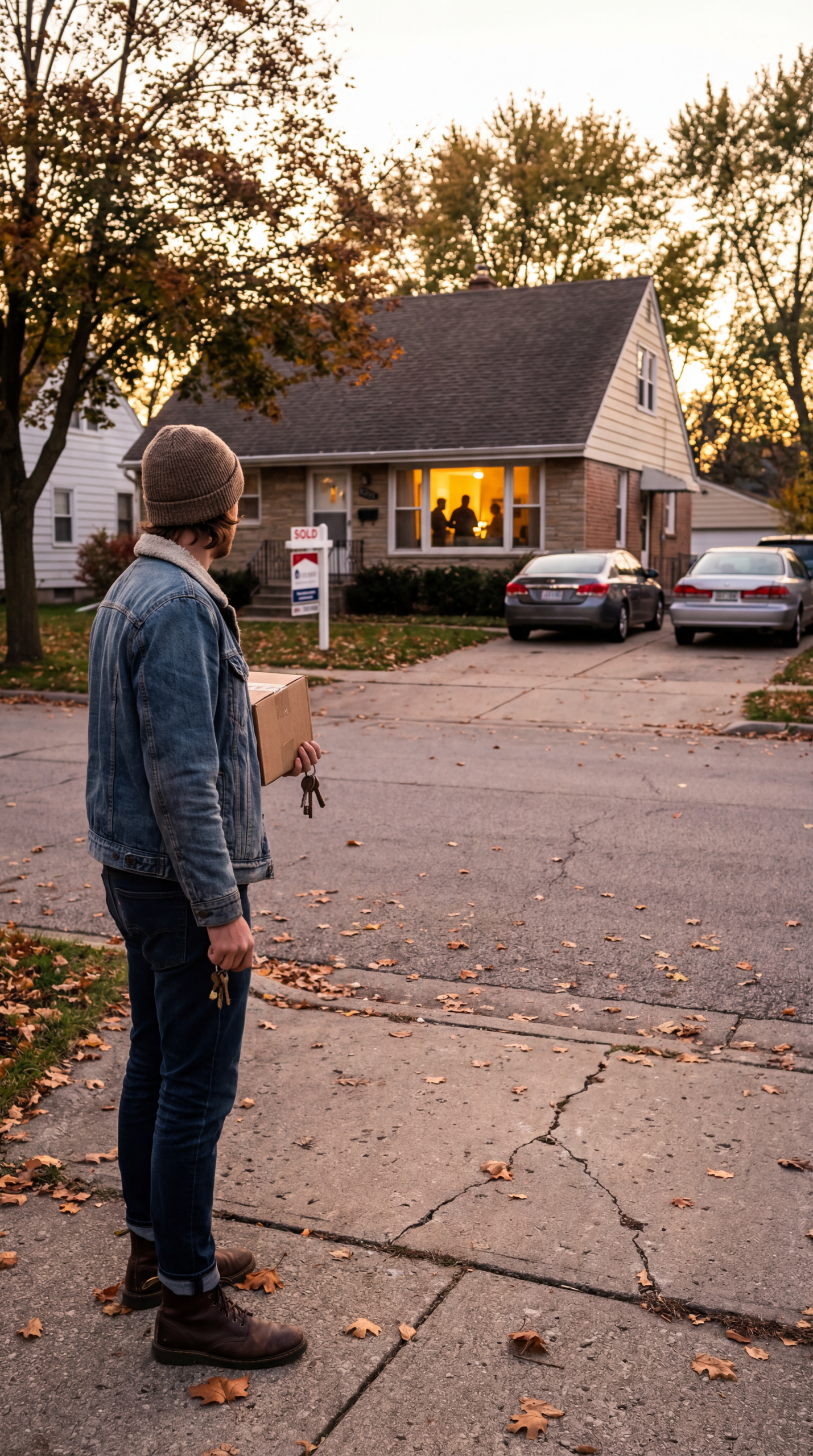
But it was too late. The new owners had moved in. My mom sent me a picture of their “Welcome Home” mat with a smiling caption: “They’re a young family with a little boy! Isn’t that sweet?”
Sweet.
I blocked the number for an hour just so I wouldn’t respond with something I’d regret.
What This Was Really About
It took a few weeks and a lot of journaling to realize that my anger wasn’t just about the house.
Yes, I was mourning the physical place. The rooms that had held every version of me. The familiar creaks and smells and corners where I’d hidden when I was upset.
But under that grief was another layer: the realization that my parents didn’t see me as someone to be considered, only as someone to be informed after decisions were made.
They saw me as a child when it was convenient (“You’re not mature enough to handle being part of this conversation”) and as an adult when it was convenient (“You’re almost thirty, get over it”).
They decided my emotions were too big to accommodate. So instead of including me, they removed me.
That stung more than any paint color change ever could.
Where Things Stand Now
It’s been a few months since the sale closed. My parents are settled into their new condo, which, objectively, is nice. It’s modern, accessible, close to the lake like my mom wanted.
They’ve invited me to visit multiple times. So far, I’ve only gone once.
Walking into their new place felt like walking into a hotel. Pretty, sterile, unfamiliar. None of my history lives there. There are framed photos, sure—but they feel like props, not roots.
My parents seem vaguely frustrated that I’m still “hung up” on the old house.
When I mentioned missing “home,” my mom gently corrected me: “You mean our old house. This is home now.”
I nodded, but inside, a quieter voice said, “Not for me.”
I’ve noticed that I’m less open with them now. I tell them less about my life. I share fewer emotional things. It’s like a switch flipped, and I no longer trust them to handle my feelings with care.
I’m not cutting them off. I’m not going no-contact. But I am recalibrating.
If they can make a major life decision that uproots the place where my entire childhood lived—and intentionally keep me out of it because they didn’t want to “deal with my reaction”—then I’m allowed to build some distance to protect myself.
Am I Overreacting?
Sometimes I wonder if they’re right. Maybe I am overreacting to “just a house.” Maybe this is about something I haven’t fully unpacked yet.
But here’s what I know:
- I’m allowed to grieve places that mattered to me.
- I’m allowed to feel hurt when people I love hide big decisions from me.
- I’m allowed to be angry that my feelings were labeled “drama” before I even expressed them.
Maybe one day, I’ll feel less raw about it. Maybe one day, I’ll walk by that old house and smile instead of feeling like I’m about to cry.
For now, when I drive through my hometown and pass that street, I look away.
The house I knew is gone. A new family lives there now. Their memories are being layered on top of mine.
And somewhere between that old house and my current apartment, I’m trying to build a new definition of “home” that doesn’t depend on my parents—or their decisions.
Because if this whole experience has taught me anything, it’s this:
Sometimes the places we thought would always be there vanish overnight, and the only “home” we can really count on is the one we build for ourselves.